Tag: releases

  • Dynamics CRM Platform Evolution Revisited

    Dynamics CRM Platform Evolution Revisited

    MVP_year_2_cakeIn celebration of receiving my second Microsoft Dynamics CRM MVP award today (thanks to the whole #MSDYNCRM community for your support!), I’m publishing an article series on the Microsoft Dynamics CRM 2013 Customization and the Platform Evolution.

    For the regular readers of my blog this title may sound eerily familiar, and you are correct. This is indeed a re-release of my earlier webcast topic that I presented in May for MSDynamicsWorld.com. I’ve previously shared the links to the live recording and the slide deck, but this time I decided to put it all down in writing. I had a huge pile of speaker notes, so I tidied them up a bit and published them as articles on this site.

    Why bother revisiting the same old story? Well, it all comes down to my own behavioral patterns and personal preferences. You see, even though there’s an ever increasing number of webcasts, podcasts and other forms of streaming content published these days on highly interesting topics and shared all over the social networks I hang out at, I very rarely find myself actually consuming any of that content. Jeffry van der Goot nicely captured the underlying issue in his recent tweet:

    Stop_the_videos

    Recordings of people presenting on a topic that they claim to be experts in just isn’t a very effective method of online knowledge sharing, if you ask me. Sure, you might be able to convey your message a lot more effectively with the help of audio and video, but the problem is that I, the audience, have a difficult time in assessing whether the content you’ve prepared really is worth my precious time (my precious free time in most of the occasions, I might add).

    It’s not just that all of us can read much faster than we can listen. It’s the avenue of opportunities that a piece of information receives when it’s put down in writing. The audience will be given the chance the glance at the content from a higher level, scan through for highlights that capture their attention and, most importantly, easily revisit any of the words transmitted in this form of communication. The content producer, the presenter of words, also gets to enjoy the same benefits when reviewing his or her own thoughts in a structured manner and designing the detailed message that is to be delivered. Last but not least, written content is infinitely more discoverable via the tools we all now turn to when in need of answers to our everyday questions – the mighty search engines.

    Now that I’ve explained the “why” behind the content strategy, it’s time to return back to the “what”. The Platform Evolution article series is about exploring some of the key themes that are shaping the process of how we can deliver customized business solutions on top of the Microsoft Dynamics CRM 2013 platform. The discussion is broken down into four parts:

    • Part 1: The History. Where does Dynamics CRM as a product originate from and how did we get to where we are now with the CRM 2013 version?
    • Part 2: Mobile Computing. How has the evolution of client devices affected the CRM platform and what should you know about the new client options?
    • Part 3: Customizing CRM Today. What is the difference between a traditional CRM system and a modern business application built to match the CRM 2013 design language?
    • Part 4:  Delivering Responsive Solutions. How could we optimize the user experience of our application without diving into the sea of custom code?

    Hope you find something of interest in these articles, but as said, they are there for you to conveniently scan through and judge for yourself. Because life’s just too short for sitting at your computer, watching long recordings that in the end didn’t quite deliver what you had expected.

  • CRM 2013 SP1: Case Creation and Routing – The Details

    In my previous post about the new functionality included in CRM 2013 SP1 / Spring ’14 release I laid out the big picture of how case creation and routing rules relate to cases and queues in Dynamics CRM. Now it’s time to take a more detailed look at how you would actually configure these rules to automate your case creation process. There are a few limitations that it’s good to be aware of before you jump into applying these new tools in your service management scenarios.

    Case Creation Rules

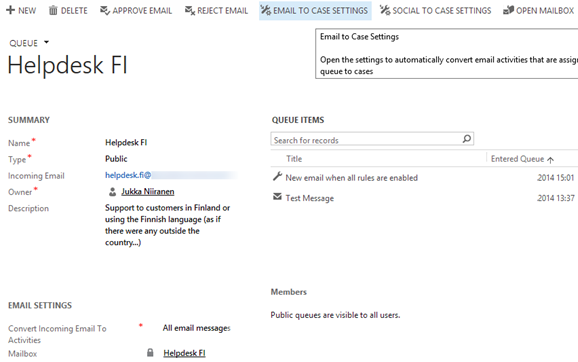
    As illustrated in the big picture of queue and case management in my previous article, Case Creation Rules are specific to a single queue. Also, you can only have one Case Creation Rule per queue – per channel. It is nevertheless a 1:N relationship between queues and rules, since a queue can have a Case Creation Rule both for email and social activities (the latter of which are not yet leveraged in this release). The Command Bar buttons on the updated queue form, labelled “Email To Case Settings” and “Social To Case Settings”, take you to the respective rule record.

    CRM2013SP1_queue_settings

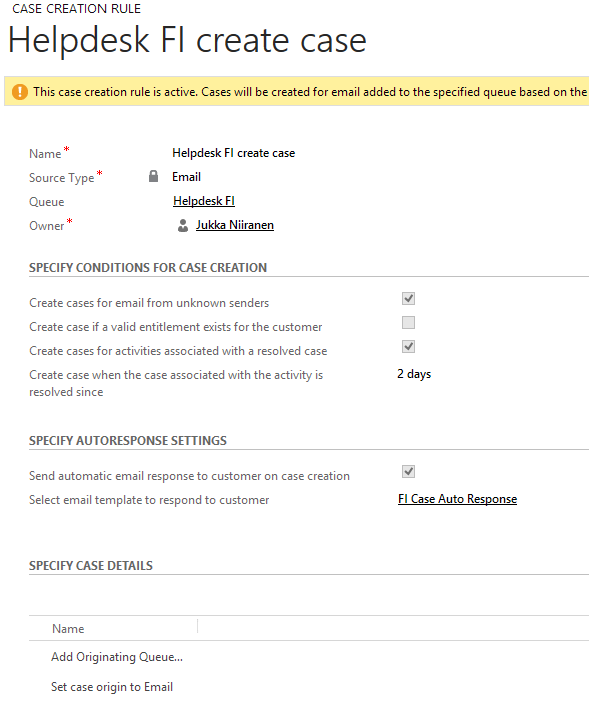
    The Case Creation Rule form allows you to configure predefined conditions for case creation. Emails from unknown senders can be filtered away from case creation. Also the existence of a valid entitlement for the sender (contact) or the senders company (parent account) can be used as a filter. Finally, email related to an already resolved case can be set to generate a new case record, with a configurable “quarantine” time period. So, if you resolve a case today and the customer replies “thanks for your help”, this probably shouldn’t generate a new case, but a reply sent after 3 days to the same email thread might warrant opening up a whole new case record.

    CRM2013SP1_case_creation_rule

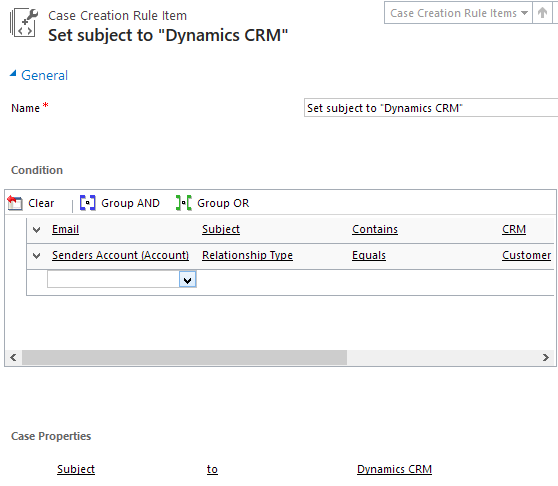
    That’s all the conditions you can apply for the automatic case creation. There’s an additional entity called Case Creation Rule Item that’s found in the “Specify Case Details” subgrid. What this feature allows you to do is specify a condition on the activity record (email or social activity) and set values for the newly created case’s fields. As an example, if the email subject contains word X, you could populate the case subject lookup field with value Y. So, you can’t use these Rule Items to determine whether a case will be created or not, but you can pass along some variables from the originating activity.

    CRM2013SP1_case_creation_rule_item

    The entity fields you can access in the Conditions box are limited to those directly related to the email (or social) activity. There is however one welcome exception and that is the Senders Account. This means that when the email is coming from a known contact, there’s a way to reach into the fields of the account related to the contact (related to the activity), to check variables like relationship status, customer category or other important pieces of information in a B2B service scenario. (more…)

  • CRM 2013 and the Platform Evolution: Webcast Recording and Slides

    Last week I presented in a webcast for MSDynamicsWorld.com on the topic of “Microsoft Dynamics CRM 2013 Customization and the Platform Evolution”. If you weren’t able to attend this live event, then have no fear, because it has all been recorded and documented for future generations.

    First off, below are the slides that set the background for my presentation:

    Next we have the actual audio recording of the presentation on YouTube:

    So, what was the session all about? The key message which I’ve tried to convey here is that the Dynamics CRM platform has entered “the next chapter” with the release of CRM 2013. This will not only impact the end users but also place a lot of demands on the system customizer role to learn new tricks and approach the task of solution design with a different mindset than in traditional CRM implementation projects.

    The presentation includes a comparison of the old world vs. the new and also highlights some key elements in the CRM 2013 platform that you should pay attention to when building your solutions today. If you’ve got any questions or comments on the content, then please don’t hesitate to post them below. And if you attended the live webcast, then thank you very much for tuning in!

    Oh, and in case you’re interested in hearing my thoughts on the very latest CRM Online Spring ’14 release / CRM 2013 SP1, then you can catch me in a Google+ hangout hosted by CRM MVP Donna Edwards on Wednesday, June 4th. Check out more details here.

  • CRM 2013 SP1: Case Creation and Routing – The Big Picture

    The latest Dynamics CRM Online Spring ’14 release is now rolling out to existing and new customers (starting from the US data centers) and the on-premises equivalent of CRM 2013 Service Pack 1 will soon follow is now available from MS Download Center (here’s the KB article for more details about SP1). The quickest way to check if your CRM Online organization is already updated to the latest release is on the About screen, accessible via the gear icon in the top right corner. If your version reads 6.1.0.575 (or 6.1.anything) then you’ve got the Spring ’14 release available and you can proceed to the Install Product Updates menu to enable the new features.

    CRM2013SP1_version

    This release, previously known by the codename “Leo”, focuses on enhancing the service management capabilities of Dynamics CRM. There’s a great “What’s New” page on CRM Customer Center that provides a detailed listing of the new features launched now, including an eBook of the changes in service management. Instead of repeating all of this information, I’ll try and provide an overview of how the features align with one another and specifically how they could be applied in real world scenarios for managing incoming service cases from customers.

    Enhancements in Case Creation and Queues

    I guess we’ll still need to first list the new options we need to be aware of when configuring the service module in CRM 2013 SP1 to handle emails and cases  via queues. First off, there is now support for server side synchronization of emails (and other activities) between CRM Online and Exchange Online, without having to use the old Email Router technology (no support for hybrid deployments, though). Then there’s a new feature called Case Creation Rule that allows you to automatically convert an email message or a social activity record placed in a queue into a new case record. Finally, we have Routing Rules that can be leveraged for moving items into queues.

    The following is my own interpretation of how these three areas are aligned in CRM 2013 Spring ´14 Update / Service Pack 1. The picture illustrates how an email message from the customer would flow through the system automatically based on the configuration of the aforementioned features. It also includes a few bullet points about the supported actions for each component. (Feel free to click on the image to view a bigger version that won’t stress your eyes so much.)

    CRM2013SP1_Queue_Case_Configuration_small

    When going through the Leo release features I found it a bit challenging to get a clear view of the logical order in which the different functional areas found under the new Service Management settings menu should be applied. Also the relationships between them and the restrictions imposed on the number of records was something I only learned through trial and error. Hopefully this illustration makes it easier to identify the roles of case creation rules and case routing rules in the new release.

    Rules vs. Workflows & Plugins

    Looking at the picture, someone who has previously configured Dynamics CRM to be used in an email, queue and case based support process will surely find many familiar actions from the list. At the end of the day, pretty much everything here has already been possible with previous CRM versions. With those you just needed to leverage the workflow engine in the CRM platform to configure the case creation and routing activities. So, what’s really new here and why has Microsoft built this into the latest product release?

    Behind the scenes, what the case creation and routing rules do is they create the workflow processes for you. This can be seen from the release documentation where the administrator of those rules is reminded about the requirement to have sufficient security roles for performing the corresponding actions via workflows. So, taking a very simplistic view, you could think of these new features available in the Service Management as a dedicated UI for configuring common process automation actions for customer service scenarios.

    There’s definitely value in having these new features available right inside the core product. In previous versions, it has been far from trivial to build the necessary functionality for frequently encountered requirements, such as “email to case”. Several ISV add-ons have been developed to deliver such functionality and system customizers have surely spent a ton of time pushing the CRM workflow editor to its limits in an effort to automate the common tasks that a service organization would need to perform when managing cases in Dynamics CRM. Now there’s a new standard way to implement these processes via a method that is fully supported by Microsoft, which in turn will lead to far more customers taking a serious look at these case management capabilities in their business application platform.

    CRM2013SP1_Service_Management_Settings

    It’s important to keep in mind that these new features don’t replace any of the existing CRM platform functionality. They offer a default method to configure common features, but they will not cover every possible scenario that you’ll come across in real life implementation scenarios. That means you can still use workflows and plugins to extend the process automation for service case management. For example, while a case creation rule provides the possibility to set an auto response email to be sent to the customer upon case creation, there’s nothing stopping you from doing this via familiar workflow process if more complex business logic is needed than what the new Service Management UI in CRM makes available.

    In the next blog post I will take a more detailed look at how the case creation and routing features can be leveraged in practice, so stay tuned!

  • What’s on the 2014 Roadmap for Microsoft Dynamics CRM?

    The annual festivities of the Microsoft Dynamics Convergence event in the US have now been completed for the year 2014. This means that the outline for upcoming releases in this calendar year have also been presented to the 12K attendees in Atlanta as well as anyone watching the sessions via Virtual Convergence. The following roadmap slide shown at the event tells us the big picture: it’s going to be a busy year for Dynamics CRM!

    Microsoft Dynamics CRM roadmap 2014

    OK, so if the first “swim lane” in the CRM Roadmap schedule is titled “CRM”, then what’s with all the other lanes then and how do these non-CRM items relate to the Dynamics CRM roadmap? Well, here’s the thing: this ain’t the CRM you used to know. It’s no longer that IIS application you used to install on your own little Windows server along with a SQL database and maybe a client component in Outlook. It’s now a suite of services that cover not just your internal processes and tools for your employees but also a wealth of external touch points where your customers will also encounter your CRM system, be it directly or indirectly. Oh, and naturally most of it lives in the cloud, because that’s also where your customers are.

    Of course customer relationship management has never been about just that single CRM database where you keep your own contact records, but now it has become very obvious that also Microsoft’s offering in the field of CRM has grown way beyond that. Following on the footsteps of Oracle and Salesforce.com, the acquisition and integration of a growing number of tools to complement the traditional core Dynamics CRM platform means the future CRM product will be much more modular, as opposed to the earlier “one app & license for everybody” approach. Let’s go through each of these lanes in the CRM roadmap and look at what was announced for them at Convergence 2014, starting from the most familiar one: “CRM”.

    CRM

    After last fall’s release of the new Dynamics CRM 2013 major version (code name Orion), you might have been lead to believe that there wouldn’t be so much happening with the core platform this year, at least in the on-premises world. The earlier communication from Microsoft indicated that the plan was to introduce a new release for CRM Online twice a year and roll out an on-prem version once a year. The code names for these releases were also shared: Leo in Q2 2014 and Vega in Q4, one year after CRM 2013 RTM.

    This is no longer true. But wait! It’s not an R8 style cancellation but rather a positive piece of news. The Q2 2014 release Leo will be for both CRM Online and on-premises customers, as will Vega. It doesn’t mean all the features will be identical across deployment models but it does promise to deliver new functionality also to customers who are running CRM on their own servers. What exactly will be the delivery mechanism (Update Rollups were supposed to be clear of any new features) or how the official naming convention for different versions will evolve is not yet clear, but currently Microsoft is referring to this as the Dynamics CRM Spring Wave. Partners will have a training blitz session for this wave on April 8th/9th, so expect to see more details made public after this.

    The functional changes in Leo will focus on the service module of CRM. New features showcased in the Convergence sessions included SLA management with a timer control available on the case form, merging cases and linking parent/child cases, entitlement management, email to case automation and improvements in the queue feature usability. Considering how much these new features alter the case entity functionality and configuration options, it would have surely been quite difficult to continue supporting two different feature levels if Leo would have in fact been Online only. For callcenter scenarios the new Unified Service Desk (USD) will offer functionality similar to what has previously been delivered via components like the Customer Care Accelerator (CCA) or User Interface Integration (UII). Expect to see also other feature enhancements or tools released as a part of Leo that will not be customer service specific, as well as new capabilities for CRM Online subscription management.

    The contents of the Vega release had not really been disclosed prior to Convergence 2014. As this release is still further away in the future the details are not yet as clear as for Leo, but a number of very interesting enhancements to the core Dynamics CRM product were shown on the CRM roadmap slides. Calculated fields will finally be available without writing custom code, via a graphical editor with intellisense support. Business Process Flows (BF) will be enhanced with support for branching processes. On the UI side we can expect to see built-in capability for visualizing account hierarchies. These three features all address very common scenarios that Dynamics CRM customers require in their system implementations, so it’s great to see them introduced as configurable features that a system customizer can leverage right out of the box.

    Social

    Remember when Microsoft bought NetBreeze one year ago? Their service has now been integrated into the Redmond product portfolio and carries the name Microsoft Social Listening. Last month it was announced that Microsoft Social Listening will be offered as part of the CRM Online Professional licenses at no additional charge, whereas on-premises customers can get it for an incremental cost. This “incremental cost” was later specified to be $20 per user per month for CRM Professional CAL holders. So, while it’s not free for everyone, the pricing is still in line with Microsoft’s previous announcements of wanting to “democratize social” and integrate it as just another channel into their CRM product. (more…)

  • Bringing Customer Service Back to CRM with Parature

    In case you missed the big news last week, Microsoft has acquired a company called Parature. Similar to the two marketing related service providers MS has bought earlier, Marketing Pilot and Netbreeze, this latest acquisition is intended for expanding the footprint of Dynamics CRM on the customer service side.

    MS_Parature

    It’s been no secret that this was the next area where Microsoft was looking to build up some new capabilities for Dynamics CRM. Thinking about the existing feature set for customer service scenarios in the product, we basically haven’t had any significant enhancements to the service module since CRM 3.0. Sure, the recent platform enhancements on the process automation and UI side can be leveraged in customer service as well, but in terms of specific out-of-the-box functionality that would be aimed at helpdesk scenarios, it’s been pretty quiet so far. Case management and queues for email routing have been very useful features for many organizations using Dynamics CRM. Service scheduling and knowledge base articles… well, not so much.

    The world around CRM software has changed quite a bit from 2005 when CRM 3.0 came out. Not only have online service portals and support content websites become incredibly affordable for any company to set up via cloud based services like Zendesk, but the customers of those companies have also been given a whole range of independent social channels to reach out to one another. These days the customers are in charge of the conversation, which means that if you don’t offer a forum for them to submit feedback and questions, they’ll just set one up for your brand on GetSatisfaction on their own. Regardless of how many 1-to-1 contact points you offer them, they’ll still go and share their frustration over on public channels like Twitter.

    This is obviously not a world where back-office applications like traditional CRM systems that mainly offer features to your employees instead of the end customers provide a very comprehensive solution for customer service management. Sure, integrating with the customer account details, managing the support ticket process and collecting information about past interactions are all essential components of customer service in the new world, too, but they are becoming relatively less and less significant factors in the processes needed for delivering great customer experiences. When the customers no longer pick up the phone to call you when they have a problem but rather use it to search for answers on their own, call center automation software isn’t the area you should primarily be looking to invest in.

    Integrating the customer facing components of modern online customer service solutions to the internal CRM systems has been the way to build systems that are up for the challenge presented by the age of the social customer. While system integration is a natural part of any CRM implementation project, requiring each organization to come up with their own solution of how to put the pieces together isn’t perhaps the most effective way forward. For example, Parature had already launched their integration with Microsoft Dynamics CRM Online back in 2009, but how many people were actually aware of it? I might have stumbled across Parature a few times before, but they certainly didn’t occupy a space on my top-of-the-mind list for possible solutions to suggest to companies using Dynamics CRM. Merging these services into Microsoft’s Dynamics CRM offering is certainly going to expose them to a potential customer audience of a completely different scale. (more…)

  • History of Microsoft’s CRM Software

    History of Microsoft’s CRM Software

    Happy_birthdayI recently read the news that Siebel had turned 20 years. Man, that is a respectable age for a CRM software product! Although its market share may have peaked 10 years ago already and today the discussion on the future of Siebel is now circling around the question of when will the last Siebel instance be turned off, you still have to the give credit to the CRM software grandfather. Here’s how Denis Pombriant puts it in his “Siebel at 20” article:

    “In many ways, though, Siebel still is the market. Go into a Global 2000 company and you will see a Siebel system; today Salesforce users might flank that system’s users too. For many of these companies, Siebel is a workhorse system that has been through some of the wars and continues to be serviceable.”

    Inspired by this, I decided to compile a few pieces of history around Microsoft’s CRM product, to provide some context on where it originates from and how the platform has developed over the years. After all, with the first version having been released in 2003, Dynamics CRM has also now reached the 10 years milestone. I’ve personally worked with Microsoft’s CRM only starting from 2005, but the story starts from much earlier than that. I’ve had to do a bit of software archaeology in digging up the events that took place before my first encounter with CRM 3.0, so not all the details may be accurate and you’re more than welcome to add your comments at the end to fill in the blanks.

    Alright then, let’s step onto the timeline and start our journey towards CRM 2013 right from the beginning.

    Before CRM

    A common belief that circulates out there in the wild is that CRM is just another product that Microsoft has bought and integrated into its business software portfolio, like the ERP products Great Plains, Axapta and Navision (nowadays Dynamics GP, AX and NAV). Well, that’s not entirely true, but we can trace back the origins of CRM to the year 2000 and a product by the name iCommunicate.net. Here’s an article taken from IThell.com:

    iCommunicate.net – the first IThell.com Halo Award winner!

    Without a doubt, this is the winner as the coolest (and most helpful) new product of the expo and is the first product to be awarded the Halo Award for providing a solution that can truly help folks in IT by making it easier than ever before to cost-effectively manage customers, customer solutions and resolve customer problems. iCommunicate.net is a web based, out sourced solution (ASP) for CRM with a tremendous feature set and a great pricing model.

    In 2001 Microsoft acquired iCommunicate, which had 10 employees at the time. The developers behind iCommunicate.NET moved to Redmond and started developing a modern, web based CRM application together with Microsoft’s team. Aaron Elder, the lead developer of iCommunicate, shares many wonderful bits of information about the project in his MSDN blog posts. Here’s an enlightening quote on what the starting point was for developing Microsoft CRM:

    When I first joined the team the “application” was literally a mess, this of course was “ok” because at the time the application was referred to only as the “reference app”.  The application that you all know and dare I say love, was originally only going to be an MSDN example of what you could build on top of the CRM Platform!

    There are not many screenshots of iCommunicate.NET available anymore and I’ve only managed to save these two from Google’s cache. According to Aaron, the Microsoft CRM 1.0 UI was simply a logical evolution of the UI he designed for iCommunicate.NET, so perhaps this is one of the more concrete heritages carried over from the pre-Microsoft era of the CRM product.

    Version 1

    Here’s the press release that marked the birth of Microsoft CRM: Microsoft announces new customer relationship management solution. Notice how Microsoft bCentral is one of the online services mentioned as a CRM solution. This service hosted by XO Communications apparently offered some basic contact management and email campaign functionality aimed at the SMB market.

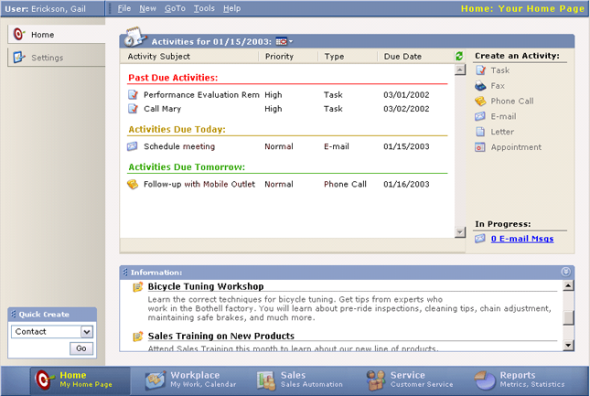
    Microsoft CRM 1.0 was released in January 2003, with the official name being the catchy “Microsoft Business Solutions Customer Relationship Management 1.0”. Here’s a screenshot of the home page that the system offered to the users for a quick glance of the open activities, alongside a Quick Create menu and an announcements list. The navigation bar at the bottom of the screen offered the familiar modules of Workplace, Sales and Service. The reports of CRM 1.0 were not built on SQL Server functionality yet but instead leveraged the well known Crystal Reports product (which was later acquired by Business Objects, which in turn was bought by SAP).

    Microsoft CRM 1.0

    Although it wasn’t possible to perform any advanced customization tasks on CRM in a supported manner, such as adding new entities, the Microsoft partners were already at the time finding good business in filling the gaps of CRM 1.2. Still, everyone was really putting their hopes on CRM 2.0 being an easier product to sell to customers, with more built-in features and improved reliability.

    V2/3.0 and The Birth of XRM

    What was first called Microsoft CRM 2.0 and later Microsoft CRM 2005 became vaporware, as after being delayed a few times the version was never released. In the meantime, Microsoft had revealed information about an ambitious initiative called Project Green in 2003, which aimed to to combine all the business products (CRM, Great Plains, Axapta, Navision, Salomon) onto a single code base. It wasn’t until 2007 that the project was announced as dead & buried, with each of the ERP products remaining separate platforms for the foreseeable future and CRM naturally carrying on with its own roadmap for primarily managing the customer facing interactions instead of financial transactions.

    Microsoft CRM 3.0 was released in December 2005. Or more precisely, Microsoft Dynamics CRM 3.0, as the Dynamics brand was launched in September 2005 to harmonize Microsoft’s ERP and CRM product offering. So even though we didn’t get a Microsoft Business Framework (MBF), at least product names were all aligned under the Dynamics umbrella. This branding update didn’t quite manage to cover all corners of the application and the name “Microsoft CRM” or “MSCRM” in short still carries on today as popular nickname for the product.

    The UI of v3.0 introduced the navigation paradigm that has been largely carried onward to the current CRM 2011 version. Imitating the Outlook modules, the product now had a “Wunderbar” in the bottom left corner of the screen, including the new Marketing module that introduced basic campaign management functionality into the core CRM offering.

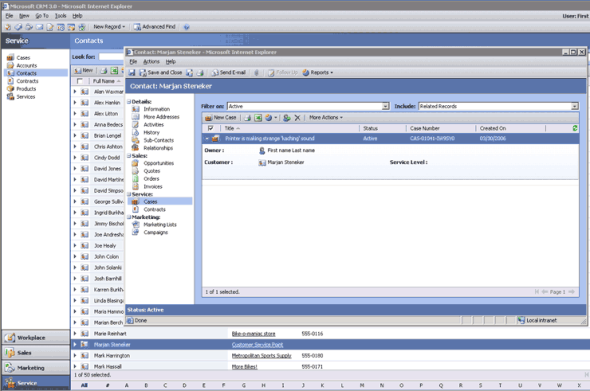
    Microsoft Dynamics CRM 3.0

    Most importantly, with CRM 3.0 it was now possible to create brand new custom entities to expand the default data model to cover whatever business domain that the customer was working in. The term “XRM” was introduced into the Microsoft corporate lingo to describe these new scenarios for eXtended Relationship Management. A whitepaper from 2008 titled “Microsoft Dynamics CRM as a Business Application Platform” written by Jason Hunt and Aaron Elder, the original architects of the platform, goes into great depth on why Dynamics CRM should not be considered as “just CRM” but something much more formidable and powerful. (more…)

  • Dynamics CRM 2013 Finally Revealed

    There were a couple of announcements made regarding the upcoming version upgrade of Microsoft Dynamics CRM (previously known as “Orion”) during the World Partner Conference 2013 event (WPC13) three weeks ago: 1) it was named as “Microsoft Dynamics CRM 2013 / Microsoft Dynamics CRM Online Fall ’13 (depending on your deployment model) and 2) the client licensing model was unified between Online and on-premises to consist of Professional, Basic and Essential license tiers. The CRM related sessions also presented several interesting facts about where Dynamics CRM is heading (see my WPC13 recaps of Day 1, Day 2 and Day 3 if you missed them), but all in all they were more about the product roadmap rather than detailed features of the next release.

    CRM2013_BlitzToday, on July 31st, Microsoft held the Dynamics CRM Training Blitz Day for all its partners. The sessions were split into two tracks, but for most of this blog’s audience I’m sure the track “Technical Overview for Application Consultants, Presales Consultants and Developers” was the preferred choice. The sessions presented by the Redmond allstars Eric Boocock and Girish Raja consisted of the following topics:

    • Reimagined User Experience in Microsoft Dynamics CRM 2013
    • Process Agility in Microsoft Dynamics CRM 2013
    • Microsoft Dynamics CRM 2013 Mobile Client Application
    • Yammer Integration in Microsoft Dynamics CRM 2013
    • Outlook Client and Exchange Sync in Microsoft Dynamics CRM 2013
    • Microsoft Online Portal Administration in Microsoft Dynamics CRM 2013
    • Upgrade Process in Microsoft Dynamics CRM 2013
    • Business Rules with Dynamics CRM
    • Client Extensibility in Microsoft Dynamics CRM 2013
    • Extensibility on the Server and Cloud with Dynamics CRM
    • Microsoft Dynamics CRM as a Platform for Business Apps

    If you’re a Microsoft partner and have access to the event site, you really need to schedule some time for going through the recordings and other content available, because this is effectively the “What’s new in Microsoft Dynamics CRM 2013” training kit that summarizes the new and updated features of the product you’ll be working with from Q4 onwards.

    Although this was a partner event, it was declared “free to tweet” and resulted in a wealth of content being shared over on Twitter. I collected the most interesting content related to new features of CRM 2013 onto a Storify post that you can view below, to get a quick overview of what was announced in the Blitz event.


    There will surely be more material made available to Dynamics CRM customers shortly, so that they’ll have a better understanding of what it means when they see the update notifications in their existing CRM Online instances. If I’d have to summarize the CRM 2013 release highlights in five bullet points, they would be:

    • The new UI that was previewed in the “public beta” of the Polaris release looks like a worthy successor to the previous forms & ribbons. The impact to user adoption and differentiation from competing CRM products is potentially huge, while the feared breaking changes to existing customizations may not be as big as the initial reaction might have suggested (things will break, of course, but I don’t foresee a catastrophe).
    • Business rules and synchronous workflows are the real killer feature of CRM 2013, since they expand the no-code capabilities of the product immensely. They will surely not cover all the common customization scenarios in the first release, but they point the way towards a declarative future where custom development efforts can be targeted to where they are really needed, meaning system integrations.
    • The mobility story with responsive design and “write once” business logic is far beyond what the “CRM Anywhere” path announced in February 2012 (and later cancelled) would have allowed to achieve.
    • Server side sync is long overdue and many organizations will surely be happy to replace the email router with this solution. Tracking individual items will still require Outlook, though. And while we’re at it, the new UI in Outlook client with its popups and hidden global navigation doesn’t look all that hot, but friends of Outlook and CRM 2011 may disagree with me.
    • Acquisitions of Yammer, Marketing Pilot and NetBreeze will play a significant role in the future of the product, but CRM 2o13 is still very early days for this feature set. It’s loosely coupled services like this which will surely make the most of the rapid release cadence of CRM Online (twice a year), so keep an eye on them.

    As with most new things, there’s a great deal of excitement I have towards the CRM 2o13 release based on what I’ve seen, and at the same time a healthy sense of fear on “is it all really going to work”. Lucky for us, we can now seek validation for the excitement and relieve our fears by downloading the beta for Microsoft Dynamics CRM that has been posted on Microsoft Connect today patiently waiting for a public beta to become available (if ever). Yes, the beta link shared by the CRM team previously was apparently not meant to be made available publicly, so you’ll still need wait for a while to get your hands on the latest version of Dynamics CRM.

    When will the actual Dynamics CRM 2013 product be released then? Many sources are pointing to The Partner Connections Event starting on October 20th as being the official launch event. Also many CRM Online customers have already received information on their organizations having been scheduled for updates to take place during Q4 2013, so I think it’s safe to assume this to be the time frame for general availability of the next version of Dynamics CRM.

  • Keep Calm and Prepare for Orion

    keep-calm-and-prepare-for-orionJust a quick note to all the readers of my blog regarding a new post I wrote for MSDynamicsWorld.com on how existing customers can start preparing for the upcoming release of Orion, the next version of Dynamics CRM.

    That is all. Keep calm and carry on.