Category: Tips

  • Know your application: the MB2-868 exam for CRM 2011

    You pass! That’s a sight for sore eyes after staring at 75 grey screens full of Microsoft Dynamics CRM 2011 Applications certification exam questions for almost 2 hours. I received 750 points out of the required 700 minimum, so not exactly a walk in the park, but who’s going to care about the detailed statistics of how you acquired your MCTS certification?

    During the test I did have to go back to some 15 questions I marked for review during the initial round and spend a fair amount of time rolling the virtual dice in my head. Well, not exactly like that, but rather trying to reverse engineer the process of how the people at Microsoft might have designed the application to function in different scenarios and what reasons and practical limitations lead them to these choices. While many of the questions could well be taken from real life use cases, the way in which you need to be able to solve these problems in the exam is quite far from the normal routines. In real life you experiment, investigate and iterate, whereas here you’ve only got a few words to work on; each of them possibly containing a hint towards the right answer, or alternatively loaded with the malicious intent of leading you astray.

    Just because you’ve been working with the Dynamics CRM application on a daily basis for several years, doesn’t guarantee you would pass the MB2-868 exam. Even MVP’s have failed on their first attempt, so beware! The amount of product information covered in the Applications exam is growing all the time as new features are introduced and with CRM 2011 there’s a lot to read, let alone to try out in the application itself. At least when I was going through the training materials, the most time consuming part was when I constantly kept coming up with new ideas about “hey, this is something we must also set up for our presales demos”. Even though I had started digging deeper into the new version functionality already before the beta of CRM 2011 was released (and compiled my findings into two “what’s new” presentations you can find here: pt1 and pt2), preparing for the Applications exam made me realize how much of pre-2011 functionality you also need to keep in mind at the same time.

    So, tell me then, how important is it to remember by heart from which menus a particular standard report can be executed, when they’re A) all available from the Reports menu anyway and B) usually available in the right context for the user? Or what about studying all the different record statuses in which certain actions can be performed, when we’ve got a graphical, context sensitive ribbon persistently available in the UI, gently reminding us of the things we can and cannot (greyed-out/hidden buttons) perform at any given time? Like it or not, this is the direction that these multiple choice exams tend to drift towards: detailed information that’s perhaps nice to know, but won’t matter much in terms of real life skills required while actually using Dynamics CRM.

    If we look at Microsoft’s target audience definition for this exam, it reads:

    This exam is intended for individuals that plan to implement, use, maintain, or support Microsoft Dynamics CRM 2011 in their organization.  The exam is also intended for service schedulers, administrators, office managers, CEOs, and consultants who want to demonstrate foundational understanding of the application functionality.

    Quite a broad definition then. If you as an end-user or administrator are interested in learning details about the default functionality available in Dynamics CRM 2011, by all means do attend the training courses and download the training manuals from CustomerSource. They contain a wealth of useful information and some nice exercises you can try out in, for example, your very own 30-day trial environment of CRM Online (which may offer you quite a different “vanilla” training environment than your customized production CRM server). However, don’t worry too much about “demonstrating foundational understanding” of Dynamics CRM through the MB2-868 exam. The system is far easier to use in everyday life than how the exam questions portray it, so you’re better off in directing that time and energy towards exploring the possibilities that Dynamics CRM gives you in customizing the system to fit your business data and to automate your business processes. That’s where the real ROI of your CRM system is hiding, after all.

    Microsoft Dynamics CRM 2011 Applications courseware


    For those of you who need to take the exam due to MS partner competency requirements, the MB2-868 exam page section “skills measured”  is a useful document to keep by your side when browsing through all the CRM 2011 applications MOC courseware. Checking the topics enables you to better balance your study efforts, to make sure you’re not just diving deep into one module and neglecting another. This is how everything counts:

    • Marketing automation: 27%
    • Sales management: 30%
    • Service management: 24%
    • Service scheduling: 19%

    For example, service scheduling and service contract management have been standard features of the Dynamics CRM product for a long time, yet I find it hard to discover real life use cases of customers having deployed these processes into production use. Either the organization has initially tried using them, but later given up due to the mismatch of the built-in process flow and solved their problem with custom entities instead, or then they’ve gone down the customization route directly. As a result of this, it’s not necessarily an area that CRM consultants would be too knowledgeable on, when considerably more of their time is spent configuring and training the sales process in CRM.

    Does this then mean that these modules should have less emphasis in the exam? Well, at the end of the day, probably not. If you look at things from Microsoft’s point of view, it is in their best interest to have CRM consultants be aware of all the different functionality that their product contains out of the box. Precisely because their common tendency might be to focus on what they already know best and leave out the rest of the story when discussing with potential and existing Dynamics clients, it’s actually a fair exercise to make these specialists step outside of their comfort zones for a while during the certification process. Sure, you may not need the information in the projects you’re working on right now, but you need to have the ability to get up to speed quickly when duty calls.

    Finally, here’s a few practical tips from me on how to prepare for the CRM 2011 Applications exam:

    • Goal management: understand what values are recorded on which entity, the impact of ownership, fiscal year settings.
    • Teams and queues: this is where most of your answers based on experience from CRM 4.0 will guide you down the wrong path, so forget what you know and learn the new CRM 2011 way of working.
    • Charts and dashboards: what the user can do vs. what the admin can do, this should actually be pretty much 101 stuff if you’re well in grips with the solution management side of things. However, you shouldn’t forget about SSRS entirely: open each default report at least once and try them out, just to refresh your memory.
    • Marketing lists: Try building a few dynamic marketing lists to see how they’re different from the traditional static ones, and also how to mix’n match them.
    • Scheduling: you’ll need to understand how capacity management and resource selection rules work from the service and the resource perspectives, there’s just no way around this.
    • Record statuses: trust me, things that require no attention from you in everyday life will be very important here, so play around with as many different entities as you have time for and examine what actions are available on the ribbon in which record status.
    • RTFM: knowing how the system works is not good enough, as some of the questions are clearly derived from how the use cases are described in the training material, and in these kind of exams every word in the questions and answers is significant. So, don’t just play around with the fun tools built into CRM 2011 or trust what a lecturer tells you – also read through the MOC PDF’s.

    And just to close things off, some useful links for seeing what others think about MB2-868:


  • CRM 2011 subgrids ain’t what associated views used to be

    Back in the days before we had Microsoft Dynamics CRM 2011 available, it was a commonplace customization to show entities related to the parent entity directly on the parent’s form by utilizing an iFrame. Making information such as latest history items (nowadays called closed activities) quickly visible to any user opening the form is often justified, as one key functions of a CRM system is to share information about what interaction has taken place with the customer. Referencing the URL of the related view on the iFrame was not exactly supported, but it was a relatively safe customization to apply nonetheless.

    Due to popular demand, Microsoft introduced an official method for achieving this UI customization in CRM 2011 through the use of the form sub-grid element. As a part of the entity forms redesign, the subgrids have now become an out-of-the-box feature on several default entities, such as accounts, contacts and opportunities.

    Different navigation points, different views

    It’s important to note that subgrids don’t use the entity associated view definition, which is applied when traditionally navigating to the view by using left side menu items on an entity form. Instead they allow you to separately choose a filter to “view only related records”, in combination with any of the system views available for the entity in question (but not the associated views, as those are “special” views). 9 times out of 10 you’ll want to keep the filter on, as showing non-related records on the entity’s form would under normal circumstances defy the standard UI logic of how Dynamics CRM presents records in different windows.

    OK, fair enough, so that’s why the columns in a subgrid aren’t updated after you edit the entity related view, like you used to do in CRM 4.0 and previous versions. We can live with that. In order to provide a consistent user experience, I would recommend that these two views are set up so that they have identical contents. This is because an “oldskool” CRM user may navigate through the left side menu by habbit, whereas a person new to Dynamics CRM will probably prefer to just scroll through the form. Sadly there’s no “save as” functionality available on the entity related view, and you can’t promote a normal view to become a related view (since there’s only one of them). This means you have to manually configure the two views to be indentical in terms of attributes, column order, width, sorting and (in some cases) filters.

    Rolling up the records

    Another thing that may surprise a seasoned Dynamics CRM consultant until he learns the tricks of the latest version is that the aforementioned feature has further implications specific to accounts and opportunities in particular. As we’ve come to know, these entities have special capabilities enabled in the activity views: the roll-up functionality. Instead of being restricted to only activities directly related to a record, we can actually see a bit further. Let’s take a simple example of an account and it’s open activity associated view:

    It’s that “Include Related Regarding Records” selection above the grid which allows us to view activities not only related to the account itself but also the ones regarding a contact of the account and an opportunity related to it. Pretty neat, as it’s often the people working at an account that we associate communication and activities to, such as emails and appointments.

    Now, let’s take advatage of the new CRM 2011 functionalities and look at the activity subgrid that’s conveniently available in the out-of-the-box configuration of an account form:

    Huh? Where did my activities go? They’re still there, but this particular navigation path will not allow you to view them, since you’re on a subgrid and, as we previously concluded, subgrids can’t show the entity associated view. This means there’s no way for you to apply the “Including Related Regarding Records” functionality over here.

    I’ll be the first to admit I’ve fallen for this trap in customer demos more than once. The menu anchor for accessing the Notes & Activities subgrid is just too tempting to click, when what you really intended to do was to view the fully featured activity associated view and access a complete list of the related activities. If the difference between view columns was a minor inconvenience, then this is downright misleading to many users I’m sure.

    The quick solution for this would be to just remove the activity subgrids from the account and opportunity entity forms where the results can be contradicting, thus forcing the user to navigate through the old fashioned menus into the related activities views. Another option would be to perform the old iFrame trick and just embed this view onto a form iFrame, which does sound a bit 4.0-ish. The last option is to go and vote on Dynamics 365 Ideas site, requesting MS to include the full roll-up functionality for subgrid views in a future version of Dynamics CRM. (more…)

  • Upgrade gotchas: Outlook client for Dynamics CRM 2011

    Last weekend I finally did my first installation of the RTM versio of CRM 2011 Outlook client onto a machine with Outlook 2010. I had previously only worked with the Outlook 2007 client version, which is lacking a few nice features in the UI, as described in my earlier post.

    I came across a few issues that might cause problems in the installation process, so I decided to link the relevant KB articles and other related content into this blog post to help you save some time when upgrading to the latest version of Microsoft Dynamics CRM on your client machine. I’m using CRM Online here, so some things may differ from the on-premises client version, which no longer has a separate client version, but of course the authentication methods do differ.

    Before you begin: go with 32-bit

    Yeah, I’m sure most of the new business laptops nowadays come with a 64-bit (a.k.a. x64) version of Windows 7. Nevertheless, you should treat 64-bit applications with caution. Why? Well, it’s a bit like with IPv4 vs. IPv6. Everyone knows the old world as we know it is coming to an end, but there simply isn’t a concrete enough reason for developers or companies to go “all in” with the 64-bit apps.

    With Microsoft Dynamics CRM 4.0 the situation was quite nasty, as there was not and there will not be support for the 64-bit versio of Microsoft Office. You simply had to tell the users to “downgrade” their Office, which is not the most optimal starting point for getting someone to adopt a new application such as Dynamics CRM. Now with the arrival of Dynamics CRM 2011 we do in fact have an x64 client for Outlook, so everything should be in order, right? In theory, it is, but if you’re planning to install any fancy RIA apps from the Dynamics Marketplace into your CRM 2011, you should read this blog post from Customer Effective. That’s right, Microsoft hasn’t releases a 64-bit version of the Silverlight add-on for Internet Explorer, which leads us into the following situation:

    KB2500373: Microsoft Silverlight web resources cannot be viewed in the 64-bit version of the Microsoft Dynamics CRM Client for Microsoft Office Outlook

    It’s a fact of life: the world is not 64-bit just yet. With the Office applications there’s not likely to be a significant performance boost from using the x64 version, so take the easy way out and just install the 32-bit Office 2010. Let’s revisit the topic when we all have Windows 8 and Office 2013, shall we?

    Favorite folders no more

    KB2494600: There is no option to add Microsoft Dynamics CRM entities to favorites in Microsoft Office Outlook 2010

    The Solutions Module is a new feature that has become available in Outlook 2010, as described here in the MSDN library article. It allows developers to integrate their applications directly into the Outlook navigation pane, which is what Dynamics CRM 2011 Outlook client is doing to achieve the seamless integration into the native Outlook navigation items.

    What’s the downside? Unfortunately the add-on solution folders cannot be added to the Outlook favorite folders group. Bummer. This was one of the first things I always instructed people to do when training them on how to use Dynamics CRM. There’s no better way to drive CRM adoption that getting the list of the company’s accounts and contacts to be available right below the Outlook inbox folder, where most people start their day at the (MS) office. Even though the CRM folders are now more visual and available under the CRM navigation pane tab, there’s still likely to be tens of entities visible for most CRM users, out of which they typically access just 3-4 most popular ones. I, for one, hate navigating through hierarchical folders that require you to expand them to see the what’s hidden on the next level, so always visible one-click navigation is how I prefer to arrange my working environment, be it SharePoint workspaces or CRM menus in Outlook.

    Following the instructions in the KB article, you can achieve the old favorite folders functionality also in Outlook 2010, but this will require you to disable the Solutions Module. Which, if I’ve understood correctly, will again turn the flashy CRM folder icons into the generic folders that we see in Outlook 2007 or Outlook 2003. Guess we’ll just have to figure out which is a bigger loss for the end user experience and make a choice, until there is a feature enhancement available for the Outlook 2010 Solutions Module (I hope there’s no technical limitation on why this couldn’t be implemented in a future service pack).

    Clashes with Windows Live Essentials

    KB2498892: Unable to Configure the Microsoft Dynamics CRM Client for Outlook against Dynamics CRM Online

    Seems like the Windows Live ID authentication in CRM Online has some issues with the “consumer products” for Windows Live. This might not be a big issue in big corporate environments with locked-down client machine configurations that don’t allow using consumer targeted services such as Hotmail or Skydrive. However, as Dynamics CRM Online is clearly making the former enterprise level applications like Customer Relationship Management suites available to even the smallest organizations with its low monthly cost per user and ease of deployment, there’s likely to be more and more users who’ll be transitioning from Microsoft’s consumer product lines to the new cloud-based business product lines, such as CRM Online and Office 365.

    Basically you’ll need to run a repari install on the Windows Live ID Sign-in assistant or Windows Live Essentials 2011 to make it compatible with the Outlook client for CRM Online, which is also using Windows Live ID to connect you to the CRM server. That should do the trick.

    But wait, isn’t Dynamics CRM Online a business product? Why is it using the WLID authentication method meant for the consumer products? For comparison, here’s an aswer from Allen_MSFT on the Office 365 FAQ to a question regarding weather using Office 365 will require WLID.

    “Re Windows Live ID, you don’t need a Windows Live ID to use Office 365 or to use your Windows Phone 7 with Office 365.  Windows Live services are for consumers, so they are not linked within the Office 365 portal.”

    Indeed. I’m waiting for the day when also Dynamics CRM Online will be migrated over to the new Microsoft Online Services Delivery Platform, which will hopefully give us better tools for managing CRM user accounts and authentication.

    Missing Outlook ribbon after CRM client installation

    KB2494581: The Outlook and CRM ribbons disappear from Microsoft Outlook when you use the Microsoft Dynamics CRM Client for Microsoft Office Outlook

    I had this one happen to myself, since I had been using a previous beta version of the CRM 2011 client on my machine. I had uninstalled both Office and CRM, but there still remained a few lines in the registry that needed to be removed to get the Outlook ribbon to reappear.

    I have to tell you, Outlook 2010 really looks naked when the ribbon is gone (not just hidden). I’m not sure if there even was a way to do any basic Outlook operations like sending emails with the ribbon completely blank, so I started googling around immediately and came up with the instrcutions that pointed to the following steps required to restore the ribbon:

    • Run Regedit.exe
    • Locate the HKEY_CLASSES_ROOT\TypeLib\{2DF8D04C-5BFA-101B-BDE5-00AA0044DE52} key
    • Delete the 2.4 key that’s found under it. It’s not needed anymore, there should only be 2.5
    Update Nov 9th 2011: Since this appears to be quite a popular post on my blog, I decided to append this information here. Today I was creating a new Windows user profile on a PC that already had the CRM 2011 Outlook client installed on a different user profile. When launching Outlook for the first time as this user, the ribbon was missing from the CRM menus (not the whole Outlook as in the aforementioned case), even though everything was working fine for the previously configured user account. In this particular occasion the client was linked to a CRM Online organization which had received the R7 update (a.k.a. Q4 2011 Service Update), but the Outlook client was still on Update Rollup 3 level. After I deployed Update Rollup 5 on the machine and rebooted, the ribbon was restored for this new user profile. So, be sure to check that the client and server hotfix levels match if you encounter a ribbon display problem.

    Reading pane always shows the contact layout

    Dynamics CRM Deployment Forum: CRM 2011 reading pane error in Outlook 2010

    Unfortunately this one doesn’t have a knowledge base article or a fix yet. I encountered this issue briefly when installing the Beta version of CRM 2011 Outlook client. Back then, all it needed was a reboot and the reading panes and icons were restored. With the RTM version of CRM 2011 client, the issue is more persistent. Each and every CRM entity appears as if it was a contact, presented in a business card layout that only contains the entity primary field (name) and not any other data. Click the image below to see an example of the account record shown as a business card with the contact icon.

    Update Nov 10th 2011: Thanks to Wimco’s post on Dynamics CRM Forums, I was finally able to fix the reading pane layout problem on my PC. I simply uninstalled the Office 2007 Primary Interop Assemblies, after which I also applied the latest Update Rollup package and voilá: the reading pane now shows the fields specific to each entity.

    Further update, March 23th 2012: The EMEA Dynamics CRM Support has published an article, where they suggest another fix for the Outlook client preview pane problem. Apparently an existing DisableFormRegions registry key can cause the contact form to be shown instead of the correct entity form.

  • Attribute maps and importing customizations

    After performing the basic installation of MS CRM, you will have a system that contains the default entities with all their fields, forms and so on. The next step will be to modify the entity customizations to suit the business needs of the organization. Typically there will be a development and/or test environment where the customizations are first performed, before being imported into the production server. This should be an easy operation through the Import Customizations menu, but sometimes you may end up with a nasty error like this:

    “This attribute map is invalid. The selected attributes should be of the same type. The length of the target attribute should be equal to or greater than the length of the source attribute and the formats should match. The target attribute should not be used in another mapping.”

    This can happen when the source customization has some default attributes mapped in a different way than what they are by default. As pointed out by Will Willson in this blog post, CRM only adds new mappings between entity attributes during the import. It will not delete any existing mappings, so you may end with the source entity having two mappings pointing to the same field in the target attribute.

    If you have a hunch on what entity and which attribute might be causing the problem, the quick solution is to go and remove the existing mapping prior to importing the new customizations. If you’ve got no idea on where the conflict is, you can try enabling CRM Platform Trace, reproducing the error, then opening the resulting trace file that begins with “w3wp-MSCRMServices” and searching for the tag “FAILURE”.

    (This issue is described in the confidential Microsoft KB article 921977, available through Customer Source.)

  • Tabbed surfing with IE7 and CRM: the Quick Tabs bug

    One of the prominent features of Microsoft CRM’s user interface is that all records are opened into a new pop-up window. While this does make navigation quite consistent throughout the different areas of the application, the downside is that it won’t take long before you have 20 separate browser windows open and you’re forced to take a break for cleaning up the taskbar.

    Internet Explorer 7 brought tabbed browsing into the toolkit of anyone who’s forced to work with IE due to their day-to-day business applications. This would be a nice way to control the clutter of MS CRM windows as well, but unfortunately this has not been possible for many users. I’ve seen numerous different client machines in different organizations experience the same bug: opening CRM pop-up windows in new tabs instead of new windows has spiked the CPU load up to 99% for no apparent reason.

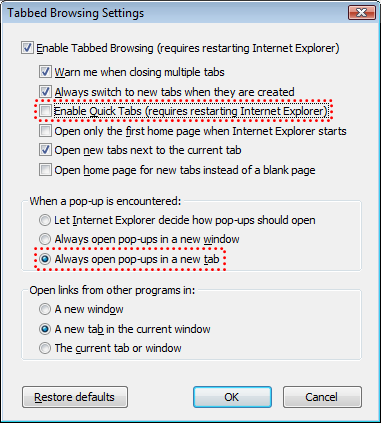
    Finally, after 2 years since the launch of IE7, there is now a workaround for this bug. All you need to do is go to IE’s Internet Options – Tabs – Settings and uncheck the option “Enable Quick Tabs”. After that, you are free to change the pop-up setting to “Always open pop-ups in a new tab” and watch as Microsoft CRM diligently opens the records in the same browser window without any performance impact.

    Thanks to Joel Lindstrom for uncovering this on CustomerEffective’s blog.