Tag: UI

  • Don’t Merge Your Forms in CRM 2013

    If you have been using Dynamics CRM before the 2013 version was released, you may have something in your system called “information forms”. This is not a very descriptive term for them, since of course all the entity forms are about presenting “information” to the end user. These forms actually date back to a time in the Dynamics CRM platform history when there was only a single form available per entity. Times have changed quite a lot since then, as entities can now have role based forms, mobile forms, quick create forms and quick view forms.

    Although not a specific form type in itself, CRM 2013 introduced a whole new layout for the default entity forms as a part of the UI refresh. Instead of the traditional & boring two column layout, the new CRM 2013 forms are made up of three columns that can consist of not just entity fields but also related entity subgrids, the social pane, Bing Maps component and other exciting new features. Whereas the old default forms were called “Information”, the names of these new forms follow the entity names. So, the account entity will have a new form labelled “Account”, as an example. (By the way: check this tip for optimizing your form naming convention.)

    Merge Forms Feature

    Since the new forms are designed to make better use of the new navigation paradigm of CRM 2013 as well as present the data in a much richer way than the old “ERP style” forms of past CRM versions, customers who are upgrading their Dynamics CRM deployment to the latest version are advised to migrate into using these new forms. In fact, Microsoft has stated that the next major version (CRM 2015) would no longer support the use of the old “information forms”.

    To make this transition easier, Microsoft has provided a feature called “Merge Forms”. This new button available on the form editor in the CRM customization UI (which still utilizes the old CRM 2011 style layout even in CRM 2015, by the way) is intended to be used for bringing the tabs, sections and fields from your old forms onto the new forms with as little clicks as possible.

    CRM_merge_forms

    The process is described in the article “Update your forms to Microsoft Dynamics CRM 2013 or Microsoft Dynamics CRM Online Fall ’13”. Even more detailed steps can be found from the PDF document “How to Prepare for the CRM Online Fall ’13 Service Update”. Basically what the feature does is bring in the contents of the old form to the end of the currently open form, with the intention of making it faster to rearrange your customized fields and sections to align with the new default form’s content and layout.

    Sounds like a handy feature, right? There’s only one slight problem with it: it doesn’t work.

    Conflicting ID Values

    “What do you mean it doesn’t work? I have used the button to bring in my custom fields and it did just what I expected.” Well, maybe I should rather say that it works partially. If you never export your CRM customizations into a solution file and move it to a different environment, you may not notice that anything is wrong with your forms. However, if you do want to move the customizations between development, test and production organizations, you might run into the below error message during the solution import process.

    CRM_import_solution_error_after_form_merge

    After the error, if you download the log file and open it, you’ll see a message like this:

    Error code 0x8004F658. The label ‘E-mail 2′, id: ’87dc7c9c-94c1-3953-e490-11413b31d0ad’ already exists. Supply unique labelid values.

    What the system is telling us is that we’re trying to insert an item into the customization metadata that has a non-unique ID. Depending on the scenario, the item could be a field or section label. But how did the ID end up being a duplicate? After all, we don’t assign these GUID values in the customization UI, rather the CRM platform generates them. What could have caused the system to violate its own rules?

    The answer can be found from this thread on the MSDN forums: CRM 2013 Solution Import. A Microsoft support engineer has confirmed that the error is caused by a design mistake in the Merge Forms feature. Apparently in the process of merging form content from the old form onto the new one there is more data carried over than is needed. Not only do you get the form components exactly the way they are configured in the original form, but you also get the same ID’s. Now, since the old form also exists in the system, this will cause an error message when you try to import your solution file from the source system to the target environment, like from development to test environment, for example.

    The Workaround

    The system where I ran into this problem was running Dynamics CRM 2013 Service Pack 1 (6.1.0.581) with no Update Rollups (see this earlier blog post for help on understanding the different updates and version numbering). The forum thread above does not indicate that a hotfix for the form merge bug would have been included in one of the released updates so far, so I’m assuming that all CRM 2013 environments are affected by it during the time of writing.

    The suggested workaround in the forum discussion was basically “start all over”, meaning removing the merged content from the form and re-adding the components back there one by one. In the environment I was working on this would have required many hours of work with using the form editor on a number of entities , which I wasn’t too keen on spending there. I had just migrated a copy of the CRM 2011 production organization database onto a CRM 2013 test server and was in the process of testing the upgrade steps before the final go-live, so re-doing the customizations at this stage just sounded like both a schedule challenge as well as a potential source for new issues.

    I extracted the CRM solution zip file and poked around the customization.xml file for a while, trying to think of a way out of this situation. After I realized that trying to edit the XML manually would only land me into a deeper hole, it occurred to me that there was another feature in CRM that performed something similar than the broken Merge Forms: the “Save As” button. Copying entity forms to create new variations was something that I had used many times with no issues, so perhaps I could rely on it here as well?

    I proceeded with creating a copy of each of the entity forms where I had used the Merge Forms feature. Since the new form versions created via “Save As” are able to co-exist with the original forms without causing any conflicts, this must mean that the CRM platform assigns the required new ID’s to the form components. Based on this reasoning, I therefore assumed that once I deleted the original merged form and renamed the new copy (as well as configured the form order and security roles), I would have a clean solution file with unique ID values. After testing the solution import I was extremely glad to see that this was in fact the case, as no more error messages appeared during the import. Saved by the “Save As”!

    Don’t Just Merge – Design

    So, with the above workaround and a potential upcoming hotfix, is there any reason not to use the Merge Forms feature? In my humble opinion, the merge process is not a best practice but rather just a quick’n dirty way of getting the custom fields to appear on the entity forms. If you don’t in practice know how to customize your Dynamics CRM environment but need to cope with the updated UI of the new version, then the merge will technically make it possible to keep using your CRM data. What it will not do is produce a system that your end users will enjoy.

    The merge will bring over a lot of duplicate content (all the default fields) that you may forget to clean away from the new form. It will also create very confusing components for the system administrators, such as the old “What’s New” section vs. the new Social Pane, which require a deeper understanding of the Dynamics CRM platform evolution to really figure out. The biggest risk is that the form content designed for the old version UI will end up living alongside the content that is specifically made for the post CRM 2013 world, creating a disconnected and illogical application that works differently depending on the area where the user navigates to.

    Instead of taking the shortcut and doing a quick content merge, I recommend investing a bit more time and effort in planning what’s the best way to present the data and how to make it as easy as possible for the users to interact with it through the UI. If you need some ideas for improving the user experience of your Microsoft Dynamics CRM environment, take a look at my previous post that listed 10 tips for designing a great user experience in Dynamics CRM.

  • Power User Tips for CRM 2013 Navigation

    Power User Tips for CRM 2013 Navigation

    Multitasking isn’t necessarily the most efficient working method for us humans with only a very limited capacity for concurrent threads in our CPU. The reality however is that the days of an information worker are filled with a never ending dance of switching between apps and windows. With large Full-HD monitors (and soon 40 inch 4K screens) it would simply be a waste of space not to have several applications, documents or web pages open simultaneously, to make it easier to combine information from different sources to get our jobs done.

    CRM 2013 has been redesigned for a single window UI paradigm that kills the need for most popup windows while working in the end user areas of the application. This works great when searching for information related to a particular account, opportunity etc. but there are situations when you need to work with the data in more detail, to compare the contents of multiple records, for example. At times like these you can find yourself wishing you had those multiple CRM windows you could switch between.

    Instead of having to manually open several different sessions of CRM in your browser, you can leverage the built-in navigation paths for popping records open in a new window. In a list view you can right-click on a record to reveal the menu that offers this feature:

    CRM2013_power_user_navigation_1

    If you’ve already clicked open the record you want to continue working with while navigating onto a different part of the application, you’ll find an icon in the top right corner of the form that will allow you to pop the current record open onto a new browser window:

    CRM2013_power_user_navigation_2

    Great, so there are ways to have the individual records open simultaneously. Now, as a person who mainly works with CRM system customization and configuration instead of the data, I often find myself wishing to have two different parts of the application open at any given time: the end user records and the solution management interface. This way I can more easily pinpoint the views, fields, form components etc. from the end user UI that I want to manipulate in the customization UI. Ever since CRM 2013 arrived it has therefore become a routine for me to open two copies of the CRM organization in separate browser tabs, usually by copy-pasting the URL from the first tab onto a brand new one and hitting enter.

    When working with CRM Online organizations I noticed that if you access CRM via the Office 365 Admin portal as a system administrator, you’re by default taken to the CRM Settings area instead of your home page as defined in the Default Pane and Default Tab of your personal settings. The reason is that the URL gets appended with a few additional parameters and ends up looking like this: https://orgname.crm4.dynamics.com/main.aspx?Origin=Portal&page=Settings&area=nav_administration. While I almost never want to go to that Administration page directly, it did give me an idea for a little productivity tweak that I can use for shaving off a few clicks from my average working day.

    As we can see from the URL, there are parameters for variables called “page” and “area”. The last one looks like a sitemap subarea ID (you can review these via several config tools, such as the Sitemap Editor found in XrmToolbox), so the first one must be the sitemap area ID then. Hmm, I wonder if I changed the link to point to the Solutions subarea ID instead, would that take me to the list of solutions that I so frequently need to access? Let’s try https://orgname.crm4.dynamics.com/main.aspx?Origin=Portal&page=Settings&area=nav_solution and see what happens:

    CRM2013_power_user_navigation_3

    Yup, that’s exactly where we land. Now, if only there was a way to make this a generic link that I could apply in any of the zillion CRM organizations that I need to work with… Hey, wait a minute! That’s precisely what I did just a while ago with the global Advanced Find button! All I need to do now is to apply the awesome script from Sonoma Partners’ Blake Scarlavai and create a Javascript bookmark that will take me to the Solutions menu instead of Advanced Find. As we’ve already cracked the URL code, we can now change the part between the last quotation marks to append the CRM URL with our destination of choice:

    javascript:window.open($('#crmContentPanel iframe:not([style*=\"visibility: hidden\"])')[0].contentWindow.Xrm.Page.context.getClientUrl() + "/main.aspx?Origin=Portal&page=Settings&area=nav_solution");

    While we’re at it, let’s also go and build another URL that takes us to the accounts view, which is a fairly safe bet to have as the “get out of the admin land” navigation link (although not every org may have it in the sitemap). Following the same logic as above, our Javascript bookmark contents will be:

    javascript:window.open($('#crmContentPanel iframe:not([style*=\"visibility: hidden\"])')[0].contentWindow.Xrm.Page.context.getClientUrl() + "/main.aspx?Origin=Portal&page=SFA&area=nav_accts");

    Once we paste the scripts into the URL fields of bookmarks on our browser and add them to the toolbar, there’s now a powerful set of quick access buttons to take us to the frequently visited areas of the CRM application in any CRM 2013 organization that we have currently open in the active browser tab.

    CRM2013_power_user_navigation_4

    If you’re not working within the customization area of CRM that much but would rather just have a faster way to switch between different areas and entity lists than what the touch optimized Navigation Bar of CRM 2013 enables, I suggest you take a look at a brand new solution from MVP Scott Durow (of Ribbon Workbench fame) called Start Menu for Microsoft Dynamics CRM 2013. Instead of organization agnostic Javascript bookmarks in a browser, the solution from Scott takes the CRM 2013 Command Bar to where no ribbon has gone before and introduces a true power user menu for accessing any part of the CRM application from (almost) anywhere, by rendering the sitemap contents as a dropdown menu available on all Command Bar enabled entities. Here it is in action:

    CRM2013_StartMenu

    Last but not least, if you have any thoughts on how the CRM 2013 navigation options should be developed further in upcoming releases, be sure to review these links to feature suggestions on Microsoft Connect and cast your vote for the ones that you feel would help your organization’s users to be more productive when working with Dynamics CRM. Thank you.

  • Finding Advanced Find in CRM 2013

    The user interface of Dynamics CRM has been cleaned up quite a bit in the latest 2013 version. The number of buttons visible to the user has been greatly reduced in the browser client. Another significant change from a usability perspective is that Dynamics CRM now operates like any other web application or website: within a single browser window, allowing you to navigate back & forth with the browser’s native buttons. The combination of these two factors has however lead to one side affect that may cause the users familiar with previous Dynamics CRM versions to ask the question: “Dude, where’s my Advanced Find?”

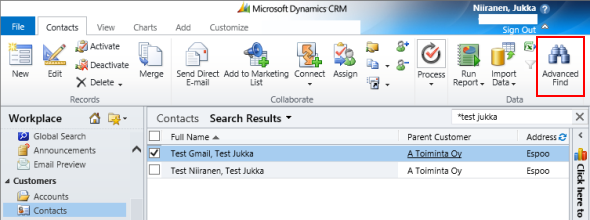
    In CRM 2011 the Advanced Find was always available in the main window of CRM. Unless you resized the window to a small enough size and made the Data tab of the CRM 2011 Ribbon collapse into a single flyout button, it was pretty easy to spot the familiar binoculars icon that represented Advanced Find. Being one of the most powerful features of the Dynamics CRM application, this button will have surely become familiar to all power users of CRM over the years.

    CRM_2011_Advanced_Find

    In CRM 2013 the Advanced Find feature is not always so easy to locate. I have observed quite many experienced users to struggle with locating the menu after the system has been upgraded. Also, when I was recently studying the Google search terms that had lead people to visit my blog, “CRM 2013 Advanced Find” and its variations appeared three times in the Top 20 searches. Since the Advanced Find feature itself has not really changed at all in the 2013 version compared to previous releases, I presume many of the questions people have in their mind while reaching out to a search engine may be related simply to “how to find Advanced Find” (as “meta” as that may sound).

    If that’s the question you have, then let me first explain a bit about the logic behind the standard behavior of the new Dynamics CRM 2013 UI in different areas of the application. Then I’ll show you an alternative method that will make it much easier to launch Advanced Find from any place inside CRM.

    Standard Navigation Experience

    When you open up the Dynamics CRM 2013 browser client with the default settings of a fresh new CRM organization, you’ll be taken onto the dashboard page. Here the button for opening Advanced Find is displayed prominently as one of the actions on the Command Bar, just like it would have in CRM 2011.

    CRM_2013_Advanced_Find_1

    If we move forward to a list view of any entity, the Advanced Find button no longer appears directly on the page. Instead the user needs to click the ellipsis (three dots) to reveal the “more actions” menu, where one of the actions launches Advanced Find into a new popup window. Another alternative would be to expand the view selector menu and choose the last option of “Create Personal View”, which will also lead the user to the Advanced Find window.

    CRM_2013_Advanced_Find_2

    How about if we’ve navigated onto a record of an entity, such as a contact, and then realize we want to perform a search on other similar records? If we now repeat the same action of expanding the Command Bar menu via the ellipsis, there is no longer an option launch Advanced Find from here. Instead we’d need to go back in our steps to the Contact list view by clicking the label in the Navigation Bar. This would then land us on a window where the option is again available.

    CRM_2013_Advanced_Find_3

    In a way this behavior makes sense, since the Command Bar actions visible on the record detail page are all related to the single record in question. Advanced Find also isn’t considered a “global” action in CRM that would be always present in the Navigation Bar (like the gear icon for opening the personal options menu), but rather it only makes its appearance when looking at a view of records (with the dashboard page being an exception to this rule). As Advanced Find really is a tool for building views, it is shown within this context of existing views for any record type.

    Creating a Shortcut Button for Advanced Find

    If you need to frequently work with views in Dynamics CRM, to perform searches on records, study different data columns than the system views offer or perform data analysis of any kind, you might find yourself reaching out for Advanced Find quite often. Instead of having to first perform a check on what is the current page’s context and then determining the steps needed for launching Advanced Find, wouldn’t it be more convenient to just have a persistent button available that would always take you to that window?

    Although Dynamics CRM itself doesn’t offer a direct way to bookmark the Advanced Find page, you can still easily grab its URL. In Internet Explorer, once you’ve opened up Advanced Find, press Ctrl+N to open it in a new window that contains the full browser controls. Now you can add it as a bookmark and place it on the Favorites bar (right-click on the top of the IE window to enable the bar if it’s not visible). The URL will be in the form of http://[servername]/[organizationname]/main.aspx?pagetype=advancedfind in an on-premises Dynamics CRM environment.

    CRM_2013_Advanced_Find_4

    Wait, don’t leave just yet! There’s more to it! The URL will be a static link that points to your current CRM organization. If you ever need to work with more than one CRM environment (such as development, test, production instances), then that bookmark will not be of any help in the other organizations. Wouldn’t it be cool to have a context sensitive button that would always take you to the Advanced Find window of the CRM environment you’re currently accessing? (more…)

  • Expanding “Add Activity” Options on CRM 2013 Forms

    CRM 2013 has introduced many UI features that aim to reduce the number of different windows between which the user needs to navigate while performing everyday actions on records. Since customer relationship management systems are often focused on capturing the various interactions between the company and its customers, activity management is naturally a core feature that should be as smooth as possible in a CRM application.

    The refreshed entity forms in CRM 2013 contain the Social Pane (shown as “Notes Control” in the form customization UI due to legacy reasons) that shows three tabs of interaction data related to the record: Activity Feed posts (Yammer posts if available), activities and notes/attachments. In addition to a much richer rendering of the activity content than the previously available subgrids, there’s also an inline control available for adding tasks or phone calls directly on the main entity’s form. This provides quite a slick user experience that makes CRM appear very effortless to use for activity management.

    CRM2013_Activities_1

    What’s missing from the Social Pane then? Well, for starters, not all the activity types are available to be created via the Add buttons on the top of the control. We have phone calls & tasks available immediately, clicking the ellipses (…) button gives us email & appointment, and if we’ve added any custom entities into our solutions they’ll be presented here, too. However, if you’d want to add any of the other default activities for the record you’re working on, meaning a letter, fax, recurring appointment or a service activity, then you’re out of luck. The user would need to navigate away from the form by selecting the Activities menu from the Nav Bar, create a new activity record from there, find the Regarding record to reference on the activity, save it, then return back to the original record.

    Another limitation has to do with the inline editing experience of tasks and phone calls. When you create a phone call via the Social Pane, it will always be record as a completed activity. So, no chance for planning upcoming phone calls and setting up a reminder, unless you record it as a task instead. Another downside of the inline form is that it’s not customizable, which means we can’t display any custom category fields related to a phone call or task. When implementing a CRM system for tracking the activities of sales people and account managers, it is a very common requirement to have some compulsory fields added onto the activity entities that the user must fill to categorize and describe the activity before being able to complete it. Well, since the inline form will log a completed phone call right after clicking on OK, this isn’t exactly the optimal feature for those scenarios.

    Ribbon to the rescue

    While some parts of the new UI are not yet customizable in CRM 2013, we do still have a way to introduce additional features onto the entity forms via the Rib… sorry, Command Bar. Even though in its default setup the Command Bar looks like a stripped down version of the CRM 2011 Ribbon, it’s still built on the very same  Ribbon XML definitions and it supports most of the features from its previous incarnation. As we know, CRM in itself doesn’t provide tools for configuring the contents of the Ribbon, which is why someone just had to do something about it. That “someone” is CRM MVP Scott Durow and the “thing” is his awesome Ribbon Workbench solution that gives us everything imaginable for customizing the CRM 2011 Ribbons as well as the CRM 2013 Command Bar.

    Since many of the common features presented on the CRM 2011 Ribbon get hidden away once the CRM environment is upgraded to 2013, Scott has been covering several scenarios in his blog where this functionality is restored onto the Command Bar. Among these articles is a tutorial on how to restore the Add Activity buttons into a CRM 2013 environment. By following these steps documented by Scott we can enable the creation of letter activities while on an entity form, as well as provide a navigation path to opening the full form of a phone call activity to control the business required fields as well as activity status beyond the options that the Social Pane inline activity form gives us.

    To demonstrate the possibilities of modifying the default activity management features of CRM 2013, I decided to take Scott’s example and expand it a bit further. In his blog post Scott shows you how to make the activity buttons appear on the Command Bar, but due to the limitation of max 5 items being shown directly on the form and the rest being pushed away into the “more actions” menu, it’s not going to be very easy for the CRM user to discover their existence. What I did instead was add a new flyout menu, promote it to the top 5 items on the Command Bar and arrange all the “Add Activity” buttons inside it. The screenshot below shows how this has been configured while in the Ribbon Workbench UI:

    CRM2013_Activities_RibbonWorkbench

    How do we get the buttons to do what we want them to do, meaning creating new activity records like they used to in CRM 2011? Scott’s blog post contains all the details you need for making this happen, but since the inherent complexity of the Ribbon XML language can make it challenging to grasp how the various options relate to one another (I’ll be the first to admit I struggled quite a while with the task before being able to achieve the result I wanted), I’ll recap the main steps here for your convenience.

    First of all, we’re not creating a completely new command but rather customizing a native CRM platform command. While the activity buttons aren’t visible on the Command Bar by default, they do exist in the Ribbon definition and can be accessed in the Ribbon Workbench by switching from the Command Bar tab to the Ribbon tab (bottom left corner of the top menu) and navigating to the Form ribbon (since this is where we want the flyout menu to appear in our example). You’ll see the familiar Ribbon in the format that it would be shown, with the Activity buttons available under the Add tab. Yeah, not too many end users probably ever discovered that second tab of the ribbon on their own, which is why the simplified design of CRM 2013 is definitely a step in the right direction, even if it means us consultants need to do a bit more tweaking of the system to enable the relevant features.

    CRM2013_Activities_RibbonWorkbench_2

    Anyway, now that we’ve found the buttons, we can right-click on them and select “Customise Command”. Effectively what this does is it brings the commands like Mscrm.AddPhoneToPrimaryRecord available for us to reference in the custom buttons that we create. While we’re at it, we can also re-use the icons and labels from the native buttons in our custom flyout menu buttons. The one thing we need to change, however, are the Display Rule settings of the now customized commands, as the Mscrm.HideOnCommandBar rule would otherwise do just what it says and hide the buttons from our flyout menu when viewed on a refreshed UI form.

    As mentioned, please refer to the original blog post to guide you through the detailed configuration of the custom buttons. It will give you everything except the different layout, which is the flyout menu that you can see below. In practice this method allows us to create up to five traditional dropdown menus on the form’s Command Bar. We now have a button labelled “Add Activity” that will open up a list of different activity icons, which in turn will lead the user to the traditional full create form for the chosen activity type. It will pop open in a new window, allow the user to edit the details, then close the window and return back to the parent entity form. Just like in the “good ol’ times” of pre-2013 Dynamics CRM.

    CRM2013_Activities_2

    If you took a closer look at the flyout menu shown in the picture, you may have noticed one non-standard entry at the end of the list: Site Visit. What’s that? And why’s it under a menu section called “Quick Actions”? Thanks for asking, let me explain what it’s all about. (more…)

  • Similar Opportunity Analytics with CRM 2013 Quick View Forms

    A while ago when performing a requirements gathering session for the sales process functionality in a CRM implementation project, my client asked me whether Dynamics CRM was able to show information on the opportunity form about how similar opportunities had performed in the past. Thinking of an analogy from the world of consumer web apps, this would be a bit like Amazon’s feature where they show you similar items that other people had purchased after ordering the product you are currently thinking of buying.

    Similar_items

    My initial reaction to the request was “I wish we could do that, but you’re looking at either a significant chunk of custom development or a considerably more expensive piece of software to get that functionality”. After a moment of thinking about it, though, I realized that the new CRM 2013 version already had some platform functionality that could be leveraged for delivering such a feature under the right circumstances.

    Quick View Forms across multiple relationships

    Traditionally Dynamics CRM has been an application where you can show information from either the current record the user is working on or the child records directly related to it. It wasn’t until CRM 2011 that showing the related child records right on the entity form became a supported scenario. With CRM 2013 we’ve gained another important feature that we can use to expand the scope of information being shown to the user on a single form. The new Quick View Forms allow us to show several fields from the parent entity on the current entity’s form. Even better, the Quick View forms support the CRM 2011 subgrid feature, which also makes it possible to show information about the child records of the parent record on one of its other child records.

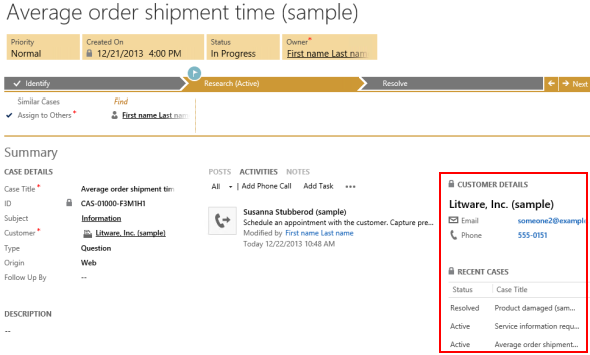
    “Whoa, that’s way more relationships that I can visualize in my head! What does all this actually mean?” No worries, these are not the type of features that would be immediately obvious to even the more seasoned CRM consultants. Let’s approach this via an example from the out-of-the-box configuration of the CRM 2013 case form. This new form contains a Quick View Form called Customer Details:

    Recent_Cases_CRM_2013

    The Quick View Form not only shows details about the customer account but also a subgrid of all the recent cases where this account has been the parent record. So, starting from the case record, we go one level up in the hierarchy to query the account record and then we come back down again to retrieve a list of child records for this account. The Recent Cases subgrid returns back to the same entity as where we start from, but this is not a requirement, as is demonstrated by another subgrid included in the same Customer Details Quick View Form that lists the recent activities regarding this account. Effectively we can show any entity information that is maximum two hops away from the current record and that share the common parent record.

    Applying Quick View Forms in customer segment analysis

    How could we leverage this feature in providing the CRM user some insights on how similar opportunities have worked out in the past? The key here is finding an entity that we can use for binding the different opportunities together and showing relevant information about them that will be helpful for the CRM user in deciding on the actions to take in pursuing the new sales opportunity. If it’s an existing customer that has done purchases in the past we could of course benefit from seeing this history, but assuming that we’re dealing with a scenario where repeat purchases are not that frequent, we should look for a different variable that could help us in surfacing the past sales analytics that can help us in winning the new deal in question.

    Let’s assume that we’ve got a customer segmentation model in place where we assign each new and existing account a segment value. The actual rules behind the segmentation process are beyond the scope of this article, but the one thing that’s critical here is that the segment information is stored in a dedicated “Segment” entity. This custom entity has a parental relationship to the account entity, which basically means that we can open a segment record and see all the accounts belonging to that segment. Now, because of the fact that each account has a value in the segment lookup field, we can also configure it so that every opportunity created for the account also inherits the segment value of that account. Effectively we’ll then have a similar 1:N relationship between the Segment and Opportunity entities as we have with Segment and Account. The end results and our target configuration will therefore look something like this:

    Account_segment_opportunity

    We need to have a bit of redundancy in our data model in order to be able to leverage the Quick View Form feature for our desired purposes. Technically we could determine the segment of the opportunity record just by examining the value on the parent account of that record, but we wouldn’t be able to reference it on the opportunity form customization UI. Therefore it is crucial that the segment value is carried over from the potential customer account onto the opportunity record, either through a relationship attribute inheritance or a real-time workflow that retrieves the value right after the opportunity record is created (preferably both, to cover all scenarios for opportunity creation). (more…)

  • Address Copy Button with CRM 2013 Business Rules and Workflows

    Address Copy Button with CRM 2013 Business Rules and Workflows

    The default forms in Dynamics CRM only contain one set of address fields, but most organizations will need to surface at least the Address 2 fields for accounts and contacts to manage the different information for visiting address, mailing address, delivery address, invoicing address or whatever the business scenario.

    Sometimes it may be justified to have a bit of redundant information in your CRM database for practical purposes. For example, if you use the Address 2 fields for managing the mailing addresses for accounts where this is separate from the visiting address, it may be easier to have the mailing address fields populated also in scenarios where the values are identical to the visiting address. Otherwise the marketing assistant who is building target groups for mailing campaigns will need to perform some Excel sorcery to pick different address fields for different customers when extracting the data from CRM.

    If you’ve bought anything from online stores during the past 10 years, you’ve probably ran into a nice little feature on the checkout or registration forms where the system asks if you’d like to use the address information you entered into your customer profile also as the shipping address for the order. Often times this is presented as a checkbox field that you simply need to tick once, to save you the trouble of re-entering the same data the system already knows.

    Wouldn’t this be a nice feature to have also on the CRM account form? Let’s take a look at a form where both Address 1 and Address 2 fields are presented side-by-side. If we would have a “Copy to Address 2?” checkbox that the user could tick after having tabbed through the Address 1 fields and entering data into them, that would be quite an intuitive feature that the users would surely feel right at home with. On the account form it could look like this:

    CRM_2013_address_copy_account_1

    Now that we have our new custom field below the Address 1 fields, next we need to build the functionality for duplicating the field values from Address 1 to Address 2. So, please open you “Javascript for Dummies” textbook from page 47 and… Hey, wait a minute! We’re working with CRM 2013 now that has the great new Business Rules feature for situations like these! Forget what I said about scripts, instead go ahead to the account entity customization menus and add a new Business Rule for this form.

    On the “Copy Address 1 to Address 2” Business Rule we’ll set a single condition to monitor the value of our custom chechbox field. If the box is ticked, meaning the field value equals “Yes”, we’ll set the values of each visible Address 2 field on the form to be the same as what’s been entered into the corresponding Address 1 field.

    CRM_2013_address_copy_business_rule

    Once we publish our customizations and activate the Business Rule, we can try out the feature in practice. Let’s create a brand new account record to simulate the typical data entry process (although an existing account would work just as well). After we’ve entered the Address 1 information on the left column, the moment we tick on the “Copy to Address 2?” box we’ll see the address fields on the right side get populated with the same values in real time.

    CRM_2013_address_copy_account_2

    Great, we’re all set to move this into production now! Or are we actually? What happens when the user wants to go and edit the field values for Address 2? If we leave the “Copy to Address 2” box ticked, then our Business Rule will keep copying the values over to the Address 2 fields the next time the rule is evaluated. As we’d like to allow the user to leverage this copy feature to initially replicate the fields to Address 2 but perform the necessary changes to those values that are in fact different, such as editing the Street 2 field, we should somehow restrict when our field copy operation is triggered. (more…)

  • CRM Rocks Podcast: Discussing the New CRM 2013 Features and User Experience

    CRM_rocks_podcastThere’s a large number of great CRM blogs out there, but how many Dynamics CRM podcasts do you know of? Well, here’s one website you should definitely take a look at: CRM Rocks! Markus Erlandsson has started a new podcast series that focuses purely on Microsoft Dynamics CRM topics.

    In the first episode Markus interviewed CRM MVP Gustaf Westerlund on the available tools and best  practices that any Dynamics CRM developer should be aware of. I had the honor of being guest nr. 2 on CRM Rocks and got to share my thoughts and observations on the latest and so far the greatest release, CRM 2013. Click here to access the podcast recording in MP3 format.

    Some of the topics that Markus and me discuss during the podcast include:

    • The new UI: how will the new form design impact the user experience and what requirements does it impose on system customizers.
    • Business Process Flows: how are they different from the other process types and what do they mean in practice for the management of tasks related to business processes such as sales opportunity management.
    • Business Rules and Actions: what are the new options for code-free CRM configuration and where do we still need .NET developer resources.
    • No more ribbon: are we missing out on past functionality or are we actually better off in the end.
    • A world without popup windows: why is CRM now easier to learn for new users.
    • One CRM platform, many CRM applications: what the extended client support for mobile devices means for CRM usage scenarios.
    • Auto save = no more “post buttons”: why you need to be careful when upgrading your custom business logic stored in scripts and plugins.

    I personally enjoyed the discussion a lot and if anyone has 55 minutes to spare on listening to my ramblings on CRM 2013 then I hope you manage to get something out of it, too!

  • The Next Dynamics CRM User Experience: Orion

    Post updated 2013-06-26:

    Hi there, thanks for your interest in Orion, the next version of Microsoft Dynamics CRM. You’ve probably arrived here by following a link that promised to show you what the user interface of the upcoming application release was going to be. Unfortunately you won’t find that content here anymore.

    Back in March 2013 several Microsoft representatives presented a preview of the upcoming release at the Convergence 2013 event. It was the first time that Orion was publicly shown to MS partners, customers and anyone interested enough in the product to either attend the event in New Orleans or watch the webcasts through Virtual Convergence. I enjoyed the latter ones and took a few screenshots from those sessions (which can still be accessed through the aforementioned site. Based on them, I wrote my own analysis of how the upcoming user interface changes were going to impact Dynamics CRM users, consultants, developers and so on.

    It turned out to be quite a popular post. As I write this update on June 28th, the page had been viewed over 11,000 times. Links to the post had been shared almost 300 times on various social channels. Several Dynamics CRM experts contributed to the discussion on the Orion UX changes in the comments section, on LinkedIn and elsewhere. In short, it was a hit.

    Linktally_analytics_Orion_UX

    The reason why the post cannot be available for you to read anymore is that three months after its release my employer has signed an agreement document and the contents of my (personal) blog is seen to be in conflict with the terms of this agreement. I understand the reasoning behind this interpretation and have no problem removing some of the content based on the request I’ve received. After all, I think the post has already done its job in distributing the publicly available information from Convergence 2013 in a structured format that has hopefully made it easier for anyone working within the Microsoft Dynamics CRM ecosystem to understand the direction where the product is heading in its upcoming release.

    We’re approaching the moment when Microsoft will be making official information available about the Orion release. At that point there will no longer be a need for any preview screenshots of the UI. If you simply can’t wait for that moment to arrive, then luckily this is the Internet and it does a great job in distributing information to anyone who can be bothered to search for it. If you want to stay on top of the latest news around Microsoft Dynamics CRM, one source of information to keep an eye on is the Surviving CRM Google+ page. If you want to know, how to prepare for Orion, there are some fine articles written on the topic 😉

  • Side effects of the Polaris UI

    Side effects of the Polaris UI

    Here are some of the gotchas you can expect after switching to the new UI that is introduced in December 2012 Service Update, known by the friendly name “Polaris” release. I previously compiled a summary of the changes in the new UI and publish it as the “What’s New in Polaris” slides, but I thought I should highlight a few situations that may come as a surprise when trying to adapt your existing CRM processes onto the updated user experience of Polaris.

    Relationship attribute inheritance

    As I’ve written earlier, the new forms don’t work all too well with the concept of adding child records from the parent record’s form. Previously in CRM 2011 the ribbon provided a rich, extensible set of actions you could perform on a view of related records or a form subgrid, say contacts related to the parent account or quotes related to the opportunity. While the new Command Bar is about to take the ribbon’s place as the menu of available actions for the main entity form, there’s nothing yet in place to provide similar functionality for related records. Given that CRM by nature is all about managing relationships between different objects, this currently presents quite a severe limitation on the application’s ability to fulfill its purpose.

    “Hey, don’t we have those new plus signs on the subgrids that we can use for adding related records?” Unfortunately the answer is not quite as simple, because the actions the button offers are unconfigurable and in most cases suboptimal. Here’s a take from the CRM Online Resource Center article on customizing the forms in the new sales process:

    You may add sub-grids to the new process forms as you would with existing entity forms. Note that the behavior of the “+” sign in the new sub-grid will vary, depending upon which controls you have in place on the form. Note that sub-grids cannot be customized to display charts.

    • Add Existing and Add New, both. If both are present, the “+” sign control will function as Add Existing.
    • Add New only. The “+” sign will open a new record form.
    • Add Existing only. The “+” sign will open the classic lookup dialog box.

    In most cases we have both options available, which means that instead of the new record form we’re given the Add Existing dialog. Imagine the most basic CRM scenario of them all: adding new contacts for an existing account. Here’s what you get from the form subgrid when clicking the plus sign:

    Polaris_add_related_contact

    Ok, so it’s not exactly as nice and clean as getting a new contact form right away (the classic experience), but guess we could live with that, since there’s a “New” button available there anyway. However, this reveals one of the hidden but nasty side effects of Polaris: the relationship mappings that you’ve defined in your 1:N Parent Customer relationship between the account and contact entity are not respected when using the New button in the Add Existing dialog. This means that your new contact record will not inherit any values from the account you currently have open, including common fields like address and telephone information. Even the Parent Customer field will be empty, as the system no longer understands the context in which you are adding the new record into the database.

    This shortcoming of Polaris renders many common use cases unnecessarily cumbersome. For example, try sending an email from the web UI to a contact record using the new process forms. Although a user who’s completely new to Dynamics CRM might accept the fact that he or she needs to always navigate back to the main window and choose the type of record to create, then fill out all the lookup fields and other non-inherited values, selling this to an existing user of the system would be very tough.

    Opportunity products

    The new process form for the opportunity entity does not show the opportunity products or quotes subgrids/sections by default, you’ll need to enable the visibility in form customization to menu to show them. Once you do, the layout is not very attractive, so you may want to do some clean-up on the form sections. After this exercise you can start to leverage the familiar functionality of adding line items on the opportunity record. No, inline editing of the opportunity products still isn’t possible, but maybe it will one day be in a future release.

    As we add more product lines on the opportunity we start to notice that the total amounts are no longer up to date with the latest additions. In the previous UI we would have reached out to the ribbon to click the Recalculate button to force the system to update the record. The new Command Bar doesn’t offer such an option, however. We can’t click the save button either, as there’s nothing to be saved on the actual parent opportunity itself. Our only options to get the totals updated are to A) close and reopen the opportunity form, or B) update any arbitrary field on the opportunity form. In fact, we might as well create a new checkbox field on the form called “switch to update”, to be changed each time we want to perform the calculation. The new auto save feature will then (in no more than 30 seconds) retrieve the updated value, without even flashing the form.

    Polaris_opportunity_products_small

    Recalculation is not the only issue here, however. Referring to the relationship attribute inheritance problem that the Polaris UI suffers from, this manifests itself also in the further steps of the sales process. Suppose you’ve added a subgrid for quotes on the opportunity form (or rather made it visible), to allow you to proceed with preparing an offer document to the customer. Clicking on the plus sign works nicely here for a change, since there’s no Add Existing option available for opportunity quotes, so we’re presented with the quote record containing the right header level sums and discounts we entered on the quote. We then click save and… WHAT?!? Where did all my monetary values disappear?!  Why is the quote empty now?

    Polaris_quote_products_missing

    The reason this happens is that the quote products were never created. The lack of inheritance doesn’t only limit itself to actions the user performs on the UI, but apparently some of the platform functionality also gets broken when using the Polaris forms. The Add New relationship does carry over the total values from the opportunity form onto the quote form, but none of the line items on the opportunity get added onto the quote. This means that the moment you click save and an update form is opened, the recalculation of the quote level fields takes place, thus deleting the values that existed while we were still on the create form. Sure, you could retrieve the products from the parent opportunity by using the Get Products button on the quote ribbon (as this entity still has the classic experience), but you probably wouldn’t be very happy with this workaround, knowing how it used to work before.

    As a part of the Polaris update, the default value of the Revenue field has been changed from “System calculated” to “User provided” in Polaris, as outlined in article KB2806842. I think that sends a clear signal: if you’re working with line items in your sales process, you’d be better off not enabling the new process forms. In which case, don’t forget to go and set the default back to “System calculated” after the update if that’s how you build your opportunities. (more…)

  • What’s New in Microsoft Dynamics CRM Polaris Release: The Slides

    On January 21st, 2013 the official announcement on “broader availability” of the Microsoft Dynamics CRM December 2012 Service Update (formerly known by codename Polaris) was made on the CRM Connection blog. Even though not all the CRM Online organizations have yet been updated, new trials in US and shortly in EMEA & APAC will get the latest functionality installed upon provisioning.

    The absolutely best way to get familiar with the future UI of Dynamics CRM is to get a 30 day trial organization for yourself and play around with the demo data. In fact for a large share of the existing customers this will be the only possible way, since there will be no on-premise version of Polaris. You’ll get the cross-browser support, API updates, and, contrary to previous information, the updated Activity Feeds solution when installing Update Rollup 12 for your CRM server (currently not yet available for download after having been pulled). Sorry, you’ll have to wait for the Orion release that’s coming out sometime later in the year 2013.

    Since I know many of you must be busy with deploying, supporting, developing and actually using  the current on-prem version of CRM 2011, I’ve created a summary of the new features  in the December 2012 Service Update just for you. No, not just a list of the bullet points that Microsoft has already communicated, but rather a hands-on exploration of how the new version works differently from the old CRM 2011. You’ll find it on SlideShare available for download or you can view it below (although the image quality in the streamed version is a bit crappy).

    The 34 slides cover those features I personally found noteworthy when getting to know the Polaris release. It’s not an exhaustive list by any means, but I’ve tried to highlight the changes and gotchas that a system customizer or administrator familiar with the previous versions should be aware of. The topics include:

    • Sitemap changes
    • Activity Feeds filters (see this earlier post for more details)
    • New process form structure and components (previously known as the “Flow UI”)
    • Swithing between new and Classic forms
    • Updated subgrids and limitations on working with related records in general
    • Extended case management functionality
    • Support for creating leads for existing accounts
    • + Many more!

    With this release Microsoft has done an excellent job with publishing a plethora of training videos on the Dynamics CRM December 2012 Service Update on the Microsoft Dynamics YouTube channel for anyone to watch, with no login required to access the materials on Customer/PartnerSource, so do take advantage of them. Unfortunately I haven’t yet found an official MS index page to these videos, so I suggest you refer to this post by Donna Edwards with the video links, because the video titles are impractically long when browsed on YouTube (hmm, wonder if this says anything about Microsoft’s product naming convention… probably not 😉 )

    And that’s not all, folks! By browsing through the updated Resource Center content online you can access detailed help articles on topics such as installing product updates, turn on the new sales and service process forms or customizing the forms in the new sales process. There’s so much more to this release than just the cross-browser support (although that’s bound to keep people busy as CRM 4.0 scripts start to break) that I urge you to have a look, even if you’re not working on a CRM Online environment. By starting early you’ll have a better understanding of how to prepare for the next on-premise release, what comes out of the box in Polaris and what type of customizations are sensible to make when knowing the upcoming form architecture and user experience that will arrive in the Orion release.