Category: News and events

  • Microsoft Dynamics CRM Mobile iPad screenshots

    Microsoft has released a YouTube video where Ruben Krippner talks you through the upcoming features of the Q2 2012 Service Update, a.k.a. Dynamics CRM R8. Since we already know much of the new release details through the Release Preview Guide, the most interesting part of the video is the live footage of Microsoft Dynamics CRM Mobile running on an iPad. For those of you who want to get a quick glimpse of what the client looks like, I took the liberty of taking a few screenshots from the video.

    Sitemap & Dashboards
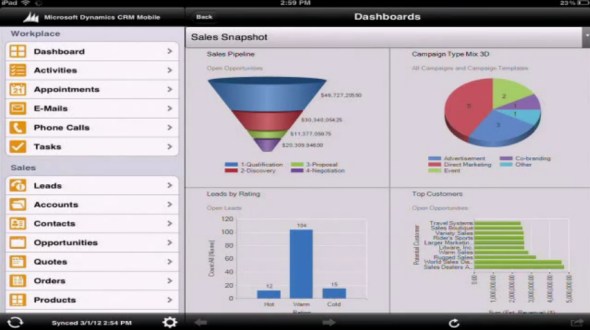
    Microsoft Dynamics CRM Mobile iPad dashboards

    As we know, the “new” client is actually a rebranded version of the CWR Mobility client for Dynamics CRM. The UI looks almost identical, apart from a new set of Metro style entity icons. The sharp edges and “authentically digital” appearance look somewhat out of place in the otherwise iOS-style app, but let’s hope that there will be a full Metro app for Dynamics CRM available once the Windows 8 tablets hit the stores.

    Dashboards appear to be close to the web UI as far as charts go. If you have other types of web resources on your dashboard (say, a Silverlight component), the results may be a bit less so. Also, I’m assuming entity grids will not be rendered on the iPad Dashboard, at least not in their original format.

    Views

    Microsoft Dynamics CRM Mobile iPad views

    The iPad UI does support filtering data through views, just like you do on the web client. However, the views themselves will not be presented in the familiar grid style with columns, rather you’ll see a list of records with the primary field and some other data stacked on top of each other. Whether this is because of iOS limitations or an inherited design from the iPhone app, I’m not sure.

    Forms

    Microsoft Dynamics CRM Mobile iPad forms

    The standard fields are presented on a form that has a single column. Picklist and date fields use native iOS controls, also field types like phone numbers or email addresses will open native apps for respective actions. Why an iPad app shows you the options to dial a phone call or send SMS, I don’t know, because at least my iPad won’t allow me to do those without jailbreaking the device, but maybe Ruben has a special version of the Apple tablet 😉

    As you can see from the form, it’s not specifically optimized for landscape mode viewing on a tablet, but rather looks like a big iPhone app. Entity forms with many columns will therefore be presented as a long list the user has to scroll up & down.

    Maps

    Microsoft Dynamics CRM Mobile iPad Google Maps

    As a funny little detail that Ruben mentions on the video how the account address opens up on Google Maps. Why not Bing Maps? Well, because the native map application on an iOS device comes from Google…

    Off-topic: It’s great that the mobile clients for iOS, Android and Windows Phone now have the basic address mapping integration in place, now we just need to get it for the web and Outlook clients as well. While the integration itself is technically quite trivial, the requirement for purchasing a Bing Maps license for using the map data on a non-public application is currently a big barrier in the desktop world. But enough about that, let’s get back to the mobile client.

    Related records

    Microsoft Dynamics CRM Mobile iPad related records

    Because the sitemap navigation pane is permanently visible on the left hand side of the screen, which on a normal web client entity form would show the related records, in the mobile client these are accessed through a button on the lower right corner of the screen. Subgrid type of functionality is not available on the tablet UI, which can make it a bit cumbersome to navigate through long hierarchies of records. As a result, using the iPad client for tasks such as order entry while on the road is not really optimal in the Microsoft Dynamics CRM Mobile client. These types of use cases will still be better met with a custom developed tablet application equipped with specific data entry screens, so toolkits like Resco will remain relevant even after this official Dynamics CRM iPad client gets released.

    Configuration

    Microsoft Dynamics CRM Mobile iPad configuration

    The mobile client is not just an alternative UI for CRM, but there is a wealth of management options for user and client management, synchronization settings, usage reports etc. Since the way you use a mobile/tablet application is quite different from the normal desktop client usage scenario, it’s important that the information presented to the user can be optimized. Microsoft Dynamics CRM Mobile allows you to do this by defining different user groups and assigning them tailored mobile profiles containing only relevant entities in the sitemap. Also the contents of the mobile forms can be adjusted, so you don’t have to show all the tens of attributes that your entities contain.

    Microsoft Dynamics CRM Mobile iPad mobile profile and entities

    Conclusions

    The CRM Anywhere theme is definitely a step in the right direction for Microsoft Dynamics CRM to become an application that truly “works the way you do”. Even though the cross-browser compatibility will enable users to open up the CRM web client on their iPad Safari browser, for any serious work on a tablet you’ll want to have a client that is optimized for:

    1. touch based user interface
    2. streamlined data presentation to support the “working in short bursts” mode of mobile device usage
    3. offline access for those moments when 3G or WiFi just doesn’t reach you

    For the subscription price of $30 per user per month (or the perpetual license you can still acquire from CWR Mobility), you can install a fully capable Dynamics CRM mobile client on both your iPad and your iPhone, and still have one user license left for trying out the latest Android phone (whether the non-offline Windows Phone 7 client will consume a license, I don’t know yet).

    You can read more of my thoughts on Microsoft Dynamics CRM Mobile on this article I wrote after the announcement at eXtreme CRM 2012 Berlin.

  • To the eXtreme, part 2: The future of the web caught up with IE and Dynamics CRM

    One great thing about Microsoft Dynamics CRM as a business application platform has been that it’s modern enough to have been born into the browser window from day one. With no legacy from the pre-web era, the product has been able to stay relevant with no major disruptions in the client side development and also supported the eventual move of the server side functionality to the data centers in the cloud.

    A history of Internet ExplorerInternet Explorer market share peaked in 2003, when 95% of all Internet usage was on IE. Coincidentally, Microsoft CRM 1.0 was released in January 2003. At the time, providing support for any other browser than your in-house product would have certainly sounded like a requirement you could de-prioritize. Today Internet Explorer commands a market share of less than 40%. There are now more iPads sold than any brand of desktop PCs combined. If that doesn’t signal the move to a post-PC era, I don’t know what does. If you’d be a company manufacturing an IE only product for PCs in the year 2012, you could soon be out of business.

    This is a fate Microsoft intends to avoid, which is why the cross-browser support for Microsoft Dynamics CRM was officially announced in the Q2 2012 Service Update release preview guide, released at the beginning of Extreme CRM 2012 conference in Berlin. We had already seen the promise of non-IE browser clients for Dynamics CRM presented in Microsoft’s May 2011 Statement of Direction and now we finally have details about what to expect in Dynamics CRM R8 release exactly one year later. As with my previous post on mobile CRM, I won’t rephrase all the content of the official announcement but I’ll rather try and reflect on the topic with some personal observations and thoughts.

    There’s Supported and then there’s “supported”

    If you’ve glanced at the table of supported browser and OS combinations, you’ll have noticed that Microsoft does not guarantee support on every browser out there on every operating system. This is not too surprising, as any web application developer surely knows what a nightmare the differences in interpretation of web standards between various browsers can be for application development and testing. In the words of Craig Dewar (Director of Product Management for MSDYNCRM), browser testing is a “gigantic effort” for Microsoft, which is why official support is not all encompassing.

    Microsoft Dynamics CRM browser and OS support

    Just because a browser or OS is not listed in Microsoft’s documentation as supported, doesn’t mean Dynamics CRM won’t work on it. So, even though there are no supported options for using Microsoft Dynamics CRM on Linux, you might not notice any problems if you access it with Firefox on Ubuntu. In fact, Craig mentioned in his keynote at Extreme CRM 2012 Berlin that even if you’re using a client that’s not officially supported, Microsoft will allow you to open support tickets on issues that are not specific to the browser/OS combination you’re running. I guess you’ll just want to have at least one Win/IE or Mac/Safari device around to make sure you can reproduce the issue when dealing with Microsoft Support representatives.

    “Macbooks for everyone!”

    In case you’ve been drooling over the cool Apple hardware that all the opinion leaders seem to carry with them these days, the future does indeed look brighter for people working on/with Dynamics CRM. Before you jump head first into the OSX & iOS world and format all your Windows partitions, it’s important to remember that what Microsoft is talking about here is just the browser client support for CRM end users.

    Outlook 2011 for Mac: sorry, no Microsoft Dynamics CRM clientWhile you can get Microsoft Office for OSX and run Outlook on you Mac, what you can’t do is use the Microsoft Dynamics CRM for Outlook client. This means you can’t track emails to CRM, synchronize your calendar appointments between Outlook and CRM, get CRM task and call reminders from your Outlook, synchronize your contacts from CRM to Outlook to your iPhone, or have any offline support for CRM data and application functionality when your Macbook doesn’t have WiFi or 3G data connectivity. All in all, you lose quite a bit of that seamless productivity tools magic that Dynamics CRM promises to deliver for all Windows users. I haven’t seen any announcements about a CRM Outlook client for Mac, so it’s pretty safe to assume that we won’t see one released for the Outlook 2011 for Mac version currently available.

    OK, so how about the support of Apple’s mobile devices then? It says Dynamics CRM will run on iPad 2 with iOS 5.x, so that should at least deliver the full flavor of the browser experience on a tablet, right? Well, the problem is you might get more than you bargained for in that deal, since (as far as I’m aware of) the browser client will look and work exactly the same on all supported platforms and devices. If you’ve ever tried running the Dynamics CRM web client on a Windows 7 tablet, you’ll know that simply replacing the mouse cursor with your index finger will not magically “touchify” the user experience. What works nicely on a 24″ screen with mouse & keyboard input may not scale/transform into the tablet environment of 10″ screens and touch UI. If you’ve used a remote desktop app on your iPad, then I’d imagine this is pretty much what you can expect from a browser client on an iPad. Unless you go for the $30 per month subscription of Microsoft Dynamics CRM Mobile app or purchase a perpetual license from CWR Mobility, TenDigits or other ISV’s that develop mobile clients optimized specifically for the touch UI. The same goes for Android tablets, only with the exception that the browser client falls into the “not officially supported” territory.

    Finally, if you’re not only using Dynamics CRM but also administering or customizing it, I’ve read that you’ll still need Internet Explorer in order to access these areas in the web client.

    ‘Reimagining’ Windows, should we also reimagine Dynamics CRM?

    WinRT architectureIt’s important to note that the web client coming out in Q2 2012 is not a HTML5 product, rather it’s a trimmed version of the previous IE only client with removed dependencies on Microsoft’s proprietary extensions that only IE supports (.htc files etc.). The future is not here yet, but there is little doubt on the direction Microsoft is heading towards, with the upcoming WinRT framework and the big push for HTML, Javascript and CSS as the foundation for future Windows apps.

    Which brings us to Silverlight. It’s been widely speculated that Silverlight 5 released at the end of 2011 will be the last of it’s kind, the end of the road. Porting existing Silverlight apps to run on Win RT is said to be easy, which should naturally be in the interest of Microsoft to ensure. As I’m not a developer, I’m looking at the discussion more from the point of view of someone who needs to examine all the available technologies out there, evaluate how they fit together and build a working business solution out of them. From this perspective, there are some concerns regarding Silverlight that very much affect Dynamics CRM users as well.

    While Dynamics CRM might work on a browser/OS combination that is not officially supported, the game is different if you’re using Silverlight web parts in your CRM. If a Silverlight plugin is not available for the client, it will not work, period. This includes combinations such as Chrome/OSX, any machine running Linux and most notably the iPad. Ok, so what about making the same UI with a different technology, like HTML, Javascript and CSS? In theory everything should work on every platform in this case. You’re free to draw your conclusions on which approach is better for starting your next Dynamics CRM add-on project.

    Looking further ahead to Windows 8, we’ve already received the announcement that there will actually be a completely different edition of the operating system, called Windows On ARM (WOA), that will the basis for building always on, always connected, low power consumption devices to rival the iPad. The Internet Explorer 10 browser on WOA will not allow any plug-ins whatsoever, be it Flash or Silverlight. Furthermore, the Office 15 package that is available for WOA tablets will include only Word, Excel, PowerPoint and OneNote, but not Outlook. By now you should have figured out that the Microsoft Dynamics CRM experience on WOA will need to be quite different from what we have on Windows 7 today.

    If there will not be Outlook on the “real” Windows tablets, what does the future hold for the CRM Outlook client? I previously wrote about the legacy of Outlook and how it will be increasingly more difficult to carry all that legacy when moving to the Post-PC era of iPad-esque devices for every knowledge worker. By the looks of things, Outlook could possibly get split into Metro Mail, Contacts and Calendar apps. If this happens, then it’s easy to envision a separate Dynamics CRM Metro app sitting alongside them, integrating into all the other installed apps through a simple share contract. After all, isn’t that the way it should really be? Link contacts/friends/followers from any social network app to CRM contacts, track any type of status update/post/tweet from the same app as a custom activity type into your CRM database. There’s no reason why customer relationship management tasks should be any more complex or inflexible than that.

    It’s great to have Dynamics CRM available soon on (almost) any browser. Still, if Microsoft truly is reimagining Windows the way they claim to be and if their business customers buy into their new story, perhaps running Dynamics CRM on Safari won’t seem all that exciting anymore this time next year.

  • To the eXtreme: thoughts on Dynamics CRM Mobile

    This is my first post on news and gossip that the eXtreme CRM 2012 Berlin conference brought to us. As there’s so many posts out there already that review the contents of the Q2 2012 Service Update (aka Dynamics CRM R8), I’m going to try and reflect on the topics based on my own observations and questions that these latest announcements have brought up. The first stop is mobile CRM.

    Every consultant knows that Microsoft’s initial offering, the Dynamics CRM Mobile Express client, wasn’t really something you wanted to draw the customers’ attention to. It was just barely good enough to tick the feature box of “yes, we have mobile CRM”. On a non-touch smartphone like the popular business products from Nokia or RIM the user experience might have matched the native apps and device capabilities, but in the age of the iPhone this wasn’t at all what the users had come to expect from their mobile apps.

    When Microsoft released the new Windows Phone 7 client application in CRM R7 release (2011 Q4 Service Update), we saw a glimpse of a brighter mobile future, but there was still hardly reason for true celebration. Ok, so we had a mobile optimized client now available, but it had it’s issues:

    • Only available for one niche (yet growing) smartphone platform
    • No ability to create or update any CRM records (except Activity Feed posts)
    • No offline support

    The path towards a credible mobile offering would have been quite long for Microsoft to walk all on its own. Therefore it wasn’t really a surprise that they chose to team up with an existing partner and rebrand their mobile applications and services to the new “CRM Anywhere” solution (which is still officially called Microsoft Dynamics CRM Mobile). Out of all the possible mobile CRM ISV’s out there, their partner of choice turned out to be CWR Mobility.

    This could of course be seen as a big blow to the other Dynamics CRM mobile ISV’s, who now have to compete against Microsoft’s own offering. However, in the long term this may actually be a positive turn of events for the whole ecosystem. The fact that there will be an official mobile app available from Microsoft to all the major smartphone platforms will surely drive up customer awareness as well as interest towards the possible use cases for “CRM on the road”.

    Considering how much talk there’s been around the mobile use of CRM applications in the past few years, in my opinion we haven’t yet seen it really bloom the way many of us would have expected it to. I think one of the reasons is that mobile CRM has often been considered mainly as “CRM lite” that offers a subset of the features the full application delivers, for those awkward moments when your “CRM full” is not available to you. If mobile CRM is an optional feature that does not tie into the processes you absolutely need to execute, how likely is it that companies will choose to invest in such an additional cost factor? Ben Mitchell from TenDigits said it really well in his presentation:

    “You’ve got a perfectly working address book on your phone already. If that’s all you’re trying to replace with mobile CRM, it’s always going to be too expensive. Always attach the price of a mobile CRM solution to the business value the customer is trying to achieve by deploying the solution. Mobile functionality pricing must be delivered in the context of business objectives, not just as a last minute addition to the quotation.”

    Mobile CRM is like Social CRM in this sense: companies know why they need to embrace it sooner or later, but they’re still having difficulties in articulating exactly how they plan to go about it. As the limitations of available software are quickly fading away, the focus on real life use cases must rise on top. No, mobile CRM isn’t just about replicating the desktop experience on a smaller device. It must support the mode of working in infrequent bursts and dealing with specific scenarios, such as order entry or survey answer recording while the user is at the customer’s site. The UI needs to be optimized for the process in question, not just equipped with big icons to be poked with your fingers. Whether it’s going to be packaged apps like the Microsoft Dynamics CRM Mobile growing beyond their current feature sets in customizability, platforms like the Resco Mobile CRM Studio gaining popularity as the basis for mobile app development, or even a future release of a HTML5 compliant version of the core Dynamics CRM browser app stealing the show with responsive web design, the playing field for a true CRM Anywhere solution that takes the “mobile first” thinking into everyday practice still looks wide open to me.

    One interesting thing to keep an eye on is what’s going to happen to the Microsoft developed Windows Phone 7 CRM client. The R8 release preview guide states that there will not yet be offline functionality available for Windows Phone devices when the new service launches. This means that Microsoft Dynamics CRM will initially work better on pretty much any other mobile platforms compared to Microsoft Windows Phone 7 (doh!). I’m assuming that the current client version will receive some minor feature updates (new Activity Feeds filters etc.) but a full integration into the CWR Mobile platform will take more time. I’ve noticed in some occasions the WP7 client has actually been referred to as the “Activity Feeds Mobile App”, but I’m not sure if Microsoft could get away with renaming product X to product Y, then launching a new product X and charging extra money for it.

    This leads us to the pricing model. Whereas the Windows Phone 7 client is a free download from the Marketplace, the CWR clients are based on a subscription fee. A company who buys licenses for Dynamics CRM, be it on-premises or CRM Online, will not receive any mobile client functionality as a part of the core product. Microsoft Dynamics CRM Mobile will therefore remain as an add-on that customers must purchase licenses for separately. Considering the price is $30 per user per month, compared to the base product price of CRM Online of $44, this means in many cases not all CRM users will be given mobile client licenses. Or perhaps they’ll just be given a midprice Windows Phone device, such as the Nokia Lumia 710, and access to the free WP7 version of Dynamics CRM Mobile. With a number of Dynamics CRM apps already out there in iOS and Android marketplaces that any user can purchase for themselves and point it to a CRM Online or IFD organization, I’m not even sure companies can effectively standardize on a single official mobile app anymore, thanks to the BYOD culture and shadow IT.

    The official Microsoft Dynamics CRM Mobile service won’t be able to match the 40 markets / 41 languages level of the core CRM product, as it will initially be available only in 24 markets and 10 languages. The explanation offered by Microsoft was that there are such regulatory limitations for mobile services in many markets that they simply can’t roll out their mobile CRM offering as quickly as a cloud app like CRM Online. We’ll see how fast they can catch up and bring the service to markets like Finland. It will also be interesting to see whether the initial unavailability will simply mean the lack of local languages or if MS will actually not offer the mobile app for download at all in these tier 2 regions’ marketplaces. I sure hope it won’t be the latter option, even if it would mean I’d have to temporarily return from WP7 to Android for doing proper presales demos of the new mobile service with offline capability. The sacrifices one needs to make for the love of CRM… 😉

  • Enterprise gone social – how will CRM fit in?

    Enterprise gone social – how will CRM fit in?

    Call it a revolution, call it a bubble, call it what you want. One thing is for sure: social networks are not going away. Even though it still remains important to be able to manage and measure your sales funnel with the help of some tried & tested SFA tools, segment your customer database to build more effective target groups for campaigns, or share information on customer support enquiries across your helpdesk staff, this functionality will not be considered as important as it was during the last decade. In this new age of connected customers and empowered information workers, companies will be searching for applications and processes that go beyond what CRM has traditionally stood for.

    Let’s take a look at some of the recent news surrounding the world of CRM, to gather evidence of where we might be heading towards.

    Takeways from #SFDC #DF11

    On the last week of July, Salesforce.com held their annual Dreamforce conference in San Francisco. As a person working with Dynamics CRM for a living, it’s a good idea to keep an eye on where the other CRM solution providers are focusing their development efforts on, and SFDC certainly is one of, if not the main competitor that Microsoft has their eyes on. In his opening keynote, Marc Benioff made it very clear where his team’s focus is on, and that is the concept of a social enterprise. I’ll spare you from the marketing flare and instead present a few screenshots captured from the presentation, highlighting the new feature announcements.


    So, what’s in the pipeline for Salesforce.com during the winter 2011/2012 then?

    • Contact profiles will be “social enabled” by default, showing public feeds from networks were your customers are present
    • Data.com, previously known as Jigsaw, will power the social data discovery and data import, in combination with D&B’s database
    • Chatter Now extends the functionality from microblogging to instant messaging with presence information
    • You can invite your key customer contacts to specific Chatter networks, or even publish Chatter on the web as a customer service channel
    • Radian6’s technology will monitor those customer complaints that are not targeted at your helpdesk, enabling you to jump in on the conversation
    • All of this follows you everywhere you go, as touch.salesforce.com promises to deliver a HTML5 client that’ll make your iPad or smartphone a full-fledged social CRM control panel

    Even if you leave away some of the over-the-top scenarios presented, like friending the Coke machine or having network routers tweet you on social networks, it’s still clear that with all the promised functionality at your fingertips (once it’s available and working in a reliable manner), the possibilities for you to design and implement new business processes will be dramatically expanded. Whether companies are able to make use of and, more importantly, make money out of these new possibilities is a different question, but it surely does push the boundaries of CRM as we know it.

    Social CRM is where it’s at

    “Social” certainly is an attractive attribute to include in your product description these days. Gartner, for example, has predicted that the market for Social CRM would reach a total value of one billion dollars by the end of next year. Predicting the future with concrete figures is always a challenge, but it’s even more difficult when people don’t even agree on the definition of the market to be predicted. Several analysts have commented on Gartner’s reports, starting from reminders that an SCRM market may not really exist yet, or they have questioned Gartner’s choice of products included in their SCRM Magic Quadrants as including applications aimed at other functions than what CRM systems traditionally are about – managing customer information, that is.

    (more…)

  • First preview of Dynamics CRM Q4 2011 Service Update (and more)

    There’s an immense amount of product news coming up from the WPC 2011 conference, due to the sheer size of Microsoft’s portfolio of different product lines. Luckily also Dynamics CRM had its 15 minutes on the WPC keynote stage and we saw a few bits and pieces of what lies ahead in the upcoming Q4 2011 Service Update that will become available to both CRM Online and CRM 2011 on-premise later this year. I already wrote a post in Finnish about the CRM news from WPC, but I thought I’d also share a few screenshots here to those who haven’t seen the keynote video.

    Social business remains a hot topic and Microsoft will add some of the much needed social aspects into the next release of Dynamics CRM. Activity feeds á la Twitter, Facebook, Yammer, Chatter and the likes will be integrated also into Dynamics CRM, as can be seen in the demo dashboard below.

    In addition to allowing status updates from colleagues, the functionality we saw earlier in CRM 4.0 as the Business Productivity Newsfeed Accelerator (though merely a report) and then later on implemented through 3rd party add-ons like Vibe from Sonoma Partners, now looks to become a core part of Dynamics CRM platform. I’d imagine these automatic feed items are still posted as a result of record updates triggering workflow process rules, like in the aforementioned examples.

    Office 365 will become the new home of CRM Online in Q4 as it integrates into the same infrastructure. In addition to subscription management and authentication provider improvements, there’s some interesting benefits for CRM in the Lync integration provided from the Office 365 cloud. No longer will you be limited to only have chats and video conferencing with your colleagues. If the customer contacts in your CRM database are also users of Office 365, their presence information can be federated across organizations (if they choose to, I’m sure) and presented right inside the CRM forms, allowing you to reach out to them through Lync with one click.

    Azure Data Market is now being marketed as the “one-stop shop for premium data and applications”. The Dynamics CRM demo included a custom button called Azure Enrich, which went out into the Data Market, opened up D&B’s company database and provided the missing address information for the Contoso account. I guess the big news here isn’t how you can retrieve company data through the API, but rather what the existence of a central marketplace can actually do in making data available to a whole new scale of potential customers, from a variety of global players. The cloud is not only for apps anymore.

    In the WPC keynote demo we saw again a Windows Phone 7 client for Dynamics CRM. This time there was also one new screen included, which presents the same activity feed information (labeled as “records feed”). It doesn’t quite compete with the other flashy WP7 Mango demos presented later on in the session, but definitely a useful way for mobile workers to keep an eye on what’s going on in the CRM database while outside the office.

    Oh, and of course there was the tablet app built for running Dynamics CRM on a Windows 7 slate. With all the Metro UI goodness, I’m wondering what the out-of-the-box experience could actually become like once we reach Windows 8…

  • Office 365 launches without Dynamics CRM integration for document management

    Office 365 launches without Dynamics CRM integration for document management

    Today was finally the big day when Microsoft’s cloud productivity platform BPOS was replaced with Office 365, which is now available for subscription. Having played with the beta version for a while now, I’m overall quite impressed with how close the SharePoint Online environment now is to its on-premises counterpart. While the limitations are still somewhat more visible than when comparing CRM Online vs. CRM 2011 on-premises versions, I think it’s already close enough to enable a significant part of traditional business requirements for SharePoint to be fulfilled with the cloud platform.

    Microsoft confirmed already last fall that also Dynamics CRM Online will eventually be migrated onto the same Online Services Delivery Platform as Office 365. In addition to being a natural fit with SharePoint and Exchange, CRM Online should also gain benefits into both its subscription management as well as authentication options as a result of  this migration. However, there’s no official timeline or feature set communicated yet, so we’ll have to keep waiting possibly until Q4/2011, when the next update for Dynamics CRM has been scheduled to become available, as announced in the latest Statement of Direction document.

    Ever since Dynamics CRM 2011 was launched with built-in SharePoint document library integration, there’s been a bit of anxiety on when this functionality could be leveraged with the cloud versions of CRM and SharePoint. Since BPOS was built on SharePoint 2007, it wasn’t possible to utilize the Microsoft Dynamics CRM 2011 List Component for Microsoft SharePoint Server 2010 in the Online environment. This meant that setting up a document management enabled trial environment with CRM Online required an on-premises SharePoint server, which wasn’t too convenient. Nor was it for any customer looking to go “all in” with their MS applications. Oh well, but now that Office 365 is available, that’s all a thing of the past, isn’t it?

    Wrong! Despite of the better together marketing message surrounding Office 365 and CRM Online, there’s actually still no way to integrate the SharePoint document libraries with the CRM List Component. Sure, you can upload the solution file into a SharePoint Online site and publish it. What you cannot do in the Online version is to take care of the second part of the installation steps, which involves the AllowHtcExtn.ps1 PowerShell script,used for enabling .htc file extensions to be served from SharePoint.

    Why is this important? Because without the .htc support, you can’t actually do anything with the document library. The folder creation can be configured and it flows through as it should when accessing the Documents menu for a new record, such as an account. However, after that you are presented with the following prompt:

    “The action buttons are disabled because the SharePoint server that you are using does not allow HTC component files. To enable the buttons, contact your system administrator.” What this means is that the document library will be rendered nicely inside the CRM entity form, but you can’t upload any documents to it. Clicking on the buttons does nothing, as they’re all disabled.

    How about on the SharePoint side of things then? We can see that the entity specific document libraries are created and also the corresponding folders for each record where the document location has been defined. We can also of course use the native SharePoint UI to upload documents into the library.

    Then when you access the corresponding record through CRM, you can see that the document does appear in the library. But with all the controls disabled, you again cannot do anything with it, like open the document, for example. How nice…

    How did we end up in this situation where the latest and greatest cloud offerings from Microsoft are not working together like they obviously were inteded to? That’s a very good question. The problem with Office 365 SharePoint Online limitations and their implications to Dynamics CRM document management functionality has been a known issue throughout the whole beta phase of Office 365. There are several threads on the Office 365 community forums regarding this. Yet the response from Microsoft has been that this cannot be resolved by GA (general availability) of Office 365 (as in “today”), but rather we’ll have to wait for the first service update, probably. Come on! How can 6 months not be enough to allow one .htc file to perform its work and provide the document integration between CRM and SharePoint? I find it extremely strange that the product management behind Office 365 has allowed such a flaw to be included in the initial release version.

    Of course eventually this issue will be solved and we’ll be able to experience the full document management process flow with Microsoft’s cloud applications.

  • More agile direction for Dynamics CRM future product releases

    During Convergence 2011 Atlanta we already heard the first pieces of news about an upcoming change in the release cycle of Microsoft Dynamics CRM product versions. Now we have the updated Statement of Direction May 2011 whitepaper in our hands and it lays out a roadmap for more rapid delivery of new features into both CRM Online as well as on-premises and partner hosted instances.

    What has now been labelled as the agile release model for Microsoft Dynamics CRM will mean that an update/upgrade to the core platform will become available every six months. Contrast that to the previous 2-3 years in between major releases and you can see it’s no minor readjustment but rather a whole new way from the Microsoft Dynamics team to deliver products to the business users.

    Funnily enough, the SoD whitepaper claims that CRM 2011 is the fifth major release of the product. While it goes by the 5.0 version number, I guess some of the folks in Redmond have already forgotten that there never was a CRM 2.0 realease, rather we saw the version number incremented from 1.2 to 3.0. Oh well, time flies when you’re having fun working in the field of CRM, so let’s move on…

    The new release cycle is of course a direct result of the Cloud Power in action. No longer can you spend years in designing and developing features for your new product behind closed doors, even if you are Microsoft. Cloud applications have taught us consumers into living in a world of perpetual beta products that constantly get updated with new functionality, without any effort required from us to physically upgrade the apps. If Google can do it for Gmail, then why would the enterprise users settle for working with a standarized XP/2003 toolset for almost a decade? In the scheme of CRM, if you’re competing against Salesforce.com that has a monthly release cycle (or so I’ve heard), delivering a huge box of new features once every three years (which is what 2011 does offer over 4.0) means you’d have to actually keep three years ahead in terms of development, just to avoid slipping behind your competitor again. Doesn’t quite sound like a winning strategy.

    Microsoft Dynamics CRM Statement of Direction May 2011

    During the CTP and Beta phases of the Dynamics CRM 2011 release process there were many times when I found either myself or someone else on the forums & blogosphere expressing their thoughts along these lines: “these new features are really awesome, but I just wish the small details of X and Y could be included before RTM, so I can really truly make the most of the product”. In the world of the old release cycle, hearing MSFT representatives reply back with the words “thanks, we’ll try to include it in v.Next” didn’t give much comfort. If the next version was three years away, it’s effectively the same as “forget about it”, if you contrast it with how fast the world of applications keeps turning these days. Facebook grew from 10 million to 310 million active users during a timeframe like that.

    Smaller packages of new features twice a year should definitely help Microsoft fill the gaps in product functionality that inevitably appear whenever a big release deadline approaches and planned features have to be dropped to meet the real life requirement of shipping a release. At the moment, Dynamics CRM 2011 is lacking some functionality on three distinct areas that the Statement of Direction says will be addressed in upcoming versions to be released within one year:

    • Cross-browser support. Transforming Dynamics CRM from an Internet Explorer only application to a true cross browser app through a new HTML5 UI, thus finally making the platform an option for Mac users as well.
    • Mobile devices support. The Mobile Express client in 2011 is identical to what we had in 4.0, but with more and more iPads and Android/iOS/WP7 smartphones found in the workplace, the out-of-the-box mobile experience should be much better, with possible 3rd party apps taking it on an even higher level (offline data access etc.).
    • Social CRM. There are two dimensions in which a CRM application needs to be “social enabled” these days: 1) internal collaboration on customer information and activity feeds á la Yammer and Chatter, and 2) capturing and enabling a dialog with the customers in social media channels like Twitter, Facebook, LinkedIn.

    Dynamics Marketplace will also presumably play a role in addressing some of the needs that don’t quite fit into the core product delivered by Microsoft. The accelerators that we saw released for CRM 4.0 were nice proofs of concept, but they weren’t proper add-on products that could have been deployed by the end user organizations without customization and development services provided by MS partners. The solution management framework included in CRM 2011 will make the distribution of apps much easier and I would expect to see development also on the Marketplace functionality as a channel for app delivery (eventually commerce). When the base platform of Dynamics CRM is built on one single product edition (meaning no separate standard/enterprise or sales/service versions), modularity is enabled throug the solution packages. While the verticals will likely remain a partner driven domain, I’m expecting to see some interesting releases coming from Microsoft Dynamics Labs as well.

    (more…)

  • Cloud XRM presentation from PDC 2010

    Andrew Bybee and Girish Raja had a pre-recorded session released on the PDC10 site, called Building Business Applications in the Cloud with Dynamics CRM Online. Not surprisingly, this presentation was revolving heavily around Microsoft Dynamics CRM 2011 and how it’s new features can help developers build XRM applications on top of Microsoft’s cloud architecture: Windows Azure, SQL Azure, AppFabric and, last but not least, CRM Online. You can view the full session here, below are a few takeaways from that session for the CRM crowd.

    The concept of XRM is probably pretty clear to most of us by know, but since PDC is not a Microsoft Dynamics event, an introduction was of course presented. The example used by Andrew here was the familiar HR scenario for processing job applications.

    In the next slide the MS pieces of the puzzle are laid over the solution components.

    With the native support for SharePoint integration in CRM 2011 (limited but extendable through SDK), drawing the document management box inside the XRM platform is already perfectly valid. ERP in the cloud is not a scenario actively promoted yet, but that’s where AppFabric and CRM 2011’s Azure aware plug-ins come into play, allowing the cloud apps to exchange data with on-premises apps. The whole Azure side of things is of course presented in less detail, as these are more of generic services rather than the XRM framework which Dynamics CRM 2011 tries to deliver us. Anyway, compared to the first application development platform talks around Dynamics CRM, it’s safe to assume that Microsoft’s cloud message will become inseparable from the XRM story and form a single Cloud XRM concept. In order to challenge SFDC and Force.com, the hybrid model and power of choice will of course remain in the marketing materials, but I’m sure no one wants to build a non-cloud demo for these kind of conferences anymore.

    (more…)

  • Greetings from Microsoft Convergence 2010 EMEA

    Continuing with the format introduced in 2009, this year’s Microsoft Convergence for the EMEA region was split into three locations: London, Prague and The Hague. Out of all the options, Prague fit our schedules the best, so that became our destination of choice to hear the latest news and buzz around Microsoft Dynamics products.

    With the fairly recent release of Dynamics CRM 2011 public beta, there was certainly a lot for Microsoft to present on the CRM front. Having been working with the product since CTP3 already, I wasn’t expecting too many surprises for myself in the CRM 2011 session contents. It’s still interesting to observe what is being said about the new release and how the customers and partners react to it. There is such a wealth of new, important features included in CRM 2011 (see my walkthrough slides for starters) that you can’t really construct the one right pitch for the product. You could say that there’s something for everyone.

    We saw the first glimpse of CRM 2011 during Kirill’s keynote, when Reuben Krippner showed a bit of Process Dialogs in the Dynamic Business demonstration. From there on, Reuben was a busy man, since he was giving demos in the next four consecutive CRM sessions on the agenda. Great job pulling it off, Reuben! Let’s hope Liverpool picks up their pace in the Premier League, so we can see some more of them in future CRM demos 😉

    Barry Givens held the last CRM session of the day, focusing on data visualization in CRM 2011. Not like we hadn’t seen the charts a few times already during the day, but hey, I always enjoy hearing Barry talk about his favorite topic i.e. analytics in CRM. While the out-of-the-box charts in CRM 2011 certainly do deliver value, you should really look at the broader picture of what the visualization features introduced in the new version truly mean in terms of customization and application design. The charts are actually one alternative method of navigation, due to their tight integration with grids and the drill-down capability. They can be embedded not only on grids but also forms (through sub-grids), bringing visualizations to every part of the CRM UI. Oh, and don’t forget to check out my post about editing the .NET Chart Controls for CRM 2011. Dashboards, on the other hand, are not just an item in the main menu but rather a new form type. By allowing flexible arrangement of embedded components like grids, charts and web resources, the dashboard forms might actually one day become the next generation UI for navigating in Dynamics CRM. You know, something for the future ahead of us when every modern web app must be built in RIA fashion, with Silverlight controls and what have you.

    (more…)