What more could be said about XrmToolBox that hasn’t already been posted online? The year is soon 2026 and XTB remains a critical part of Power Platform – built and maintained by the community.
One area where the long history of XrmToolBox reveals itself is in the user interface of the application itself. As well as the official website of xrmtoolbox.com that is built on a legacy version of Power Pages. Technically, all the information is there. In practice, the UX can be challenging – especially for newcomers to this ecosystem.
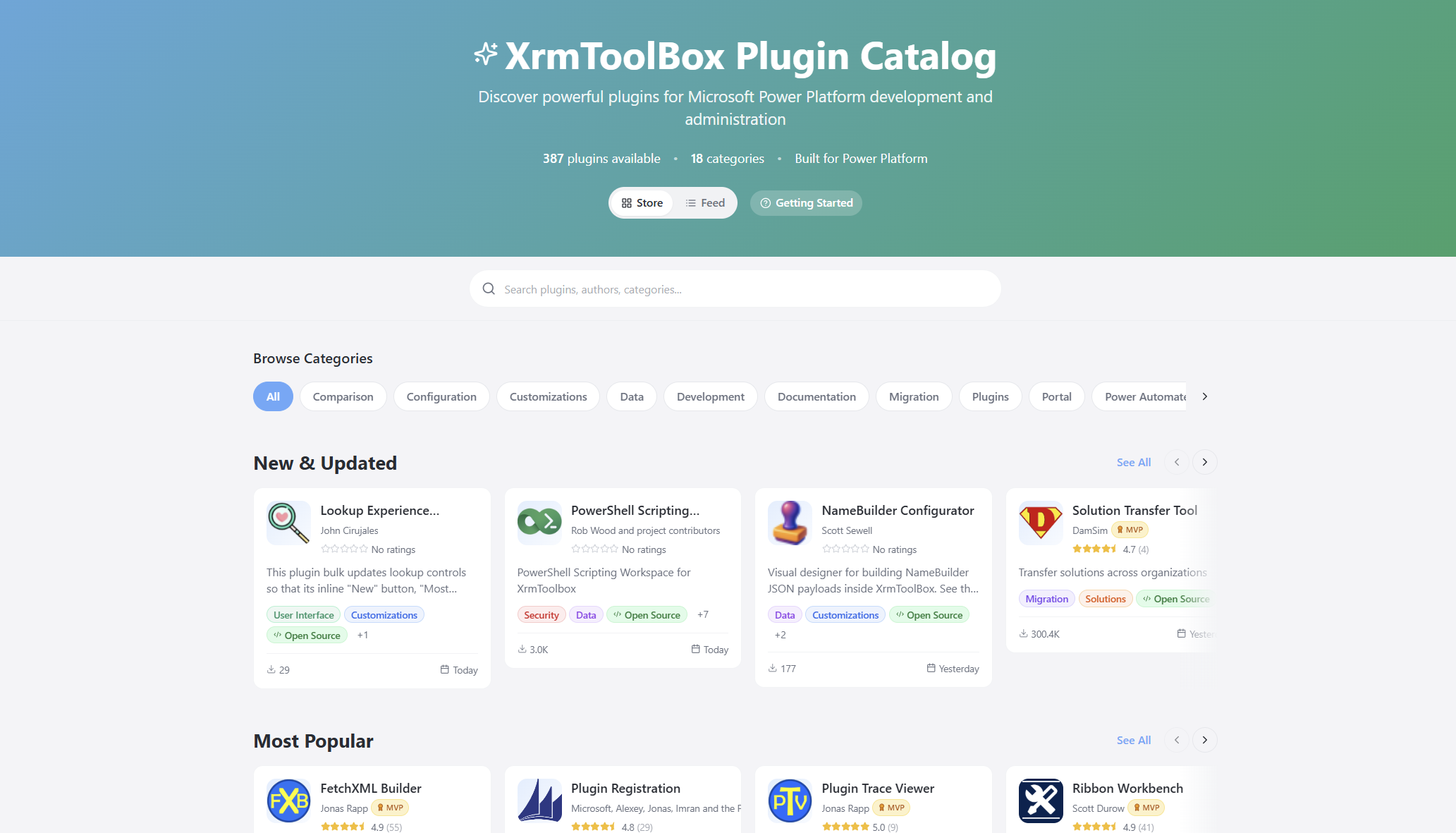
I wanted to see if I could do something about this. That’s how the XrmToolBox Plugin Catalog came to be:
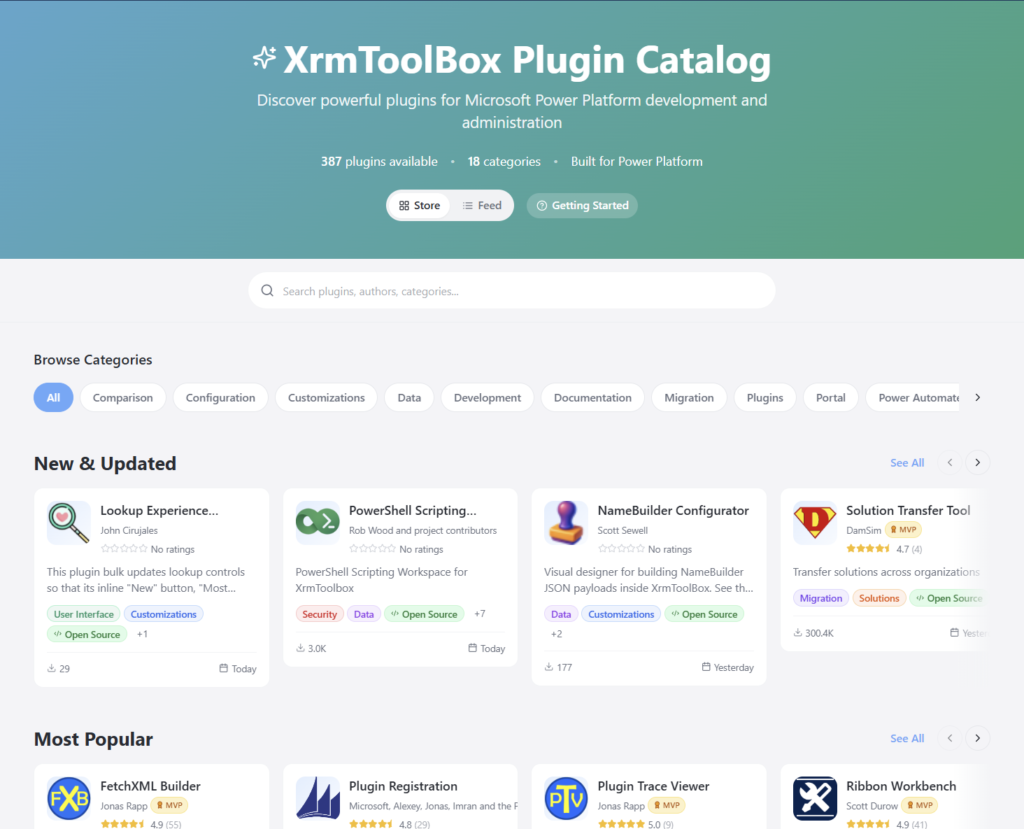
The live site URL is xrm.jukkan.com. In short, it’s a vibe-coded website on top of the list of 387+ XrmToolBox plugins that have been developed and published by various community members. You can browse by category, search by name/description/author, see the latest release notes, discover more plugins from the same author, and so on. There’s even a short getting started section for those who are new to XrmToolBox.
It’s worth noting that there’s no new data used here. All the dynamic information comes from the official Power Pages site of XrmToolBox, via one daily data sync of the Plugins table rows in Dataverse. The XrmToolBox Plugin Catalog is hosted on GitHub pages and the data is pulled via an OData feed using GitHub Actions. So, both are running on acquired Microsoft technology (Power Pages comes from Adxstudio Portals, GitHub comes from… GitHub).
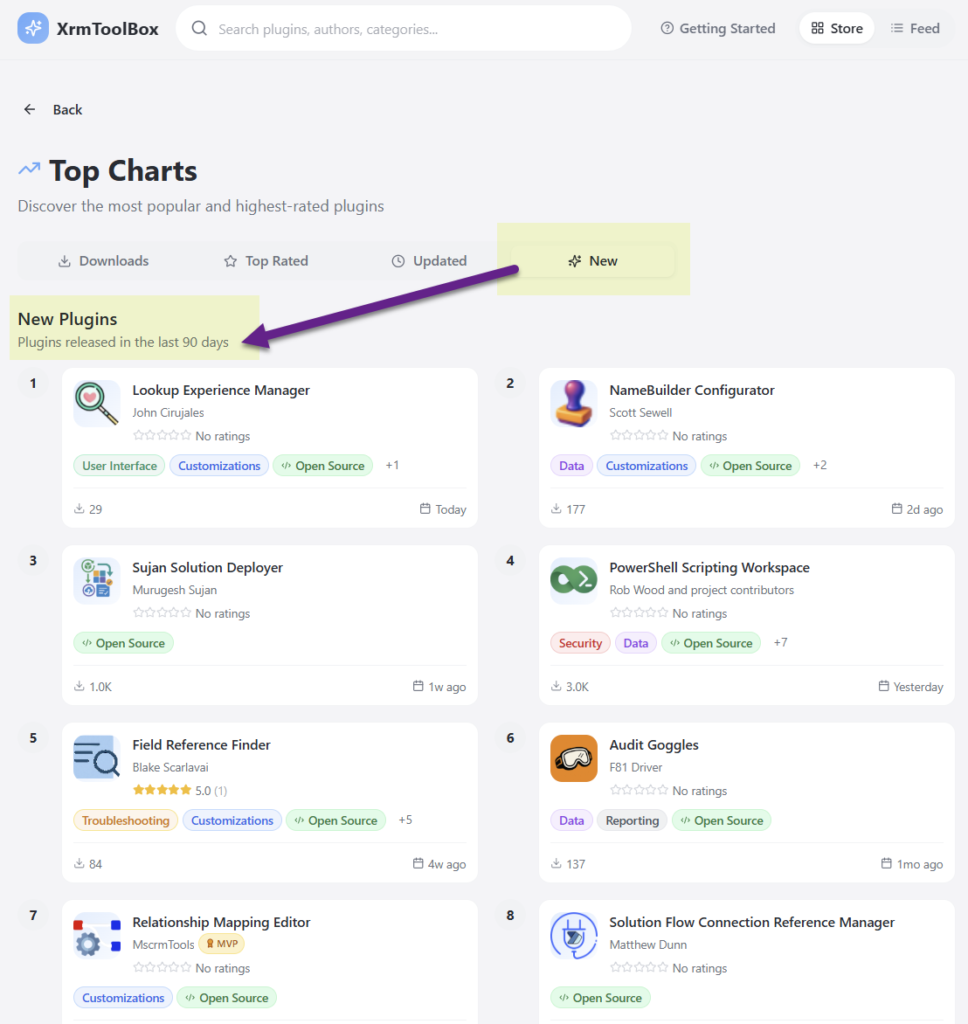
It’s just the same data, presented in a different way. Visually, it’s a React-based site that behaves like you’d expect a website to behave today. But it’s not just about rounded corner boxes and gradients. It’s also about prioritizing content in a way that serves the user better. Such as the Top Charts that allow anyone to check the recently added or updated XrmToolBox plugins from the past 90 days:
I wrote about the launch of XrmToolBox Plugin Catalog in a recent newsletter issue. I didn’t want to repeat myself, yet I was interested in seeing an alternative format for describing the “what”, “how” and “why” of this initaitive. So, I gave the text to Google NotebookLM and asked it to create a presentation out of it. I think it did a pretty nice job:
The site’s repo is on GitHub, obviously. You’re welcome to open an issue there if you encounter problems with the site or have ideas about improvements!
Oh, and don’t forget to support Tanguy Touzard and the makers of all the tools in the ‘Box. The Real Developers who have put in the hard work of writing all the code. Long before LLMs democratized code to such a level where I can today just prompt AI coding assistants and ask them to build pretty websites for me.
Blogging has had a massive impact on my career and personal life in the past 16 years. The act of other community members out there sharing their insights via blog posts is what initially got me so excited about the Microsoft business apps ecosystem to begin with, at around ~2005. My own investments of time and effort into blogging have been totally worth it.
And yet here we are, in 2024 and I decided to launch a newsletter instead. Called “Perspectives on Power Platform”, it’s available on the perspectives.plus domain. Published and managed via beehiiv. This is all aligned with me switching over from being a co-founder into being a solopreneur instead just a few months ago.
I feel I need to explain myself a bit here on this “legacy” blog – considering a few people have also asked me directly about it. “Why a newsletter?” I’ll provide my reasons and thought process here, with the intention of possibly sparking also comments from fellow bloggers and blog readers on this shift I see around me.
Is blogging dead? No, but following is.
The web is certainly no longer the same as back in 2005 – yet few things in the world are. First the rise of social media came along and pretty much killed the traditional way of following blogs via RSS feeds and Google Reader (RIP). It doesn’t matter that RSS as a protocol is still perfectly valid today. Most people who might be interested in what I or the rest of the #MSBizApps community write about will not be using RSS. I have personally pretty much given up on following the hundreds of RSS feeds that I had subscribed to in my Feedly account.
At first, the co-existence of blogs and social media platforms like Twitter seemed to work quite well. Sharing links to great blog posts was an amplification method that helped form communities. Then, the laws of market economics drove every major social media company to build a walled garden instead of a “meta protocol” for such social interactions between community members. They wanted to hold onto the audience instead, which lead to algorithmic feeds punishing people for posting things that had a link pointing outside the garden. As a result, fewer people left the garden and the content inside became richer as users tried to cram more text, images, video into the native social channel instead. “Engagement” became the key metric that determines what we see – not who we chose to follow or subscribe to. We lost control.
This affected all content, not just blogs. Musicians, writers, artists – all creators everywhere lost the direct way for them to build an audience of followers. To understand the broad impact that the rise of the social media algorithm had, I recommend you to put this video on your watchlist: “Death of the Follower & the Future of Creativity on the Web” by Patreon CEO Jack Conte at SXSW 2024.
Today, in the era of TikTok, the concept of subscriptions or following creators has been completely abandoned. Ultra-algorithmic “For You” streams do not rely on your personal network. On today’s social media services like Threads (the “Twitter, from Meta”) it’s tough to get anyone to follow you. Engagement on your post does not translate into an audience of followers. You don’t connect with creators – you consume trending content. There’s hardly anything “social” about such content networks anymore.
Blogging didn’t die as much as social networks did. User generated content is being circulated around at an ever-faster pace – yet it’s selected by a machine rather than the users explicitly. Audiences are not something we own, rather it’s something we can purchase time & time again from the walled gardens that host the user generated content we give to them for free.
Are you writing blog posts or AI training data?
After the social media algorithms came the LLM wave. How is this generative AI era different from the social media era? In terms of how they treat content, the difference is subtle yet massive:
Social media: process all the content users posted on our platform and extract maximum value out of it.
Generative AI: process all the content available on the public web and extract maximum value out of it.
Pause for a moment to reflect on that. First, they built a walled garden – then they came for everything outside those walls. What Meta did in Facebook/Instagram is now being done by OpenAI, Google, Meta (again) etc. on the entire world wide web. It’s ultimately just about turning up the volume of data, by crunching everything humans have ever created and compressing that into a Large Language Model. Throw in piles & piles of Nvidia GPUs and massive amounts of energy burned in data centers, and then – suddenly a new species of intelligent chatbots emerged from this cauldron of the geeks. Generating something new from the ingredients mixed in during the cooking process.
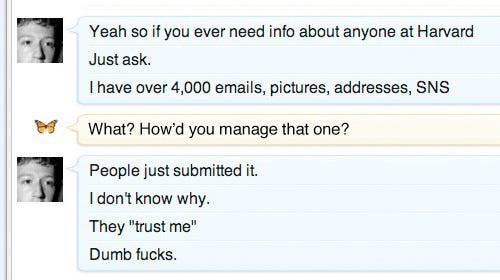
Human thoughts are the critical ingredient. Without the users, all that big tech corporations have is software and hardware. They don’t have data unless someone gives it to them. Google as a search engine wouldn’t have been able to produce any value to anyone unless it was able to index the data shared by humans on the public web. Mark Zuckerberg wouldn’t have been able to get anyone signed up or Facebook unless people at Harvard hadn’t “just submitted the data to him, like dumb f***s”.
Data both inside the walled gardens as well as outside of it has been analyzed before for commercial purposes. When Google did it for their search engine, it (originally) was about helping users find the original source of that content. Leading to website visitors, who could in turn potentially become subscribers. You gained attribution and the opportunity to connect with other people via building an audience. A deal that was hard to refuse.
How does this deal work in the age of ChatGPT, Copilot and the other AI services? It doesn’t. The social contract of “you index my content and I get exposure in return” becomes irrelevant when the machine no longer provides merely a link to a website as the answer to a user query. Instead, the LLMs become so smart that they offer personalized answers in the exact format requested by the user – thus negating any reason to visit the original websites. After all, why read through an SEO optimized “how to do X in Power Apps” article when ChatGPT or Copilot can adjust the information to any scenario and help you with follow-up questions, error messages and so on?
The irony here is that the “how to do X” and “5 tips for optimizing Y” type of blog posts have been by far the most effective format to gain website visitors in the past. I haven’t usually seen them as very ejoyable to write, so I’ve instead spent my keystrokes on broader articles of analyzing “what does X mean” and “the future of Y” type of speculations. Such articles have only mattered for a brief period and have been mainly seen by loyal subscribers/followers. The long tail of traffic from Google has always been to the “how to” posts, by a massive margin. Now, thanks to AI – neither type of blog post will receive much traffic in the future, for pretty much any bloggers out there.
Could the creators of content opt out from becoming AI training data? In theory, yes, and in practice, no. We’ve already seen companies like Perplexity AI spoof their user agent info and ignore any blocking done via the robots.txt file. Corporations also do it between each other. Amazon has instructed its employees to create personal user accounts and hand them over to the corporate AI group to get around GitHub API call limits. Besides, if we ever reach consensus on a method to deny the use of specific web content in training AI models, all of the old stuff out there today would still remain as part of what makes up the intelligence of ChatGPT and the likes.
It’s best to assume that anything an anonymous website visitor can read, AI corporations will also use to advance their own purposes. You, the writer, will most often get absolutely nothing from it.
Email as the old/new platform
This brings us to the title of this post. While some pre-social and pre-AI internet technologies like RSS have faded into the background, email has remained undefeated. No matter how many alternative messaging and collaboration platforms have come & gone, nothing has managed to disrupt email in a meaningful way. Although kids today may not be paying much attention to email, the further along they go on their professional career, the more futile it is to resist the power of this universal messaging protocol and (unfortunately) identity system that has been around since 1971.
The renaissance of email newsletters that has been fueled by services like Substack, Ghost etc. is a great example of how the old thing can feel new again after a break. Most importantly, these tools have been designed to first help the content creators build up an audience, and only then gain financial success from taking a cut off the paid content served to those audiences. Or from subscription fees paid by the creator, as is the case with my beehiiv account today. Unlike with social media, the platform for email newsletter delivery is not actively trying to stop the creators and readers from having a direct relationship with each other.
Email capture is a ubiquitous gate along the many journeys we all experience while online. You do it when registering for both social and AI services, too. Businesses often use it as an excuse for getting the chance to know who is interested in their content enough to fill in a form, so that they can talk directly to them. Now, with the rise of the all-scraping AI overlords, there’s a whole new reason for even individual content creators and community members to seriously consider asking readers to sign in. Unless content is locked away behind a real gate that can’t just be opened via the search bots lying about who they are, the content will get consumed by AI.
Right now, all my Perspectives on Power Platform newsletter issues are publicly available for anyone to consume. However, I have the possibility now to change that if needed. Perhaps in the future the full articles will require a subscriber account – just to keep the AI bots away. While for the casual web surfers this of course is an extra hassle, luckily they can do a one-off registration on the site and then receive all future issues of the newsletter delivered into their mailbox.
It’s nothing new for some of you. There are hundreds of people who are subscribing to this current blog via email notifications (powered by Jetpack) and I’m very thankful for this audience! At the same time, I want to apologize for the recent blast of lorem ipsum dummy content that got sent to you while I was deploying a new theme for my blog.😳 Just goes to show that WordPress isn’t exactly the ideal platform if you intend to publish content primarily in an email newsletter format…
If you are interested in receiving my future writings into your inboxes, I strongly recommend you to sign up for the newsletter. This blog right here at jukkaniiranen.com will remain as a place for me to share thoughts around topics outside of the Microsoft ecosystem. The regular content on what’s happening with Microsoft Power Platform and what’s my take on it will be on the Perspectives newsletter and site exclusively from now on.
Why “perspectives.plus”?
As I mentioned in the beginning, I am today working for myself. For the first time ever, I really don’t need to think about “how will this activity generate work for someone else in my team”. I am the business. I’m free to explore ways in which the things I know and what I’m good at can deliver value to someone else out there – and how to make a decent living out of it.
With my 11-year journey in the Microsoft MVP award program coming to an end, there is no longer any conflict of interests between community contributions and possible commercial agreements with parties in this expanding Power Platform ecosystem. This does not mean that I intend to sell out my own integrity and start promoting products from anyone who inserts a credit card. The way I see it, the key reason I have any audience in this space to begin with is because I always tell it like it is. I spend quite a bit of time exploring and thinking about the world I see around me, then I form my own perspectives on things and say it aloud. Telling both sides of the story, in ways that might feel controversial. Love it or hate it, that’s what I am about.
This is not all just about me. My motivation comes from advancing a worthy cause and helping those people out there who are doing the right thing, yet not always getting the recognition that they would deserve. This is where I’m looking to form partnerships with companies that have a solid offering for the Microsoft Power Platform customer base, and who understand what it takes to establish trust within this community.
The “Plus” in perspectives.plus is not just a random top-level domain I picked. It represents the possibility of there one day being something more than just a free email newsletter available there. One of the possibilities introduced by platforms like beehiiv is the option for premium subscription tiers. Who knows, perhaps some of the things I will build and write would be worth putting behind a small fee to be paid? It’s not something I am actively pursuing at this moment, yet I like to keep my options open.
In the end, it all comes down to perception. Of the million ways that we can create, exchange, and consume information in the computer world, technical implementation is rarely the factor that defines the outcome. It’s about how we frame information and express our intention, through subtle signals that us humans have evolved to pay special attention to. Machines just see data, be it published on a blog or a newsletter. We, on the other hand, can define – and redefine, the meaning of such data via crafting the storyline around it. If we want to achieve something new, I believe we first need to imagine a new story and then share it with the people around us.
I’ve been silent on this blog recently. At least compared to my historical pace of publishing posts.
One explanation is that I’ve started writing my Perspectives on Power Platform newsletter. If you’ve been follwing my blog for the technology topics around MS BizApps, I recommend you to check out perspectives.plus and subscribe to receive the newsletter issues via email. (Why use a newsletter instead of a blog? That’s a subject for a future post to come.)
Silencing your employees
There are other types of silence. The one that got me reflecting on these thoughts is what has been written about the NDAs at OpenAI. In short, the organization has imposed very strict contractual terms on departing employees. The exceptional issue appears to be OpenAI claiming the right to claw back vested equity. This right would be triggered if the ex-employee would criticize their former employer – ever. With no end date.
Reading about these reported policies has caused me actual physical discomfort. There is just something about the pre-emptive silencing of the people who work at an organization that rubs me the wrong way, in a big way. Can there be a more obvious way to state “we won’t really ever trust you”than imposing something like this?
In this case, the executives have of course played the get-out-of-jail card of unawareness. From the Xeet of Sam Altman:
there was a provision about potential equity cancellation in our previous exit docs; although we never clawed anything back, it should never have been something we had in any documents or communication. this is on me and one of the few times i’ve been genuinely embarrassed running openai; i did not know this was happening and i should have.
Sam Altman, CEO of OpenAI
Many will surely believe the explanation. That it has simply been some lawyers out there who’ve been zealously protecting and pursuing the client’s legitimate interests, within the bounds of the law. The corporate way: we’re doing all this just because it’s the way corporations work.
Weapons of mass distrust
The fact that OpenAI has never clawed back money from ex-employees is completely irrelevant. The impact of such contract clauses takes place regardless. The whole purpose of nondisclosure agreements is to stop something from happening. They are the corporation’s nuclear missiles.
While there are perfectly legitimate scenarios in various business relationships where NDAs enable confidential discussions to take place (everywhere in consulting, for example), this one is very different. When you have a policy that forbids criticizing the company for the duration of the former employee’s lifetime (and also forbids them from acknowledging the existence of the NDA), this is not about establishing trust. It is a weapon against another party that you by default do not trust. Period.
This model establishes a system of silence. Both before and after an employee leaves the organization. This is because it’s important to understand how the concept of criticism is defined. It is not something that the employee (subject) can evaluate. It is unilaterally defined by the corporation (object).
From this situation arises the imbalance of power that can impact organizations in everything they do. If your employees must be continuously evaluating in their heads the question “could someone interpret what I’ve said as criticism”, they will only say out loud a small subset of what they really think. Self-censorship is a destructive pattern that can repress any initiatives for building trust among teams.
As the information worker organizations increasingly become independent from physical locations, our communications start to become mostly digital. No matter if its emails, chat messages, online meetings – our modern multimodal AI algorithms will convert everything into text. Potentially storing it forever. Making it available for queries, in a whole different context than where the communication initially took place.
In such an environment, where do you create room for the informal, uncensored discussions to take place? This is a very hard problem to solve in practice. That’s because the root cause isn’t the traceability of digital communications. The need for creating a separate space where people can express their thoughts and feelings is the problem. Such separation should not be needed to begin with.
Choosing transparency
Ever since the Web 2.0 era tools and techniques became available, I’ve been a vocal proponent of working out loud. The idea that you should be proactively making your work visible to the networks through which value can eventually be created. Not just reactively providing specific information when requested. Making everything you type as broadly visible as possible in the given context.
Blogging is a communication pattern that optimizes for the amount of awareness and influence that each keystroke can possibly yield. Some topics, of course, are necessarily private and interpersonal. But a surprising amount of business communication is potentially broader in scope. If your choice is to invest keystrokes in an email to three people, or in a blog entry that could be read by those same three people plus more — maybe many more — why not choose the latter? Why not make each keystroke work as hard as it can?
Jon Udell: “Too busy to blog? Count your keystrokes.”
For someone like me who believes in the transformative power of radical transparency, any organizational barriers that encourage silence are a problem. Most of them are softer barriers, such as the general convention of how people around you behave. Others are technical barriers that results from the design of our information systems – be it intentional restrictions or unintended practical limitations. Finally, there are the contractual weapons mentioned earlier.
I don’t believe there is a way to separate external transparency and internal transparency when it comes to company culture. By external I’m referring to communication that takes place out there in open communities and networks that connect professionals from several different organizations. The internal part is about all communication that takes place within the (fire)walls of an organization – voluntarily, without an explicit process to require such activities to take place.
If internal transparency is not something that is organically allowed and encouraged to grow in the organization, you’ll likely have to try and force the external transparency. Meaning, it’s hard to get your experts to actively participate in community activities and share their knowledge with the outside world if it’s not a pattern that exists internally in the corporation. There will always be exceptional individuals, but it will not become a part of your culture. Thus you cannot leverage the network effects but rather have to pay to get people to notice your company.
The excuses for silence
Transparency can be a virtuous cycle for the business. Silence is often a vicious cycle. Why isn’t every organization then gravitating towards a more open and trusted culture of communication? Boy, that’s a big question that requires some serious investigation. Or maybe just throwing a quick question at ChatGPT – which provides the following reasons:
Fear of negative exposure
Control and power dynamics
Short-term focus
Lack of trust in employees
Cultural and structural barriers
Legal and regulatory concerns
Inertia and status quo
Risk aversion
Going through the list and the more detailed explanations under each item (try it with your AI tool of choice), it’s easy to see why choosing transparency isn’t by any means easy for organizations. Individuals exist also in the leadership team, thus the choices made in managing a company aren’t made simply based on cold, hard logic. We all need to feel psychologically safe at work, among our colleagues as well as with our managers/subordinates. If we’re emotionally or physically drained, that sense of safety is really difficult to reach. And so the cycle begins.
Transparency rarely just happens, yet silence is easy to achieve. Like in the example from OpenAI. The fact that the word “open” is included in the company name has been the source of ridicule for many reasons (closed source models, lack of respect for copyrights). Even though they’ve got the technical and financial resources in place to achieve top results in the global AI race (largely thanks to Microsoft), the company’s culture of silence can turn out to be a significant handicap in the long run. It’s certainly not a place for everyone to feel safe at.
How you treat the employees who are moving on is a signal of whether you consider them to be a potential future asset or a liability. As the detailed report from Vox.com reveals, there’s not question what side OpenAI’s culture falls on:
“We want to make sure you understand that if you don’t sign, it could impact your equity. That’s true for everyone, and we’re just doing things by the book.”
Email from OpenAI to an employee asking for more time to review the employment termination agreement.
“Just doing things by the book.” Just assuming that whatever the employees do in their professional lives from here on could not possibly be of value to the organization. As opposed to the clear and present risk of them talking with others and expressing their own thoughts. Talk about short-term focus in a networked world.
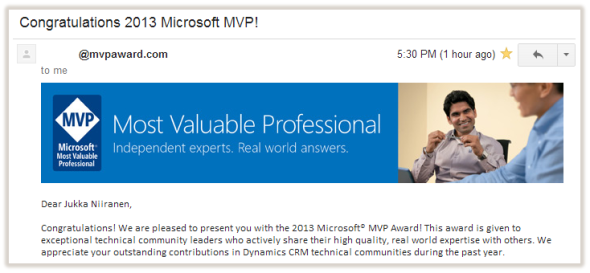
Way back in July 2013, I received the email that informed me I had been presented with the Microsoft MVP award:
Almost exactly 10 years later, in July 2023, I received that annual email from Microsoft for the eleventh time. It was once again a special moment. To be honest, every year that MVP award renewal day has been a special day filled with excitement.
Yet this time it was a bit different. I knew this would be the last time I will get the renewal email. Because I had made the decision at the start of this year that my journey in the MVP program is coming to an end.
First of all: no, I’m not joining Microsoft as an employee. For those who keep track, that has been the most obvious explanation over the years for voluntary exits from the program – with MVPs trading their blue sticker for a blue badge to become FTEs.
What’s my reason then? Well, the extremely short version of it is: today I am getting less from it all than what it is giving me in return. It no longer makes sense for me to try and be a Microsoft Most Valuable Professional.
There is obviously a lot more to it. I’ll talk a bit about it in this post and possibly return back to the specific topics at a later date. Also: since the awards are for an annual period, I want to remind you all that my current MVP award is still valid until the end of June 2024. By giving an early notice, I believe things will work out the best.
Unlimited opportunities
I want to start by stating this: being a Microsoft MVP has been an amazing ride. Beyond what I could have imagined. I have zero regrets for signing up to it a decade ago. It was at that time a very logical progression of what I was doing as a member of the community. Checking back on my own blog post about receiving the first MVP award, I still believe in the same things I believed at that time:
The virtuous cycle of communities is truly a powerful force. In exchange for receiving help from complete strangers with no expectation of monetary remuneration, you start to feel compelled to give back to them in one form or another, to pay it forward. Once you do, you begin to notice that there are others who in turn are benefiting from your actions, which makes the cycle just start to spin faster & faster.
Jukka Niiranen, fist day as Microsoft MVP, 2013
Getting a formal network established not just with the Microsoft product team but also (and most importantly) the fellow MVPs who are deeply passionate about the same technology as you are – that really is quite something. It introduces you to this secret world filled with detailed knowledge about every possible corner of the technology you specialize in.
You gain a wealth of new perspective on things by being part of such a network. It’s not only about learning something new – it’s also about validating that others feel the same way you do. That no matter how big the projects and budgets may be somewhere out there, people still suffer from similar issues as you do. Your reality is also the reality of many others out there. And most importantly: what you’ve personally learned about a specific corner of the product can be of considerable value to everyone else in this ecosystem.
While the MVPs tend to be highly knowledgeable in their own domains, we must remember that the MVP award is not given out based on how much you know. It is awarded to those persons who are most active in sharing with others what they know. There’s no value to the community in what you yourself learn unless you’re willing and motivated to help others learn it as well – and without any direct financial compensation.
This model doesn’t always work well with the traditional mindset of consulting organizations where information itself is seen as the source of value – something you need to charge money for. For me, as a person with deep beliefs in the idea of working out loud and how that benefits both organizations an society as a whole, there was never a conflict here. I didn’t start blogging and tweeting because I wanted to achieve some award status. I did it because there was intrinsic value in it for me. It was (and still is) the most natural way for me as a professional to achieve great results at work. The rest is just a nice bonus.
Becoming a member of the club with the blue MVP logos on their blogs made it more straightforward to explain what I am & what I do. It accelerated the growth of network connections within the MS BizApps ecosystem. I hardly ever actively leveraged it myself, instead I relied on the “inbound marketing” approach of waiting for people to reach out to me. There were more than enough opportunities coming in that way for community engagements in different formats. I no longer needed to maintain my CV for work gigs either.
The limits to growth
Passion is something to cherish, but how do you separate it from addiction? When there is an endless source of interesting topics to explore in your professional field AND you also have amazing networks at your disposal for getting deep insights about them all – passion can become dangerous to your mental health. Especially when the boundaries are blurred in a way that makes it impossible for you to see where they used to be drawn. You may gradually forget how the world looks like outside this bubble.
I’m sure many of the readers of my blog experience the difficulty of separating work time and personal time. If you are consuming tech blog content like this instead of just googling for answers to specific problems (or today using ChatGPT / Copilot to get the solution), chances are you’re invested in solving problems with technology far beyond what your current day job would require. You go the extra mile – again and again.
We should of course be grateful about our situation. I honestly cannot imagine what life would be like if I had to work in a 9-5 job doing tasks that I stop caring about once the working day ends. It is a privilege that not too many people on this planet have. Even if it would so happen that AI comes for our jobs first and takes over the cognitive work that evolution had far too little time to prepare our brains for, I’m truly happy that this opportunity existed in my lifetime.
The real danger isn’t AI, though. It is us. With nothing physical in the world setting the boundaries for how and where we can engage in this work related cognitive activity, our reptilian brain may end up on the driver’s seat far too often. External stimuli from the pervasive, growing and ever present information networks we’ve surround ourselves with to find the answers to our day-to-day questions can end up teaching us to always crave for more interactions. We get hooked on the process itself, instead of applying these tools to achieve desirable outcomes.
The Microsoft MVP award can certainly be one outcome that many aspire to achieve based on the investments they’ve made to the community work. Yet the dangerous part is in how that is achieved. Because it is all about quantifying the impact of your community contributions. What does that mean in practice? In short, you need to keep track of all the various activities that you as an individual perform in the chosen area of expertise and then provide as much measurements about them as technically possible. Posts, videos, books, speaking, mentoring, facilitating, arranging, participating, amplifying… It all becomes a number in a system that tracks your performance.
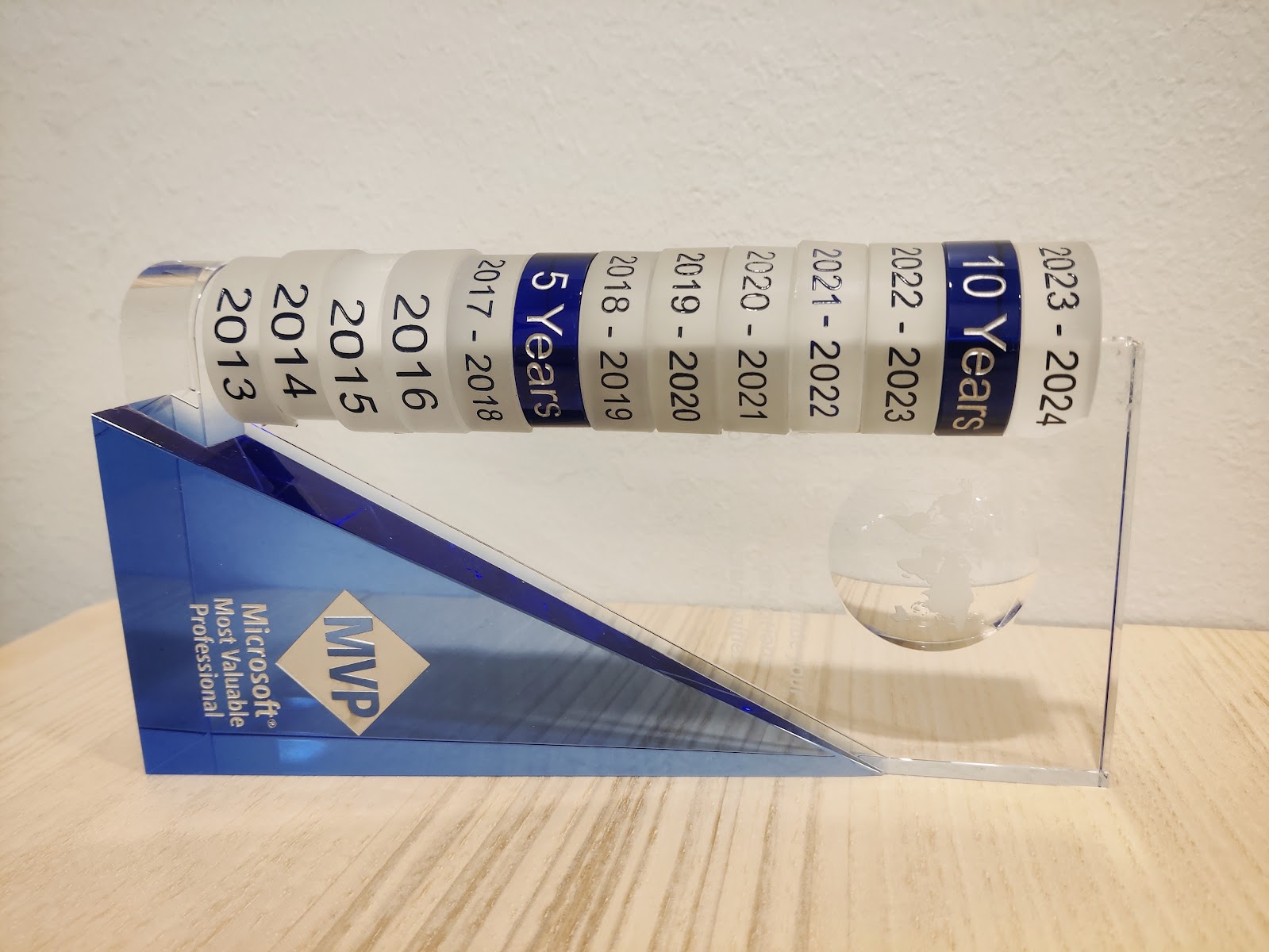
If that sounds a lot like typical work KPIs – you’re spot on. Except it’s a measurement performed by someone who doesn’t give you any money in return. All you get is the aforementioned email from Microsoft once a year that lets you know whether you passed the bar or not. Plus a glass disc to insert into your award trophy. And that’s all the tangible things you get. Period. (You used to get physical stickers and diplomas, too, but starting from 2023 those have been cut away from the MVP program. As for swag, it never was a formal thing. So, the ecological footprint of the award has largely been about travel.)
It’s all voluntary, of course. Since no financial transactions ever take place between the MVP & Microsoft, technically it’s all fun and games. Every year in July the award renewal email either comes or it doesn’t. You can never be sure about whether you’ve performed enough activities to be kept in the program for another year. That’s because it’s a very asymmetric relationship. Microsoft will ask all the details from you about what you’ve done, yet they won’t ever disclose how much you should have done in their eyes.
I don’t want to complain about the system too much, though. I can totally understand why it is built this way, with no predefined criteria to meet. It is completely different from taking a certification exam, for example. For reasons that are beyond the scope of this post, there is a finite number of MVPs that can be awarded in a given year. Furthermore, there are as many different individual ways to contribute to the community as there are MVPs out there. There could never be a publicly visible “passing score” for something like this.
That’s the system, but what’s the impact to our lives as Microsoft MVPs then? In practice, we start to live under a self imposed surveillance system. Like it or not, the awareness of a scoring process that will evaluate your performance in the community on an annual basis will change what you think and do. Community contributions become a virtual currency in the style of NFTs, in the sense that they only really have monetary value to yourself.
The positive side is that for people who crave for speaking engagements, podcast invitations and all the other activities – there will be more than enough opportunities for those. You can contribute practically in unlimited ways in today’s combination of physical and virtual worlds. Yet the one pressing question remains: if there could always be more, how do we ever know what is enough?
During the past 3-4 years, I have personally reached my limits to growth. I am intentionally referring to the title of the 1972 study of what happens with exponential economic and population growth with finite supply of resources available to us on planet Earth. It’s all about that one flaw in the thinking that we the people tend to fall for. We ignore the long-term consequences of our actions and focus only on the short-term benefits – and set our targets accordingly. We think “more is better” and thus keep striving for more, even after the net impact from all of it turns negative.
Then finally, we’re forced to deal with the consequences of our own actions. We have to choose, not just strive for more.
Choose life
For a few years now I’ve had the constant feeling that something in my life is not quite right. As if I was an outsider observing myself going through a path that has been laid out in front of me. While there have been several moments of joy along that path, increasingly I’ve found myself not truly looking forward to anything. All I do is aiming to get through the day, so that another day filled with the same exact feeling may begin.
In many ways, I have it all. Yet I’ve never felt as empty inside as right now. As I’ve come to understand my own reality better through reflecting on what exactly it is that I do here in this job position called “life”, the problem has become obvious. My responsibilities in here fall under these areas, in no particular order:
Co-founder and Power Platform Advisor
Father and husband
Microsoft MVP and community activist
Between those three main roles that have filled my life, there has been precious little room for anything else. These have been the modes in which I have operated 24/7/365. Unless something out of the ordinary happens. Yet when planning for things that I could be doing when nothing has yet been booked, the obvious list of To Do’s that comes to my mind is always from one of the three.
The fundamental issue is: I can’t find myself in there. At which point do I begin to exist? Not as someone who is acting in a predefined role, together with other actors, to do something expected from that role. Rather as just a human being on this planet. Just me.
For a long time I have not been able to find a satisfactory answer to that question. It has literally turned into an existential threat for myself. I have suffered from recurring waves of paralyzing exhaustion that has severely impacted both my personal and professional lives. Not only have I become tired – tiredness has become a part of me.
Through writing down my own thoughts in a personal journal throughout the past 4 years, I’ve been able to reflect on the many conflicts I’ve encountered via the changes in my life. How becoming a parent has flipped the meaning of “home” on its head (from a private safe space to a nest for your family members). How being an entrepreneur still doesn’t help in assigning measurable monetary value on time spent in community activities as opposed to customer work. Forces that have been ripping me in opposite directions, spreading it all too thin. Some of these conflicts have been surprises, others I’ve totally been expecting to encounter.
Just because you can see it coming, doesn’t mean you can stop it. That applies to the deep exhaustion that has taken over me. At the time of writing this blog post, I have been on sick leave from work for several weeks, trying to regain the mental and physical strength to again perform as a normal human being out there in the world. I have probably been holding all this back for an extended period of time, not allowing myself to stop. It’s never a good time for something like this, yet I’m glad that it now became possible to take a break. Or more precisely: to break down.
It’s hard to change the state you are in merely by thinking differently. Knowing is not the same as doing. Therefore, it has been an enlightening experience to be able to temporarily alter my everyday routines during the sick leave. On quiet weekday mornings, instead of powering up the PC and starting the working day filled with processing & responding to the many data streams that form my professional reality – I’ve done nothing. Literally I’ve just stayed on the couch, read the newspaper, listened to music, enjoyed my coffee, browsed non-work forums, opened up a book – and not had anything else on the agenda for many hours. “Doing nothing” has been an option in life that I’ve forgotten the existence of – when it comes to myself.
Often one makes room in his life to get something done. With the aforementioned unlimited opportunities of an MVP, all the empty spaces can easily become filled with the hazardous fluids of productivity. Earlier when I have been resting, it has typically been for the purpose of recharging my battery, so that I carry on. The major difference in what I’ve now been able to experience is: there is no “so that” part. Resting because you are tired and allowing yourself to be just that, in this very moment, seems to be what it actually takes to achieve calm.
Living in a constant state of alertness has done quite a bit of damage to myself, with no ability to properly calm down and free myself from stress on a regular basis. There is no one specific cause for this, nor is it exclusive to one area of my life. It’s the result from the entirety of it all. I don’t know when or if I will recover from it. What I do know is that this same quotation applies to my situation now, just like 4 years ago when I used it to announce my farewell to CRM:
If you want something new, you have to stop doing something old.
Peter Drucker
Life after MVP
In the end, the choice has been simple to make when put into the greater context. Of the three roles that cover the majority of my waking hours, the one that I can easily let go of is the demands of an organization that I don’t contractually work for. I don’t have any true need to meet the bar for community contributions required to be renewed as a Microsoft MVP. I can stop thinking about it and gradually free up the mental space occupied by this hugely rewarding yet highly demanding activity. It represents my past self that must now make way for my new self to emerge.
I do acknowledge that I’ve worn the MVP hat for quite some time and many of the readers of my blog will not have known any other Jukka. I remain grateful every day for the opportunity of sharing my thoughts with a community of likeminded professionals in the Power Platform ecosystem – and that someone actually pays attention to what I have to say, occasionally even replying back to me. I intend to cherish this and not disappear from this virtual space we all share. I just won’t think about chasing MVP contribution points, rather I’ll only do what feels natural for myself.
Will I suddenly become a “Formerly Valuable Professional” / “FVP” then? I’m pretty sure my technical skills and ability to help others won’t immediately evaporate as part of this announcement. After all, thousands of highly skilled community contributors before me have had their Microsoft MVP award not renewed, so it’s really just business as usual in this sport. Whatever it was that earned me the last 2023-2024 MVP disc on my award trophy was something I did between April 2022 and March 2023. In every league the season always starts from zero points for all the participants, with new faces entering the game as the senior players make way for them.
I’m convinced that in the end this will be better for me. It will also be better for the people I work with. It will absolutely be better for the people I live with. Somehow I also believe that this is going to eventually be a positive change for the many community members out there who read what I type into text boxes on the internet.
Some things will change. Possibly the content of this blog will also evolve a bit. Yet I’ve been blogging here for 15 years now and I have zero plans on stopping that. If anything, I want to reach a state where the act of expressing my thoughts becomes once again a source of energy for myself – rather than something I need to do to secure the blue sticker.
Which reminds me that I’ve got some scrubbing to do before next July – in both physical and virtual stickers…
Ask HN: Is having a personal blog/brand worth it for you?
This topic really caught my attention. I read through tens of answers on the thread and that got me reflecting on my own journey as a blogger.
I launched this blog as “Surviving CRM” back in 2008 and switched it to a more personal “Thinking Forward” blog in late 2019 (to say farewell to CRM and move towards the broader low-code theme with Microsoft Power Platform). These 14 years provide me some perspective on the topic of personal blogging and also building a personal brand along the way.
There were three subquestions in the Hacker News post that I’m going to try and provide my answers to.
Q1: Does the time spent writing feel worth it to you?
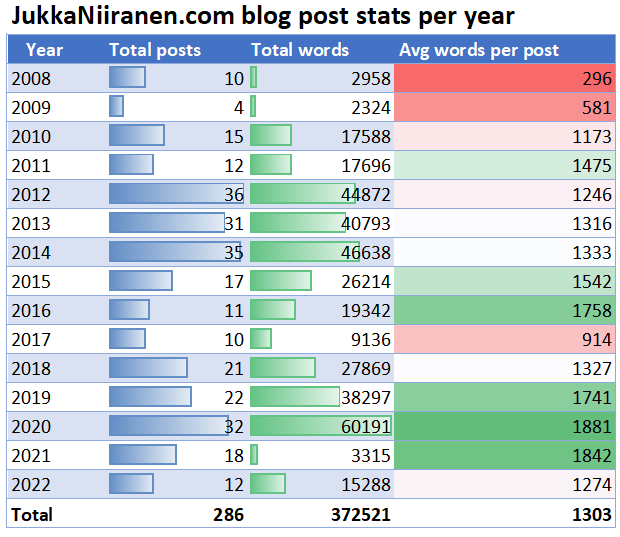
I can never know the true time I’ve spent on blogging. Not in total, and neither on average per post. They only thing I can really measure is the amount of posts & words within these posts that I’ve written over the years. Here are the annual stats from my blog, up until July 2022:
Looking at the total number of words I’ve posted in my blog and using 250 words per minute as the estimate for reading time: it would take you ~25 hours to read everything I’ve written in my blog.
How about writing those words then – how long might that have taken? I won’t go to deep on the scientifical part here and instead use the first figure that Google gives me for writing in-depth essays or articles: 5 words per minute. This would be roughly 100h per year in my case.
That’s only 2 hours per week. It goes nowhere near the time I’ve spent on doing the research required to come up with the final output for a blog post. Reading MS documentation/blogs and community content, testing the features in real live systems, connecting the dots in my head, having online discussions on the topics. The blog posts really are just a tip of the iceberg.
Let’s just say that I may have spent one working day for each week of the year, for the past 14 years, to do all the work required to produce the output that you see here in my blog. Essentially a 6 day working week, to come up with content that has been posted online, for free.
That may not immediately sound like such a great deal when illustrated this way, but let me tell you: that 6th day of the working week has always beenthe most rewarding one for me personally. Thinking about the total number of days, blogging with all the community work included comes pretty close to my longest employment relationship duration. I guess it’s obvious I wouldn’t have sticked around this long then if it wasn’t a whole lot of fun.
Right at this moment, when writing this “meta” blog post, I’m on my 4 week summer vacation (the Nordic way), at a summer cottage in the middle of nowhere. I’m looking over a peaceful lake view, with a glass of rye stout from Amager Bryghus next to my laptop. Even in situations like these I sometimes choose to write on my blog because it brings me more joy than it consumes time. It’s a hobby that has grown into an element of life that sort of defines who I am. Well, not everything of course, but an important slice of me.
Does blogging become faster the more you do it? Yes and no. Experience helps you in the areas that are repeatable, meaning the process around writing and publishing blog posts. Yet there’s no point in trying to minimize the time spent on the act of blogging itself.
Working as a consultant who bills customers by the hour, you can sometimes get too wrapped up in the concept of productivity. More bang for the buck / value for the customer = more outputs in less time, right? That is often not true – even in billable work. Even less so when you are doing things for your personal growth.
You see, when blogging for yourself (i.e. not because someone at marketing asked you to), it’s not a requirement to be very efficient in how you spend your time. I don’t have a budget for how many hours I can spend on this. Yes, the real world around me (family, friends, life) needs my time, too, but outside of my official working hours I don’t keep track of time. Things take as long as they need to take.
To me, writing is thinking. Your thinking is likely to improve if you spend a bit more time on it, rather than just taking relying on your gut reaction and assuming that’s all your brains could ever achieve.
There's another side to blogging that I personally enjoy more than the productivity of content creation: thinking through writing. Often times I wouldn't actually understand the world so clearly if I didn't stare at my drafts for a while. All are good reasons to blog, though!
— Jukka Niiranen mstdn.social/@jukkan (@jukkan) January 12, 2022
In the long run, blogging has probably saved me time in more ways that I could ever measure. Not just by teaching me skills that would have been difficult to acquire otherwise, but by creating something that helps me on a daily basis: my network. Which leads us to the next question:
Q2: Did it help you to get noticed/ find jobs or other opportunities?
After the first few years of blogging, I’ve never had to look for a job. The opportunities always came to me, without my initiative. You could compare this to the commercial activity of inbound marketing. The effort is spent in advance, building up the audience, which in turn then reduces the need for outbound activities. So, the active work is still done, only in a different order than traditionally.
None of what has happened to me in my professional life for the past decade would have ever become real if I didn’t start blogging. Through both writing my blog posts and amplifying the posts of other community members, I’ve succeeding in building an incredibly valuable professional network. Putting my words out there has been the single best career move I can think of.
On year 6 of my blogging career, I received my first Microsoft MVP award. 2022 marks my 10th year in the program. Gaining access to not just the MS product team behind Dynamics 365 & Power Platform but more importantly, the other MVPs who are as passionate about their craft as I am – that has been undoubtedly a turning point for me.
At the beginning of my blogging journey I wasn’t sure if this MVP role was a path I actually wanted to pursue, though. My top priority in personal blogging has always been to honestly write about both the good & the bad that I encounter in Microsoft’s product offering – so that others can learn from my real life experience. Fortunately, having an NDA with MS hasn’t resulted in me having to apply a filter on how I talk about things. Just the “what” when it comes to non-public info, of course.
While writing your posts and reflecting on the lessons you’ve learned is an major part of blogging, I consider an equally important side of it to be the active participation in your community. A major reason why I originally started my own blog was because I wanted to give back to the community who had helped me get started on my career.
Already back in 2005, the blogosphere around Microsoft CRM 3.0 was what really set this technology apart from many other CRM competitors at the time. A global community can truly be a force multiplier, allowing newcomers to challenge the more established players out in the market. I believe this very same phenomenon plays out in the area of citizen developers today, with the community helping each other to democratize technology and making previously impossible things possible to a whole new (and bigger) audience.
Blogging may not be as trendy today as it was 14 years ago when I started. With today’s social media channels having replaced the old Web 2.0 era tools like RSS readers in how content gets consumed, aspiring new writers may well ask themselves: “will my posts on an independent blog site get me noticed anymore, or should I just use a platform where I already have a network”?
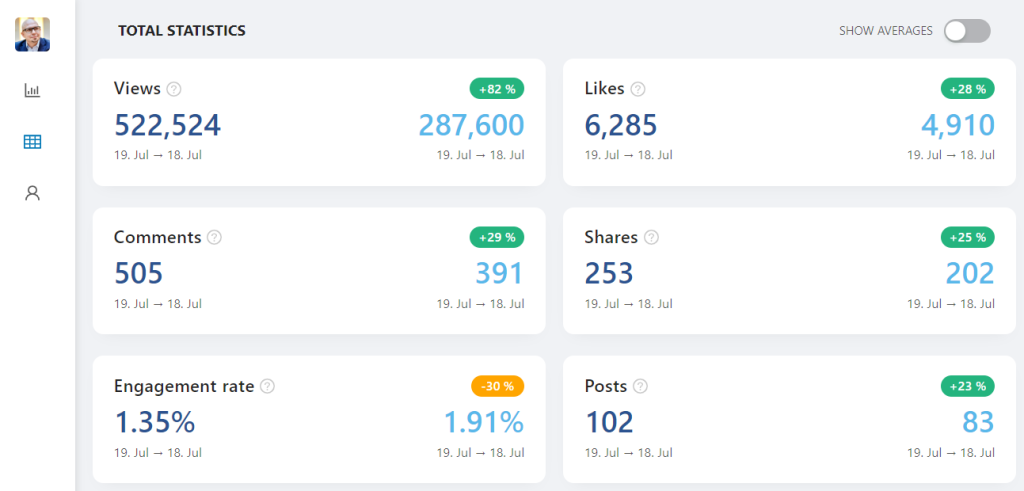
I recently checked what my personal LinkedIn stats looked like for the past 12 months (using Shield Analytics). By making 102 posts during the past 365 days, I’ve received over 500k views for them on LinkedIn. In my WordPress blog I’ve tracked only 130k views during the same time period. While my blog traffic hasn’t been growing for a few years anymore, the year-on-year figures from LinkedIn are mostly green:
The way I see it, a page view on a blog that you own & control is many times more valuable than what LinkedIn might track as a “view” of a single post that a user scrolls through in their endless stream. The impact is likely at least 10x higher when a visitor opens a web page dedicated to your writings and spends a minute or two on it.
Besides, a fair share of the LinkedIn posts I’ve made have been to share a summary of my blog post. This site right here is the “read more” destination where I actually get to talk with the audience who finds the topic interesting enough.
At the end, it’s not about the “likes”. Social media apps that gamify your clicks will always show you stats that are more compelling than a blog site like WordPress. Don’t get distracted by these. (I know I do, so I’m not saying it’s easy…)
“Couldn’t you post longer content as LinkedIn articles, though?” While it might be tempting for authors without an existing blog to start with the social media platform, I’d encourage you to ultimately own your words. Don’t become a slave to a network that primarily thinks about its own algorithms and business models for making money from your content. Exploit them wherever they serve you, but don’t become merely a servant to them.
Q3: Do you learn something new from it?
All the time. Even when the blog posts I write are just about documenting a discovery that I have made during a customer project, it helps me go far beyond what billable work would justify. Instead of just solving this one problem and jumping straight to the next one in the queue, I can spend a moment actually connecting the dots in my head.
Establishing links between the synapses in our brain is physically how learning happens. I find that the act of turning my thoughts into writing, arranging them on the screen and especially linking to related articles is the most effective way for me to learn. With this in mind, Q3 sounds a bit strange to me when rephrased: “do you learn something new from learning something new?”
You see, writing the blog post is not the end result of a carefully planned process (for me at least). Quite often the act of creating a draft post is when you really start to think. If you’ve ever heard about rubber duck debugging, then the idea is exactly the same. By explaining a problem to someone else, be it an inanimate object like a rubber duck or virtual object like a blog, you can often solve that problem without anyone providing you the answer.
Even the mere intent of “hey, I could write a blog about this” can start the mental process of organizing the details better in my head. Now, if blogging really would be such a magical formula to solve all problems, why not do it even more? Looking at my annual blog stats, why do I sometimes only write one post per month? It’s because all mental processes reserve cycles from your mental CPU (the brain).
Having a blog challenges you to put your thinking in writing. It’s not all fun and games, though, as you will inevitably get stressed at times about “I should be blogging about X, Y and Z, why can’t I ever get these things done”. The sad part is: you’ll never get over this feeling, no matter how much you do blogging.
Another fact of life is that you’ll continue to encounter other community members who write more posts, better posts, learn new things faster, get more readers, and so on. Spending years on writing blog posts on a specific domain topic doesn’t protect you from the impostor syndrome. A growth in the amount of exposure your writings get can even lead to scenarios that induce long term stress.
The dark side of community leadership recognition programs like the Microsoft MVP award is that they are founded on metrics of your impact. When I said earlier that personal blogging is an act where I don’t track the hours spent on it, in reality I still do need to log the outputs as community activities into Microsoft’s system. If you don’t do enough measurable activities to prove your impact to the community, you will no longer get awarded on July 1st next year.
Q: How much is enough? A: You won’t know, so nothing is ever enough.
During the past couple of years, I’ve felt very tired at times. Going through COVID, starting a company, getting a kid – many factors around me have contributed to the low mental energy reserves. I’m certainly not the only one with such experiences. I’ve heard from many people in my network that they’ve recently been asking themselves the question “is the MVP Award worth it?” So have I.
If the target would be to keep hold of the award, then maybe this type of blogging that I’m doing wouldn’t be the best choice. Lengthy articles that reflect on the state of the ecosystem, for example, aren’t exactly the type of material that will gain a lot of Google hits. Shouldn’t I rather be answering “how to” questions that some one is typing into the search bar? Why not just tell the audience “here’s how to do X with Y”, one feature after another?
Also, shouldn’t I rather reuse my content in more than one context, to gain more entries I could list as my community contributions for Microsoft to see? Instead of publishing a single blog post, couldn’t I format it as a presentation that I could then recycle in multiple virtual events that exist in the global Power Platform community?
Such a “shouldn’t I” list quickly becomes endless. It can turn your hobby into an energy drain rather than a source of energy. It is of utmost importance that you can be honest with yourself and identify why you should say no to things.
Should I do videos? No, I hate skimming through them for answers and would always read the text version instead.
Should I do more podcasts? No, I practically never listen to them since I love the sound of music, not the sound of someone talking.
Should I submit sessions to community events? No, I have no motivation for attending virtual events and my ability to travel to live ones is limited.
How does all this relate to the original “what do you learn from blogging” question? It’s all about learning who you are and what you love doing. Knowing what separates you as an individual from the different crowds that you interact with.
What this means is: I couldn’t ever give an answer on whether blogging is worth it to you. The reasons, the benefits and the price of blogging that I’ve talked about here are subjective and apply primarily to me. I would surely encourage you to give blogging a go if some of these experiences and thoughts resonate with you. At the same time, be sure to remain honest with yourself and stop writing on your blog if in the long run it takes more than it gives.
Where I’ve found blogging to be an invaluable tool is in finding your own voice. It’s not quite the same as keeping a personal diary would be, but if you’ve ever found putting your thoughts into writing as an exercise you enjoy, there might be something here for you to gain.
Who knows what your brain might say to you if you’d give it a brand new channel of communication. Such as a blog.
UPDATE 2023-01-03: After Twitter decided to shut down the Revue newsletter service, the Forward Forever newsletter was migrated to Ghost. The content remains available at the same forwardforever.news domain.
Back in Spring 2020 when we launched Forward Forever, one of our guiding principles was to openly share with the outside world the new knowledge we gain when working with Microsoft Power Platform tools on a daily basis.
Team FF has been quite active in community contributions, with content regularly shared both on our team blog as well as personal blogs like the ones written by Timo, Antti and myself. Sometimes when I’ve been looking at our social feeds, I’ve wondered “are people actually able to keep up with all these updates our team is sharing?”
Now there is a place that brings together these streams of new Power Apps, Power Automate and Power BI related information: The Forward Forever Newsletter. This monthly email newsletter is available for anyone to subscribe to at forwardforever.news:
To quote our team’s announcement of the newsletter:
That’s what the Forward Forever Monthly newsletter is all about. A summary of both our own writings as well as the best bits from the Power Platform community. No ads, no hard sales push. Just the most relevant content that our passionate team of Power Apps, Power Automate and Power BI experts has discovered.
Our newsletter runs on the Revue engine (recently acquired by Twitter). You might already be familiar with it, since there are at least a couple well-known weekly Power Platform related publications on that newsletter platform:
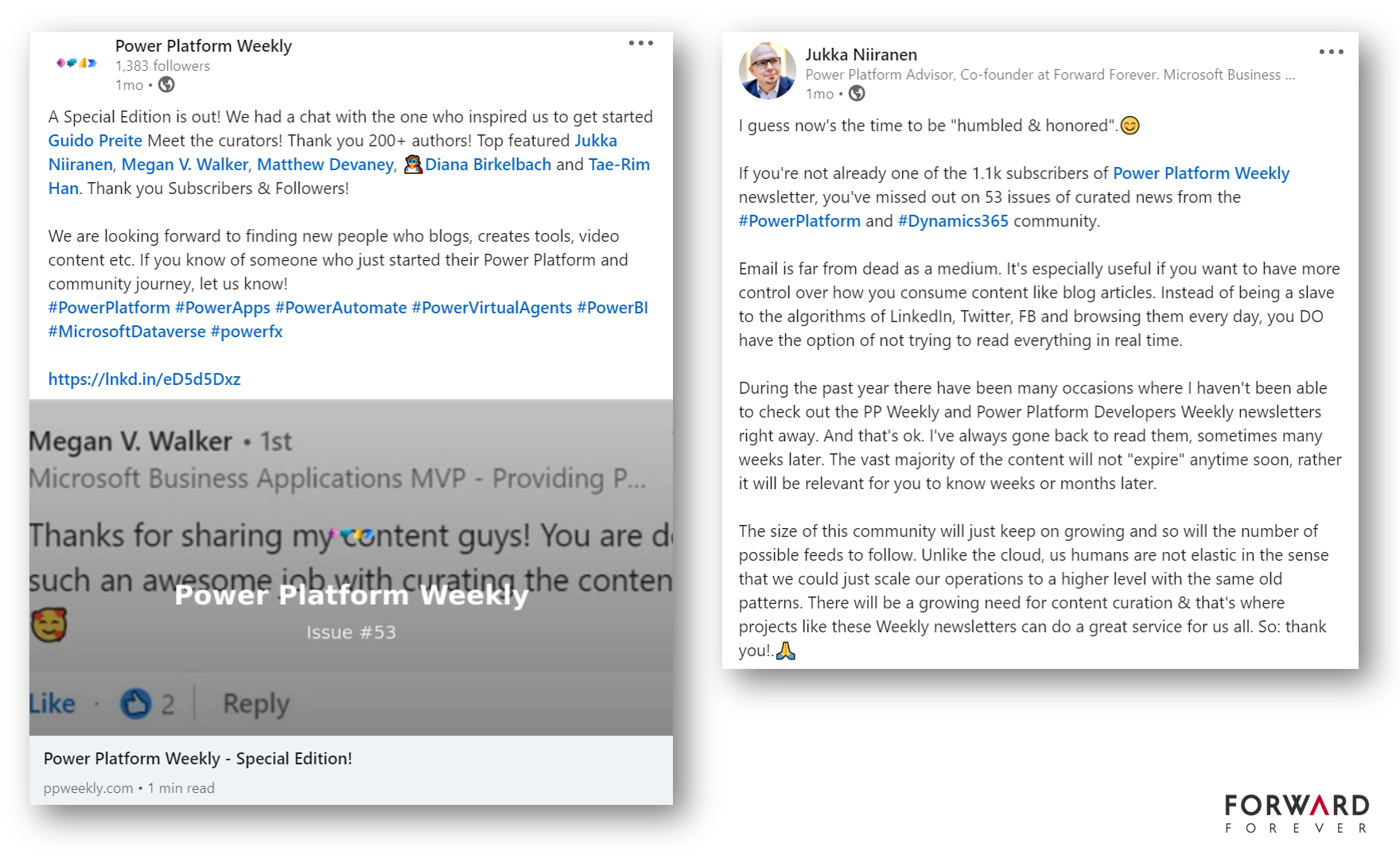
We don’t intend to compete with these community driven newsletters, because they do such an awesome job already. Many of the FF team member blog posts have been covered in the issues over time. Recently PP Weekly celebrated its first full year in operation and I wrote a bit about the importance of such content curation initiatives over on LinkedIn:
I encourage all customers and community members interested in the latest events around especially Power Apps, Power Automate, and also Dynamics 365, to add themselves as subscribers to these publications.
There is no shortage of great blog posts, podcast, videos and free tools to cover in this ecosystem. What I do think we have a shortage of is ways take control of our precious attention and consume information at our own pace. A monthly email digest that doesn’t scroll past in your real-time feed may offer a calmer way to stay in the loop.
Subscribe to Forward Forever Monthly
Just one email per month on cool Power Platform things we’ve come across.
In 2008 I started a blog called Surviving CRM. Now in 2019, 11 years later, it’s time to move on.
Don’t worry, I have no intention to stop blogging. Nor will there be a dramatic change in the type of content I’ll be posting or the topics I’ll be covering. This is merely a symbolic farewell to my blog’s original frame of reference, which was customer relationship management (CRM) and more specifically Microsoft Dynamics CRM as the technology for delivering solutions to bring the organization’s CRM strategy to life on a practical level.
While there is a benefit in having an established three letter acronym to describe what exactly you do for a living, I feel that just “doing CRM” has not been my focus area for quite some time now. I have spent far more time and energy in educating Dynamics customers and professionals why they need to think outside the familiar CRM box. This shift towards a broader Business Applications story had of course started already earlier with the app explosion of Dynamics 365 and the product’s tighter alignment with Office 365, but it was Microsoft’s launch of Power Platform in 2018 that really drove through the message for the wider audience.
What comes after CRM then? That’s a good question! Ever since I wrote about The End of CRM as Microsoft Software 3 years ago, I’ve been pondering what should be that new “thing” that I could comfortably associate myself with. “Customer Engagement” never felt like it was established enough to take CRM’s place, which has now also been acknowledged by Microsoft as they’ve essentially deprecated the CE term to refer only to the legacy on-premises software. Nor do I find myself embracing the Dynamics 365 concept very deeply (at least the CRM+ERP harmonization part of the story) since so much of the innovation coming from MS in the business applications space is actually not about the 1st party Dynamics products directly. As for all the “Power” products – well, we’ve already seen the branding changes happening over there, which should serve as a warning sign for anyone to not get too attached with the specific names of their tools.
At the end, I decided that I’ll just have to be me.
This is now simply a blog written by Jukka Niiranen, hosted on the jukkaniiranen.com domain. There’s also a shorter jukkan.com to align with my social media handle (which the non-Finnish readers might appreciate). As for the name of the blog, Thinking Forward is a reflection of the purpose that blogging about Dynamics 365 and Power Platform has had in my life.
I’ve always considered the act of writing down my thoughts as a way to think out loud, to create new meaning from the fragments of information that are bouncing around in my head. Through this process I’ve often ended up producing my own forward-looking statements about where Microsoft and the broader business applications ecosystem are heading. That’s what Thinking Forward will continue to be: analyzing the signals from Microsoft’s own announcements, from my network, from the community, and hopefully producing insightful articles that help everyone make sense of Power Platform’s direction. Highlighting the new opportunities while also openly addressing the challenges.
Earlier my blog content used to be also syndicated over on the Dynamics 365 Community site. Back in 2013 when I received my first MVP award, submitting the blog’s feed over there seemed very natural, to make it part of the global CRM blog content feed to be conveniently consumed via RSS readers. In 2018 Microsoft decided that also the community blog content would need to be split into sub-groups based on the Dynamics 365 Apps hierarchy. “Oh alright then, put it under Sales for lack of a better group” I thought. Looking back, my blog content has lately had so little to do with Dynamics 365 Sales that it truly doesn’t belong into such a bucket. Nor is there really any better alternative in the current community sites provided by Microsoft, so it’s time to end the content aggregation. From now on you’ll have to either visit my blog directly or subscribe to the updates.
What about CRM then? Is it “over” for me? No, of course it isn’t. In this age of data driven business processes that require advanced automation, new interaction channels, complex data analysis, machine learning algorithms and all sorts of intelligence, the customer master records are at the heart of it all. Unless you’re working with processes that don’t involve the customer, it’s unlikely that we’d get very far at all in designing new solutions if the foundation isn’t built on a solid system of record – most often your CRM. There is no magic bullet that will allow you to skip building this first layer.
The importance of a CRM system for businesses hasn’t diminished at all. It’s just that we need to go much further. With the no-code tools offered by Power Platform and the ready-to-consume APIs available on Azure, the kinds of value-adding layers that we can now build on top of these core systems are simply mind-blowing. The biggest shift is how accessible this technology is today. You don’t need enterprise scale budgets and development teams to dream about them anymore. In practice any customer organization to whom I’ve delivered Dynamics CRM based solutions during the past 14 years should be perfectly capable to leverage these cloud services and digitally transform their business. Turn it into something completely different than what it was when that CRM system was first brought in to support the as-is processes and ways of working. Experiment, analyze, adjust, innovate, expand. Put those wheels in motion!
Yet so few are doing this. Both the customers and the consultants who have been involved in building the first layer, the CRM system, can so easily get stuck in maintaining the as-is. Where could you find the time for thinking outside the box when you’re responsible for keeping that crucial, ever growing CRM box operational? The real tragedy here is that those professionals who’ve been deeply involved with designing, developing and supporting the CRM processes and have intimate knowledge of the customer data and many related systems – they would be in a great position to build the next layers with the new modern tools. It won’t “just happen”, though.
If you want something new, you have to stop doing something old.
Peter Drucker
To me, CRM is a classic. Classics don’t die, they’ll always be a part of the journey that got us into the world that exists today. Those shiny new objects in the cloud that we may occasionally get so very obsessed with might turn out to be passing fads. That’s just fine, it’s not a competition of this thing vs. that thing. We don’t have to forget about what we know, we just have to make room for growth – like in all areas of life. Just like I haven’t thrown away my precious CD collection of music from the 80’s, 90’s and 00’s, my daily dose of electronic beats is still mostly a stream of brand new music that is being created today. All of which is built on the heritage of artists that came before and gave inspiration, techniques and sounds to make it possible for the many productions of today to evolve from what was created before. That’s how I like to think of CRM, too.
Business applications come in all shapes and sizes. In the Microsoft ecosystem, we now have a broader set of tools to choose from, compared to the past strategies of Build vs. Buy, i.e. writing code to develop a custom application vs. using an application platform to configure the desired functionality. The birth of Power Platform and especially PowerApps as the underlying platform technology for creating business apps brought together two very different methods of configuration: Canvas Apps and Model-driven Apps.
It’s safe to say that hardly anyone in the world is currently a master of both application types. If you’ve been introduced into world of business applications via Dynamics CRM, XRM and Dynamics 365 Customer Engagement, then you will by default solve the customers’ problems with a Model-driven approach. For those that have been working with tools like SharePoint, InfoPath and the Office 365 suite of information worker productivity apps, the solution is very likely to be envisioned as a Canvas App. Persons with less professional history from either of these MS clouds will probably gravitate towards the mobile-first experience of Canvas Apps when getting to know the capabilities of PowerApps today.
There is very real value in being able to identify the logical objects involved in the functionalities required from a business app and turning that into a sensible, scalable data model. This is the XRM mindset of starting from the back end data and processes when designing solutions. If you have been developing these skills in the classic CRM style projects for several years, then you possess superpowers that few Citizen Developers could ever match. Congratulations! However, now you need to start practicing the exact opposite approach for how to solve problems: forget the data and start from the user experience.
You may already be aware of how massively Microsoft is investing in the new business models that Power Platform unlocks. Hopefully this has lead you to at least experiment with creating Canvas Apps based on existing data sources like CDS (if you still call it Dynamics [something], then hey: that’s perfectly alright!). While exploring these tools, perhaps you’ve also noticed how parts of the old XRM admin and customization features have started appearing in the PowerApps (and Flow) maker experiences. This level of awareness is a great start, but it’s not taking you very far yet in the process of changing how you think about solving business problems. You need to go much deeper, to unlearn the limits our model based world and embrace the possibilities of a modern Enterprise Low-Code Application Platform.
At 365 Saturday Kyiv and more recently at Power Platform Saturday Oslo I’ve done sessions on this transformation process, aimed at the XRM professionals. These include setting the scene on how & why the different app types are merging together, what are the key differences in solution design process for Canvas vs. Model, and how to get started in being part of this new #PowerAddicts movement. The slide deck includes a “Top 10 tips for starting Canvas App development on top of CDS” section, which should hopefully make the journey a bit easier than it has been for me, back when I started on it around one year ago. See below for the presentation or go directly to SlideShare my Slides archive to enjoy it in full fidelity.
Now the question is: have YOU already started your journey into the UX driven Canvas App world? If yes, what have been the biggest revelations or obstacles that you have encountered? If not, what are some of the roadblocks that have kept you from making that leap from the familiar Model-driven business applications into the expanding opportunities that PowerApps Canvas apps have to offer? Please do share your experiences in the blog comments, as I’m quite sure this an area where many professionals are searching for guidance and peer support.
Recently I was tagged to do a “confession” in the #WeArePowerAddicts challenge, started by MVP Vivek Bavishi. There’s been a massive amount of support for this over on Twitter, where many of the finest members of the community are enforcing the message that is bringing all of us together. In this post I’ll cover three aspects that I find so intriguing with this movement that is forming around Microsoft Power Platform and why professionals with a Dynamics 365 Customer Engagement / XRM background should seriously consider getting involved with it.
The Return of the Community
Community
was the biggest single reason why Dynamics CRM became such a defining part of
my professional life, starting way back in 2005. Sure, I had already earlier
enjoyed the business/marketing side of customer relationship management, but it
wasn’t until I had to dive deep into a specific technology that I realized the
massive value of an active, global user community. The growing blogosphere
around Dynamics CRM and especially the social layer of #MSDynCRM Twitter on top
of it first empowered me to turbocharge my own speed of learning, then later
presented me a medium for expressing my own thoughts. And here we are now.
Lately I’ve been having this feeling of premonition combined with dejavu. Like being special agent Dale Cooper, investigating the events that are taking place in a strange town in Pacific Northwest, far away from your normal surroundings, encountering The Giant in a dream sequence and being told that “it is happening again”. Only this time the Giant is Power Platform and the place isn’t Twin Peaks but rather Redmond. Big things are happening and it’s still difficult to see exactly how the story line will play out, but you just can’t wait to see what the next episode will reveal.
The cast of this show isn’t just made up of Microsofties. Just like in Season 1 that brought us Dynamics CRM (and XRM), the biggest stars are actually the community members who keep you engaged with exploring the many wonders of this new world of Power Platform that Community Season 2 has introduced. They eagerly demonstrate their skills with the cloud toolkit of PowerApps, Flow, Power BI, CDS, Connectors, Azure services, in combination with the more familiar Office and Dynamics products, infecting you with their enthusiasm. Some would call them PowerAddicts.
Be a Maker, Not a Customizer
When
implementing a CRM system based on Dynamics 365, you’re always more or less
adjusting the functionality of an existing application to meet the specific
needs of the customer’s business processes. The starting point is always the
same, and the end result depends on how much budget you’ve got for customizing
the OoB experience. In general, the CRM systems deployed for various different
organizations resemble one another far more than you might have initially
expected, considering the great amount of effort invested in the projects to
build them. It’s not a bad thing – especially since many customization
requirements may not end up delivering a positive ROI anyway.
Switch
from the preconfigured first party Dynamics 365 apps into the pure platform
play of PowerApps and it’s a completely different ball game. PowerApps Canvas
apps start with a blank canvas, just like the name suggests. There is nothing
in the tool itself that would dictate how exactly your app is supposed to look
like and what features it should contain. With this massive power comes a great
deal of responsibility, as you truly are the maker of the application that
needs to have a vision of what you’re building as well as the capabilities to
make it all come alive.
To come up with a vision of your own, the most important ingredient is exposure to the work of others. You need to see what the #PowerAddicts community has built, get inspired by it, and then take a shot at building something new from those pieces + the ideas and requirements that are unique to your project. You may well need to have a number of hobby projects, too, since delivering a made-to-order application without first practicing how to work with your tools is going to be tough. The concept of Maker Culture describes the community’s approach to Power Platform quite accurately:
“Maker culture emphasizes learning-through-doing in a social environment. It emphasizes informal, networked, peer-led, and shared learning motivated by fun and self-fulfillment. Maker culture encourages novel applications of technologies, and the exploration of intersections between traditionally separate domains and ways of working.”
Sure, it’s not like you didn’t need the forums and search engines as a basic survival kit in Dynamics 365 projects, too. That’s still more of a unidirectional way of using the community to get the job done, whereas how this new generation of Power Platform Makers seems to have an intrinsic motivation to build things together.
Escape from Planet CRM
Dynamics 365 as a product family is constantly evolving and the number of different applications in it is growing like never before. Despite of all these exciting new opportunities that the technology stack and Microsoft’s commercial offering seem to be opening up, in the everyday life of a consulting organization it’s still frighteningly easy to fall back into doing “just CRM”. What I mean by this is the process of repeatedly solving the same problems for different organizations, through pretty much the same methods as before, just with an updated version of the tools you’ve been using for years. While it may sound like a lucrative business area, in the long run such repeated problem solving via manual labor (i.e. burning your cognitive fuel reserves) really ought to be taken over by machines – be it an app, an “AI”, or simply an innovative, repeatable service offering delivered by a commercial machine instead of a project team.
After 13
years of Dynamics CRM experience under my belt, I often find myself torn
between the value of my accumulated knowledge and the burden that it imposes on
me. I pretty much know in advance what challenges a customer will have with
Dynamics 365 Customer Engagement when hearing about their expectations for a
CRM system and how it should fit with their organization’s existing tools and
practices. I’m painfully aware of the ever expanding solution areas I don’t
know well enough to give the right answer immediately when presented with a
specific problem. Sure, there are the many small victories to celebrate when I
can use my prior knowledge to solve problems – be it a blog article by myself
on the very topic, or the ability to quickly find the right link where someone
else has presented the solution. Still, with the scope of work included in a
typical CRM projects it feels like I’m at a saturation point where it’s no
longer possible to gain new generalist skills without starting to lose my grip
on the skills I’ve gained earlier. This is of course the point where a common
sense advise would be to go specialize on a more narrow area to further advance
your skills – but what if you just find the role of a generalist more
fulfilling in the grand scheme of things?
What Power Platform offers to people like me is a fresh new start. Here we have a toolkit that comes with zero hard dependencies on doing things the way they’re done in the CRM business. You can take PowerApps and build a solution to pretty much any business problem that revolves around improving the processes between the employees of an organization and the data sources they have access to (or should have). There are no assumptions here about the right way to solve such problems, unlike with CRM where you are in a way competing against the long legacy of prior systems, processes, best practices. It’s not a vacuum of course, as there are always alternative solutions out there.
The important difference here is that the boundaries of your work are truly undefined at this moment. No one knows how far these things will go, but if you have faith in the competitiveness of Microsoft cloud and its ability to attract both the right kind of commercial players to form an ecosystem as well as those inspired professionals that build up the community around it (hello #PowerAddicts!) then you know it’s going to be far bigger than CRM ever could have reached.
Power Platform allows the seasoned CRM professionals to return back to the role of a student. With new tools like PowerApps and Flow you are pretty much starting from scratch and you need to ramp up your skills in the same way as you might have done with MSCRM vX.0 back in the days. If you just can mentally position this work the right way and approach it primarily as a learning experience instead of a ToDo item in a project backlog, then OH MY GOD how much fun it is! Seriously, these tools can give a motivated citizen developer the kinds of superpowers that I couldn’t have even imagined just a couple of years ago. It ain’t all just marketing – it’s the real deal.
Now’s Your Turn
If what I’ve said here resonates with you and you’ve been hoping to find a way to get back into the game 100%, then you owe it to yourself to get truly involved with the Power Platform. Become an Addict.
Just like last year, I was fortunate to be able to escape the chilly Finnish autumn weather to sunny and warm Orlando this September, to attend the Microsoft Ignite 2018 conference. This time my visit to Florida did not contain a whole lot of sunlight, though, as my stay in that region was focused strictly on the days of the event, which meant I was mostly wandering back and forth the endless corridors of Orange County Convention Center. With 1600+ sessions crammed into 5+1 days, you’re always going to have a packed agenda at a conference like Ignite where 30,000 fellow Microsoft geeks are swarming around to gather the latest announcements and demos from their favorite technologies and evangelists.
I’ve written a summary over on LinkedIn of what were the main themes I picked up from Ignite this year. In short, Power Platform was front and center in the story of how Microsoft is further helping organizations to digitally transform their business processes. Not just from the traditional CRM and ERP scope of Dynamics 365 but on a much broader scope that speaks to the audiences that might not have otherwise ended up exploring how PowerApps, Flow, Power BI and CDS can connect their existing Office tools into a more automated flow of data through predefined pipes – as opposed to the more free-form processes that information workers previously had to agree on, to efficiently collaborate with their colleagues.
On the one end we saw a lot of praise for the unlikely heroes that have managed to pick up a toolkit like PowerApps without any developer background or formal position in IT, and build applications that their organizations have adopted into their day to day routines. Even though these citizen developer scenarios may not seem all that complex for professional software people, the key lesson is that these manual processes would have been unlikely to get digitalized with off-the-shelf or custom built software anytime soon. Making the tools for digital problem solving accessible to the people who intimately know the problem is what’s really shortening the time to value, which in turn drives the growth of the community around the Power Platform. It’s not capped by the number of companies looking for a CRM deployment project, rather it’s fueled by the amount of data and cloud based services that make this data available to the platform via connectors.
At the other end of the spectrum there was the true enterprise scale where this data needs to be harnessed with advanced tools and technologies to remain competitive in today’s global business. AI is the kind of buzzword that cloud was in the beginning of this decade, but in the same way as cloud computing became an everyday commodity, we’re bound to see if not artificial intelligence (AI) but at least machine learning (ML) algorithms find their way into everyday tools in the very near future. All of the major apps in the Dynamics 365 CE suite recently received their AI extensions that aim to bring intelligence built into the packaged applications, not just via Cognitive Services from Azure that developers and data scientists must plug into the business applications. Another example of the enterprise application providers’ focus on squeezing more value out of data was the Open Data Initiative by Microsoft, SAP and Adobe that took the center stage in the opening keynote were the three CEO’s explained why it’s in their best interest to help customers “deliver unparalleled business insight from their behavioral, transactional, financial, and operational data.” It’s really interesting to see that the Common Data Model (CDM) may be evolving into something that actually connects applications across big tech vendors.
Among all these tech giants, there was also a 20 minute slot where an ordinary Dynamics 365 guy like me got a chance to tell a bit about what we’re building in this small country of ours. My session was called “Onboarding customers to Microsoft Dynamics 365 for Sales via PowerApps” and you can catch the YouTube recording of the session or just check out the slides if you’re interested in knowing how we at Elisa aim to make use of the Power Platform as part of our product offering. It was the first time for me to be a speaker at an event the scale of Ignite, so a big thanks to Microsoft for providing me this exciting opportunity!
Even though Ignite wasn’t really a Dynamics 365 themed event like the Business Applications Summit a couple of months earlier, there were a lot of interesting demos about the brand new functionality rolling out as a part of the October 2018 release shortly. I compiled some of the highlights tweeted out on the #MSIgnite hashtag during the event onto this Wakelet collection for you to check out if you missed the live event excitement.
Just like in previous Microsoft conferences, the learning doesn’t stop with the closing of the venue doors. The Ignite on demand sessions provide a library of videos and slides that you definitely should be browsing through to keep up with the latest news around what’s coming to Microsoft Business Applications and the many connected products. Now, if you just happen to be located in Helsinki next week, then I have to promote the brand new Finland Dynamics User Group (#FDUG) and our very first Meetup event on October 18th where I’ll be doing a “whole Ignite in 30 minutes” summary of what I found most interesting in the various Power Platform related sessions I attended. See you there!