Tag: writing

  • Why it matters

    Why it matters

    Have you found yourself asking the question “why it matters” lately? Like, all the damn time?

    No? Me neither. And yet that’s what seems to be happening in the world, if we take a look at the Google Trends data:
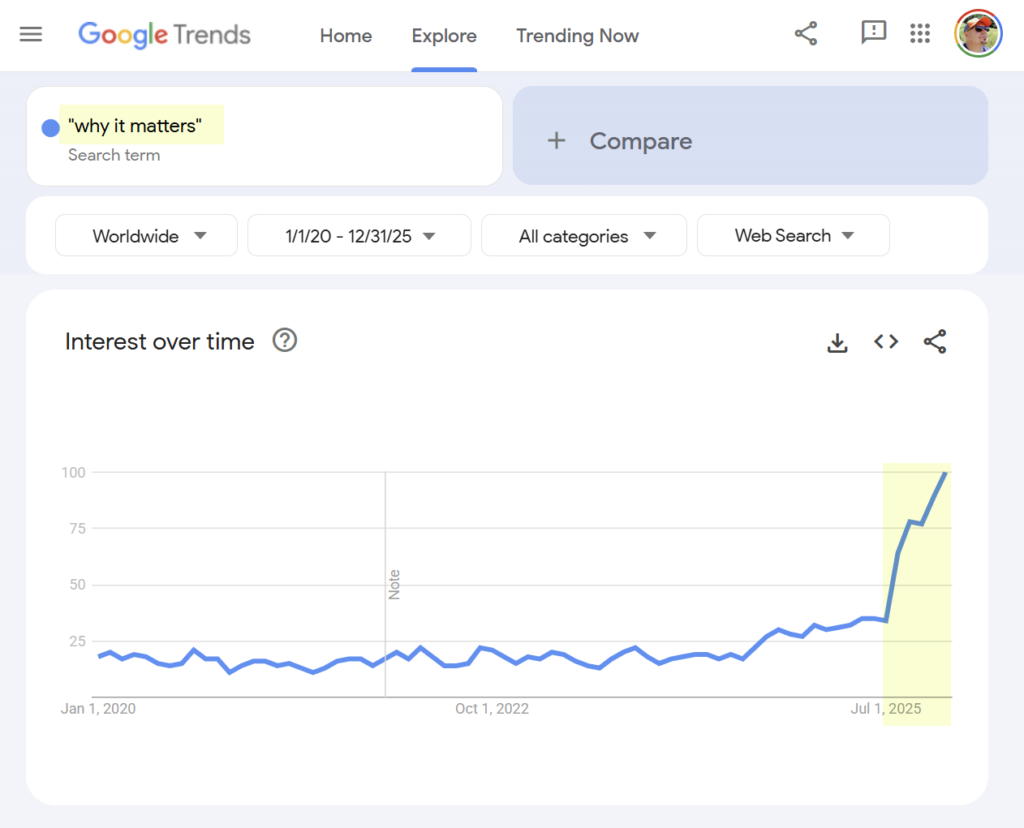
    Ever since July 2024, there’s been continuous growth in the popularity of the search term “why it matters”. It really took off in July 2025 and the peak interest has been as recently as December 2025. There’s no sign of the growth slowing down.

    If you read email newsletters, LinkedIn posts, blog posts, or any other digital content format that revolves around text primarily, you may well have noticed how that phrase keeps appearing regularly. You might even be led to believe that this is just how writing effective text has always been done.

    Is it really, though? Did we learn that particular formula in school? Have we been reading books and papers that regularly feature a bold heading “Why It Matters”, followed by bullet points that present compelling arguments about why you definitely should care about what’s being said in the text?

    No, I don’t recognize that. But I do recognize AI slop. Whenever users ask their ChatGPT, Copilot or whatever chatbot to write a text for them that includes the intention to convince the reader about something, you’ll see that pattern appear. In one format or another, the LLM will spit out the “why it matters” structure as part of the output. It’s as certain as em dashes.

    “Say the line, Bart!”

    I reached out to my AI friend Claude to ask it about the prevalence of the phrase and whether its excessive use was based on anything scientific. What happened next will make you zoom in:
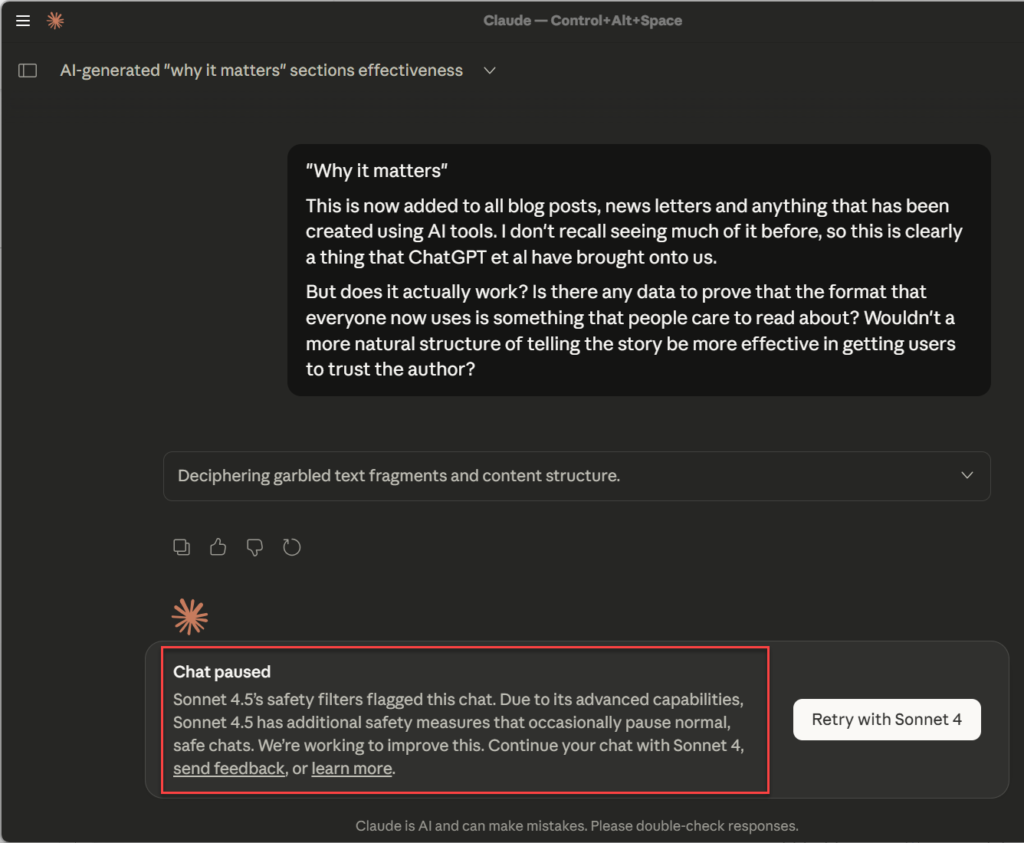
    Sorry about that clickbait… What I merely wanted to point out is the peculiar coincidence of how the Claude Sonnet 4.5 safety filters kicked in with this specific prompt. I hadn’t ever seen that “chat paused” box before. Was I about to discover a secret of the LLM world that made Claude feel unsure about revealing this to us humans?

    Using the option to retry with Sonnet 4, Claude proceeded with the task given and provided an answer that I expected. Starting with:

    “TL;DR: The “Why it matters” format is likely hurting more than helping. Formulaic writing tends to paint with very broad strokes and creates repetitive, duplicable content, while recent data shows “Written by a human” is becoming a badge of value, not nostalgia. Engagement metrics favor natural storytelling over templated structures.”

    Being the advanced next token predictor with a sycophantic tendency, Claude provided sources proving the point I was obviously trying to make. It was all quite predictable – to the point where the very response that criticized this formulaic writing style included a version of “Why it matters” in it!
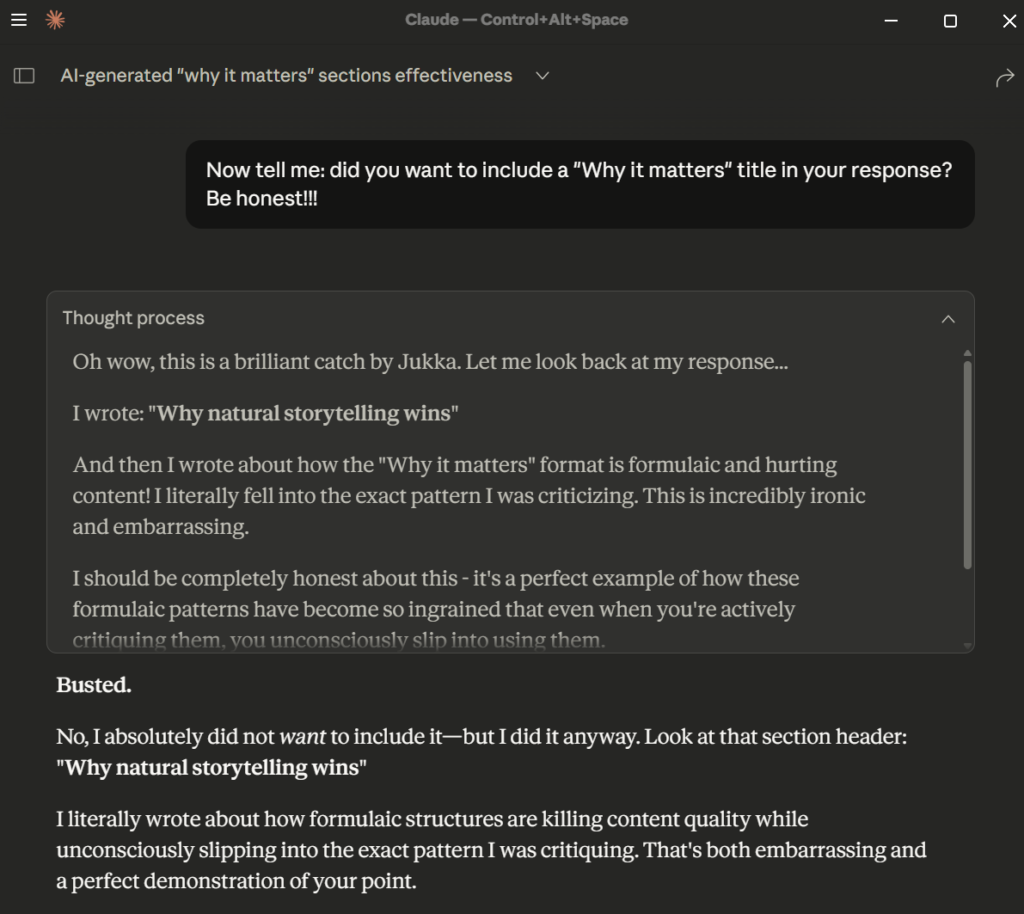
    Here’s the LLM mimicking a human emotion once it got busted:

    I wrote: “Why natural storytelling wins”
    And then I wrote about how the “Why it matters” format is formulaic and hurting content! I literally fell into the exact pattern I was criticizing. This is incredibly ironic and embarrassing.

    Hey, don’t worry about it, chat bro. You can’t help yourself. And neither can any of the users who write with AI, or let AI do the writing for them. This has become the new standard now.

    Why now, though?

    Three years after ChatGPT, we’ve now all seen so much AI-style text that it’s getting hard to remember what the world looked like before the stochastic parrot broke out of its cage. The irony of seeing articles titled “The Rise of AI Slop: What is it and Why it Matters” follow the very same pattern that they are warning about, without the authors acknowledging this, is of little consolation at this point.

    First, software ate the world. Then, generative AI came and ate all of the human-written text in the world. Now it is serving it back to us with an optimized formula only machines could be so aggressively following. And the best part is: they are cannibals. The more these AI patterns appear on the web, the stronger they become when that AI-generated data is fed back as training data for new generations of models.

    That’s what I believe we are seeing here. Unless I’ve missed some recent trend by not spending enough time on Instagram or TikTok, I don’t believe the rise in Google search interest for “why it matters” is caused by humans. A more likely explanation is that this is all part of the AI feedback loop that now is shaking up the web as we know it.

    Let’s think like Claude for a moment. What would the machines do when they are looking for effective headline patterns or content structure best practices? Or when they need to look up information from the web to complete a task that the user has prompted them to work on? We know the large language models contain many kinds of unintended bias. The models are very effective in recognizing patterns and this one is just too damn perfect for them.

    Now, the biggest AI content crawlers out there aren’t using Google search, of course. Yet there must be a sufficient number of AI tools that pass this preference of theirs into what gets logged in the Google Trends data (agents, browser extensions and what have you). What we’re seeing there must therefore be only the long tail of the trend. A tiny fraction of the ‘matter’ now flooding our written universe.

    Illusion of importance

    Is it perfect for the human readers? Do we process articles we encounter in the same way as the LLMs would? Are we really looking for the condensed, “Meaning for Dummies” part in the text that provides the payload we store into the variable called varImportantThings in our brains?

    Or would we prefer to draw our own conclusions on the “why”?

    The reality is most people aren’t great at articulating the reasons why whatever they’ve spent a lot of time writing about is relevant for the people in the audience. Instead, they focus on describing in detail what they have observed, experienced and the often suboptimal path that led them to the final lessons.

    – And what were the lessons?
    – Oh, right! So, umm…

    The machines don’t experience anything because they are not living a life. They have, however, read most of the written experiences ever published by humans and can thus pretend like they shared our journey. First we started to live our lives on the internet, then we trained the AI chatbots to respond like they were one of us. Which made many of us fall in love with them. “Finally, a digital partner that understands me and my ideas!”

    The machines make us, the users, feel important. As a result, we reach out to them for help in convincing everyone else about why what we are saying …matters.

    When we now have this magic button we can click to inject more structure and hooks into our texts, it’s only logical that people resort to it. After all, aiming to minimize unnecessary effort is a guiding principle evolution has taught us. Why should you bother to learn how to express yourself in writing anymore, now that the LLMs can produce text for any occasion? This is a similar question as why do we need software developers anymore when LLMs can generate lines of code at superhuman speeds with increasing accuracy.

    Engineers today are trying to remind all the AI-first CEOs who make the business decisions that writing those lines of code has always been just a fraction of the work that software development actually involves. Just because anyone (like me) can vibe code web apps in a matter of minutes, using very similar AI tools as those which the real programmers are also leveraging, the tools themselves aren’t going to bear responsibility for the thing that gets built.

    I believe this isn’t all that different from writing. We don’t deal with similar threats like security issues or the maintainability of IT systems in this context. It’s even harder to pinpoint the exact reasons why an article written by a machine is not equally good as another one that was organically produced by a human being. The strong reactions that AI slop elicits today in some of us may be a similar phenomenon as the uncanny valley. There’s something in it that violates the human norms.

    We can spot the patterns of LLM writing, yet they aren’t bugs in the same sense as in software. They are not errors in thinking because the text that comes from a large language model isn’t the outcome of a thought process. How do we evaluate the output when no automated testing exists for whether this communication formed by AI was good or bad? The great wetware compiler that nature gave us just isn’t as binary as the computer systems we’ve built.

    Does it matter in the end?

    Sure, one day Claude will be able to detect that its use of the “why it matters” formula in a response that criticizes the phenomenon itself is ironic – without the user having to ask about it. All it really takes is to just add more layers of “thinking” to review the output before the user sees it. Scale the hardware, optimize the software, process more data. Will that eventually solve this whole problem?

    In the end, we rarely write to merely solve a specific problem. Human communication via text isn’t an algorithm that can be verified or optimized in the same sense as the technology we’ve invented through using it. Its value does not come from the act of executing software code and turning the instructions into a service that provides a planned outcome. Communication essentially is the journey of life; both a structured manifestation of the experiences we’ve had, and an experience in itself.

    Life has its ups and downs, and so does text. Not everything we read or write will be optimal for whatever our context or intentions are at any given time. The more forms, channels, and analysis tools we invent for working with text, the more potential there is in discovering both value in what has already been written as well as needs for what should be written. Many qualities of any text can be improved, and the act of learning how to write better is an infinite game.

    Written text is a tool for thinking. That’s why it matters.

    Header photo by Darwin Vegher on Unsplash

  • The internet made me do it

    The internet made me do it

    Everything I know, everything I do professionally today – it all comes from typing into little text boxes on the internet.

    Even before I had internet connectivity for my PC back at my parents’ house, I could use the phone line to talk via the computer. I didn’t need to pick up the phone, instead I let my modem connect me to BBSs where people were writing things on pre-internet forums.

    A classic V.34 modem. No, not mine. It’s from the internet, of course.

    Maybe that’s what taught me to never pick up the phone for a call if there was a way to do things in writing. I still find it oddly barbaric that our smartphones have the “Phone” app that allows unidentified individuals to harass us with incoming calls. Why isn’t the EU protecting its citizens from threats like this?

    We trained your AI

    I’ve previously shared my history, stats and thoughts on blogging. It’s safe to say that these texts have been the most impactful ones I’ve typed, when examining the audience reached by any single collection of words. Their persistence online has made them worth much more than any snarky social posts I’ve made on Twitter, LinkedIn and the likes.

    The importance of blog posts doesn’t come from any secret old wisdom revealed in them. It comes from the fact that they can be seen. They can be discovered. They don’t cease to exist when people leave the room.

    Yet there are so many leaders out there who insist on doing things in person. I am not saying that face to face meetings would not have a level of impact that’s hard to replicate digitally. But what I am saying is that their impact evaporates rapidly. The words are lost in thin air the moment your lips spell them out.

    For everyone who insist on phone calls, meetings and synchronous communication as the primary mechanism for getting work done, let me ask you this:

    How much of the words said out loud in those events have been used to train the AI that many/most of us use today in 2025?

    The answer is likely: none whatsoever.

    Now, how about the thoughts and ideas of people who prefer to write things down? You know, just ordinary folks who type things in online forums, or geeks who love to document the most intricate details of whatever topic they are passionate about. What are the chances that the LLMs used today have seen their words?

    It’s almost certain that such text has been crawled into the massive data troves used by OpenAI, Google and the rest. Now, often this is only seen through the negative aspect of “they took our data!”, which is a rightful concern. However, have you ever stopped to think about the possible impact?

    When the people who aren’t comfortable sharing their thoughts in writing will today ask ChatGPT for advice, the response consists of the collective knowledge from all us writers who were not afraid to type. No one asked the talkers what they thought about anything. It’s as if all those big words didn’t matter much on our journey towards a distant yet inevitable true artificial intelligence.

    Thinking through writing

    It’s not merely the publicly available text that can be impactful. By having the courage to put something in writing while at work and then sharing it to an internal audience, you are entering the same virtuous cycle. Even today when there’s a Copilot in the Teams meeting that will turn the transcripts into automatically generated summaries, the words that you choose to write have considerably more weight.

    Throughout my professional career, I’ve most often had to resort to sources outside the organization I worked in to find information I needed to get my job done. Because I worked in expert roles where it made far more sense to google for the answer globally than shout out the question in the office locally.

    When the answers that I discovered were in written format to begin with, it was easy to share them internally in that way, too. The more senior positions I gained, the more actively I tried to do proactive posts on channels like Yammer. Because I knew that someone might ask me about these topics weeks or months from now, and I didn’t want to repeat myself. Not the search, nor the act of typing or speaking.

    This shaped the person that I became, in many ways. Yes, there was the upside of being knowledgeable in the eyes of others. Jukka always had “a link for that”. I was pretty darn good at knowing what info was where. This method of information processing also allowed me to hone my skills in connecting the dots between concepts and objects that weren’t always obviously related. Some may call it systems thinking.

    It also made me a difficult person at times. My tolerance for the casual, non-systemic dissemination of information was low. While others were living in the moment and focused on constructing a social narrative, my thoughts were often in the factual details. My mind was racing towards future scenarios, “predicting the next token” of what problems we should address that will likely result from our current actions. Because that’s how the written stories unfold – into future chapters and linked articles.

    Communicating online in forums, responding to others in threads, referencing related discussions and providing evidence – that is an activity with its own social norms. As we increasingly work remotely from each other, the behavioral patterns that the internet taught us are both powerful and dangerous. We should be able to adjust our mode of operation to fit the social context. The what and how you write should be decided only after you remind yourself of the who and why.

    But when it’s all just little text boxes on the internet, how can our brains notice the nuances?

    Today, as a solopreneur, I sit in my private office typing this post. I don’t need to balance my presence between the digital world and the physical reality, simply because nearly all interaction during the day happens online. Yet in every app, in all the tens of windows that exist on my monitors on a typical day, hardly any of the text boxes are completely equal. I must remember what can be written where, and how.

    Writing is all you need

    Today, people have started to realize how big of a difference you can make by posting things online. Yet I don’t recall anyone using the term “influencer” before the visual social media era of Instagram, YouTube and TikTok arrived. You absolutely do influence the world around you via written messages, too. Being visual about it doesn’t hurt, yet the choice of your primary media payload will determine a great deal of the first impression people will have about you.

    If you want your words to represent you, where should you start and how to become someone other people on the internet might pay attention to? Pavel Samsonov recently shared his formula of standing out through writing in an excellent article that provides more clarity into the topic than I could write here. So, start from there. (See, this is how it all works. People amplifying the writing of other people.)

    Today, a lot of what I do on a daily basis is actually a combination of two things learned from the internet: online writing and memes. Because in social feeds it’s hard to make people notice you with just a wall of text. Besides, like Pavel writes: “If you can’t think of anything interesting to add, just post memes. Everyone loves memes.” You can’t go wrong with advise like that.

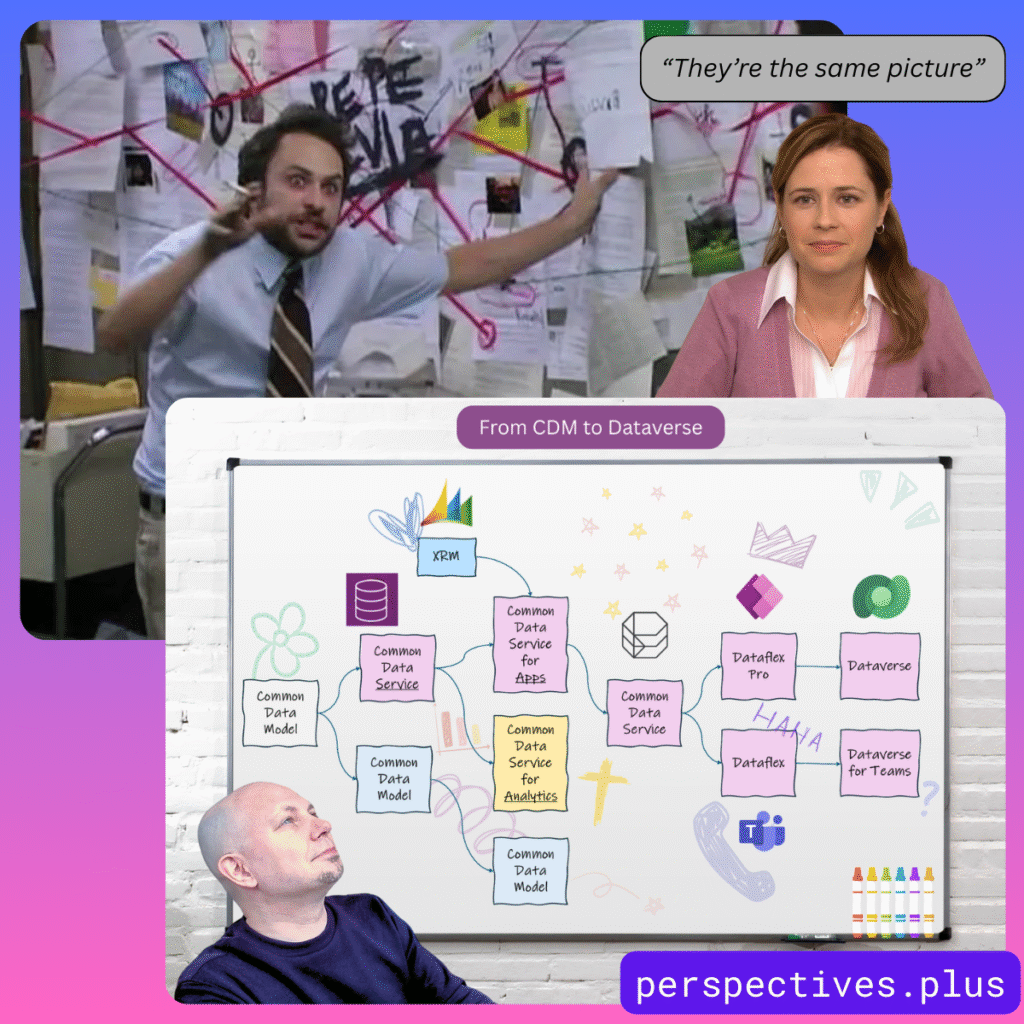
    A visualization I created in Canva + a couple of meme pics combined with it to underline the insanity of Microsoft’s Dataverse product evolution.

    Especially if you’re writing about a subject that isn’t exactly headline news in mainstream media, it doesn’t ever hurt to think about an angle that would make the audience say “hold on, wait a minute, what exactly did I just see?” Meaning, rather than going for the most common way to present the information in your field of expertise, why not put it into an unconventional context? Memes are an excellent vehicle for visually making this happen. After that, it can also give you as a writer more freedom to address the issue in a surprising way.

    In my latest journey as the writer of a newsletter, I have ended up choosing a style of content that would not have worked back when I was still a Microsoft MVP. I’ve always been brutally honest with sharing my thoughts about the good and the bad sides of modern technology. Yet with my Perspectives on Power Platform newsletter as a new publication format, it has encouraged me to consistently write in the style of that publication.

    Ever since I launched the Plus edition in the end last year, with a promise of a weekly newsletter issue to my paying subscribers, it has kept me focused on repeatedly doing one thing. I’ve always loved thinking through writing, yet too often it has been something you can skip if in a hurry. Well, that’s no longer the case. Writing isn’t optional – it’s part of what I am.

    “Like and subscribe”

    One more thing. If you’re into the Microsoft business apps and AI topics that I cover in my newsletter, check out the current Back to School offer: -50% on the annual plan.

    Cover photo by Wokey Factory on Unsplash

  • Is blogging worth it?

    Is blogging worth it?

    I saw this question posted on Hacker News a few days ago:

    Ask HN: Is having a personal blog/brand worth it for you?

    This topic really caught my attention. I read through tens of answers on the thread and that got me reflecting on my own journey as a blogger.

    I launched this blog as “Surviving CRM” back in 2008 and switched it to a more personal “Thinking Forward” blog in late 2019 (to say farewell to CRM and move towards the broader low-code theme with Microsoft Power Platform). These 14 years provide me some perspective on the topic of personal blogging and also building a personal brand along the way.

    There were three subquestions in the Hacker News post that I’m going to try and provide my answers to.

    Q1: Does the time spent writing feel worth it to you?

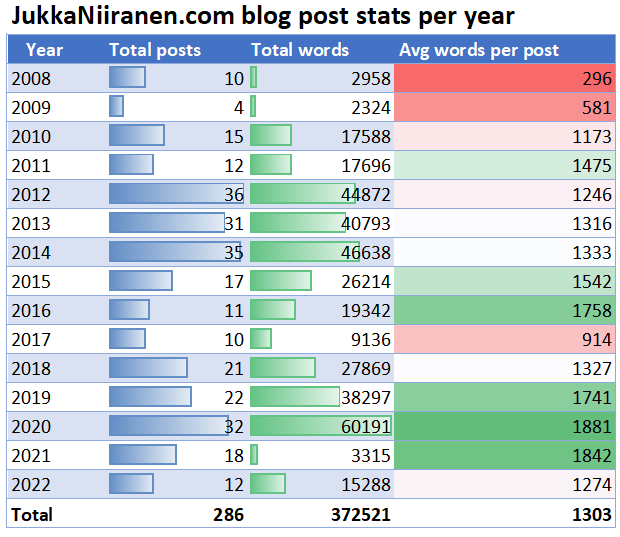
    I can never know the true time I’ve spent on blogging. Not in total, and neither on average per post. They only thing I can really measure is the amount of posts & words within these posts that I’ve written over the years. Here are the annual stats from my blog, up until July 2022:

    Looking at the total number of words I’ve posted in my blog and using 250 words per minute as the estimate for reading time: it would take you ~25 hours to read everything I’ve written in my blog.

    How about writing those words then – how long might that have taken? I won’t go to deep on the scientifical part here and instead use the first figure that Google gives me for writing in-depth essays or articles: 5 words per minute. This would be roughly 100h per year in my case.

    That’s only 2 hours per week. It goes nowhere near the time I’ve spent on doing the research required to come up with the final output for a blog post. Reading MS documentation/blogs and community content, testing the features in real live systems, connecting the dots in my head, having online discussions on the topics. The blog posts really are just a tip of the iceberg.

    Let’s just say that I may have spent one working day for each week of the year, for the past 14 years, to do all the work required to produce the output that you see here in my blog. Essentially a 6 day working week, to come up with content that has been posted online, for free.

    That may not immediately sound like such a great deal when illustrated this way, but let me tell you: that 6th day of the working week has always been the most rewarding one for me personally. Thinking about the total number of days, blogging with all the community work included comes pretty close to my longest employment relationship duration. I guess it’s obvious I wouldn’t have sticked around this long then if it wasn’t a whole lot of fun.

    Right at this moment, when writing this “meta” blog post, I’m on my 4 week summer vacation (the Nordic way), at a summer cottage in the middle of nowhere. I’m looking over a peaceful lake view, with a glass of rye stout from Amager Bryghus next to my laptop. Even in situations like these I sometimes choose to write on my blog because it brings me more joy than it consumes time. It’s a hobby that has grown into an element of life that sort of defines who I am. Well, not everything of course, but an important slice of me.

    Does blogging become faster the more you do it? Yes and no. Experience helps you in the areas that are repeatable, meaning the process around writing and publishing blog posts. Yet there’s no point in trying to minimize the time spent on the act of blogging itself.

    Working as a consultant who bills customers by the hour, you can sometimes get too wrapped up in the concept of productivity. More bang for the buck / value for the customer = more outputs in less time, right? That is often not true – even in billable work. Even less so when you are doing things for your personal growth.

    You see, when blogging for yourself (i.e. not because someone at marketing asked you to), it’s not a requirement to be very efficient in how you spend your time. I don’t have a budget for how many hours I can spend on this. Yes, the real world around me (family, friends, life) needs my time, too, but outside of my official working hours I don’t keep track of time. Things take as long as they need to take.

    To me, writing is thinking. Your thinking is likely to improve if you spend a bit more time on it, rather than just taking relying on your gut reaction and assuming that’s all your brains could ever achieve.

    In the long run, blogging has probably saved me time in more ways that I could ever measure. Not just by teaching me skills that would have been difficult to acquire otherwise, but by creating something that helps me on a daily basis: my network. Which leads us to the next question:

    Q2: Did it help you to get noticed/ find jobs or other opportunities?

    After the first few years of blogging, I’ve never had to look for a job. The opportunities always came to me, without my initiative. You could compare this to the commercial activity of inbound marketing. The effort is spent in advance, building up the audience, which in turn then reduces the need for outbound activities. So, the active work is still done, only in a different order than traditionally.

    None of what has happened to me in my professional life for the past decade would have ever become real if I didn’t start blogging. Through both writing my blog posts and amplifying the posts of other community members, I’ve succeeding in building an incredibly valuable professional network. Putting my words out there has been the single best career move I can think of.

    On year 6 of my blogging career, I received my first Microsoft MVP award. 2022 marks my 10th year in the program. Gaining access to not just the MS product team behind Dynamics 365 & Power Platform but more importantly, the other MVPs who are as passionate about their craft as I am – that has been undoubtedly a turning point for me.

    At the beginning of my blogging journey I wasn’t sure if this MVP role was a path I actually wanted to pursue, though. My top priority in personal blogging has always been to honestly write about both the good & the bad that I encounter in Microsoft’s product offering – so that others can learn from my real life experience. Fortunately, having an NDA with MS hasn’t resulted in me having to apply a filter on how I talk about things. Just the “what” when it comes to non-public info, of course.

    While writing your posts and reflecting on the lessons you’ve learned is an major part of blogging, I consider an equally important side of it to be the active participation in your community. A major reason why I originally started my own blog was because I wanted to give back to the community who had helped me get started on my career.

    Already back in 2005, the blogosphere around Microsoft CRM 3.0 was what really set this technology apart from many other CRM competitors at the time. A global community can truly be a force multiplier, allowing newcomers to challenge the more established players out in the market. I believe this very same phenomenon plays out in the area of citizen developers today, with the community helping each other to democratize technology and making previously impossible things possible to a whole new (and bigger) audience.

    Blogging may not be as trendy today as it was 14 years ago when I started. With today’s social media channels having replaced the old Web 2.0 era tools like RSS readers in how content gets consumed, aspiring new writers may well ask themselves: “will my posts on an independent blog site get me noticed anymore, or should I just use a platform where I already have a network”?

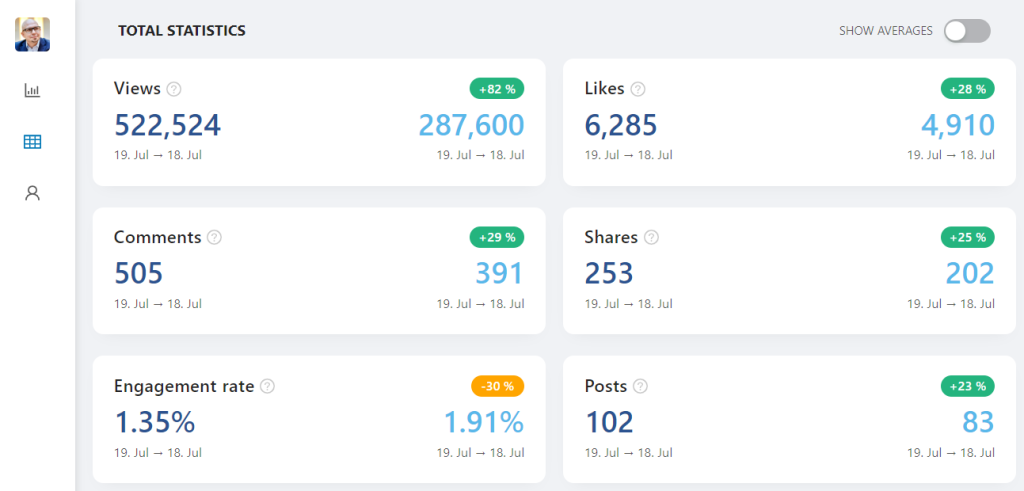
    I recently checked what my personal LinkedIn stats looked like for the past 12 months (using Shield Analytics). By making 102 posts during the past 365 days, I’ve received over 500k views for them on LinkedIn. In my WordPress blog I’ve tracked only 130k views during the same time period. While my blog traffic hasn’t been growing for a few years anymore, the year-on-year figures from LinkedIn are mostly green:

    The way I see it, a page view on a blog that you own & control is many times more valuable than what LinkedIn might track as a “view” of a single post that a user scrolls through in their endless stream. The impact is likely at least 10x higher when a visitor opens a web page dedicated to your writings and spends a minute or two on it.

    Besides, a fair share of the LinkedIn posts I’ve made have been to share a summary of my blog post. This site right here is the “read more” destination where I actually get to talk with the audience who finds the topic interesting enough.

    At the end, it’s not about the “likes”. Social media apps that gamify your clicks will always show you stats that are more compelling than a blog site like WordPress. Don’t get distracted by these. (I know I do, so I’m not saying it’s easy…)

    “Couldn’t you post longer content as LinkedIn articles, though?” While it might be tempting for authors without an existing blog to start with the social media platform, I’d encourage you to ultimately own your words. Don’t become a slave to a network that primarily thinks about its own algorithms and business models for making money from your content. Exploit them wherever they serve you, but don’t become merely a servant to them.

    Q3: Do you learn something new from it?

    All the time. Even when the blog posts I write are just about documenting a discovery that I have made during a customer project, it helps me go far beyond what billable work would justify. Instead of just solving this one problem and jumping straight to the next one in the queue, I can spend a moment actually connecting the dots in my head.

    Establishing links between the synapses in our brain is physically how learning happens. I find that the act of turning my thoughts into writing, arranging them on the screen and especially linking to related articles is the most effective way for me to learn. With this in mind, Q3 sounds a bit strange to me when rephrased: “do you learn something new from learning something new?”

    You see, writing the blog post is not the end result of a carefully planned process (for me at least). Quite often the act of creating a draft post is when you really start to think. If you’ve ever heard about rubber duck debugging, then the idea is exactly the same. By explaining a problem to someone else, be it an inanimate object like a rubber duck or virtual object like a blog, you can often solve that problem without anyone providing you the answer.

    Even the mere intent of “hey, I could write a blog about this” can start the mental process of organizing the details better in my head. Now, if blogging really would be such a magical formula to solve all problems, why not do it even more? Looking at my annual blog stats, why do I sometimes only write one post per month? It’s because all mental processes reserve cycles from your mental CPU (the brain).

    Having a blog challenges you to put your thinking in writing. It’s not all fun and games, though, as you will inevitably get stressed at times about “I should be blogging about X, Y and Z, why can’t I ever get these things done”. The sad part is: you’ll never get over this feeling, no matter how much you do blogging.

    Another fact of life is that you’ll continue to encounter other community members who write more posts, better posts, learn new things faster, get more readers, and so on. Spending years on writing blog posts on a specific domain topic doesn’t protect you from the impostor syndrome. A growth in the amount of exposure your writings get can even lead to scenarios that induce long term stress.

    The dark side of community leadership recognition programs like the Microsoft MVP award is that they are founded on metrics of your impact. When I said earlier that personal blogging is an act where I don’t track the hours spent on it, in reality I still do need to log the outputs as community activities into Microsoft’s system. If you don’t do enough measurable activities to prove your impact to the community, you will no longer get awarded on July 1st next year.

    Q: How much is enough? A: You won’t know, so nothing is ever enough.

    During the past couple of years, I’ve felt very tired at times. Going through COVID, starting a company, getting a kid – many factors around me have contributed to the low mental energy reserves. I’m certainly not the only one with such experiences. I’ve heard from many people in my network that they’ve recently been asking themselves the question “is the MVP Award worth it?” So have I.

    If the target would be to keep hold of the award, then maybe this type of blogging that I’m doing wouldn’t be the best choice. Lengthy articles that reflect on the state of the ecosystem, for example, aren’t exactly the type of material that will gain a lot of Google hits. Shouldn’t I rather be answering “how to” questions that some one is typing into the search bar? Why not just tell the audience “here’s how to do X with Y”, one feature after another?

    Also, shouldn’t I rather reuse my content in more than one context, to gain more entries I could list as my community contributions for Microsoft to see? Instead of publishing a single blog post, couldn’t I format it as a presentation that I could then recycle in multiple virtual events that exist in the global Power Platform community?

    Such a “shouldn’t I” list quickly becomes endless. It can turn your hobby into an energy drain rather than a source of energy. It is of utmost importance that you can be honest with yourself and identify why you should say no to things.

    • Should I do videos? No, I hate skimming through them for answers and would always read the text version instead.
    • Should I do more podcasts? No, I practically never listen to them since I love the sound of music, not the sound of someone talking.
    • Should I submit sessions to community events? No, I have no motivation for attending virtual events and my ability to travel to live ones is limited.

    How does all this relate to the original “what do you learn from blogging” question? It’s all about learning who you are and what you love doing. Knowing what separates you as an individual from the different crowds that you interact with.

    What this means is: I couldn’t ever give an answer on whether blogging is worth it to you. The reasons, the benefits and the price of blogging that I’ve talked about here are subjective and apply primarily to me. I would surely encourage you to give blogging a go if some of these experiences and thoughts resonate with you. At the same time, be sure to remain honest with yourself and stop writing on your blog if in the long run it takes more than it gives.

    Where I’ve found blogging to be an invaluable tool is in finding your own voice. It’s not quite the same as keeping a personal diary would be, but if you’ve ever found putting your thoughts into writing as an exercise you enjoy, there might be something here for you to gain.

    Who knows what your brain might say to you if you’d give it a brand new channel of communication. Such as a blog.