Tag: WordPress

  • 7 months of Perspectives – start of my newsletter journey

    7 months of Perspectives – start of my newsletter journey

    It’s hard to put an exact date on when my Perspectives on Power Platform newsletter was actually launched. In the very first issue, “Start somewhere”, I wrote about my decision to sign up for beehiiv and quickly put in place the foundation on which I could build something.

    At that point, in March 2024, I did not yet know what exactly I was going to build. After the health challenges I had just gone through, I knew I needed to stop doing things in a way that kept me from getting better. The 11 years of being in the Microsoft MVP program had taken their toll on my mental wellbeing. Co-founding and promoting a Power Platform consulting company alongside my voluntary community activities turned out to be an unsustainable model.

    Not a big surprise, and not anyone else’s fault either. I had chosen this path, now I just needed to find a new path forward. Today, it feels like this is indeed happening.

    To write again

    After taking a break, I quickly discovered that I still have a burning passion for writing. I just needed the right place and format for it. With Twitter now gone (to s***), I developed a habbit of creating quick posts / hot takes on LinkedIn. Regardless of their algorithm being a similar jerk as any other big social media, I learned to live within the limits imposed there. The higher character limit of a LinkedIn post suited me well, allowing me to express complete thoughts rather than just a couple of sentences.

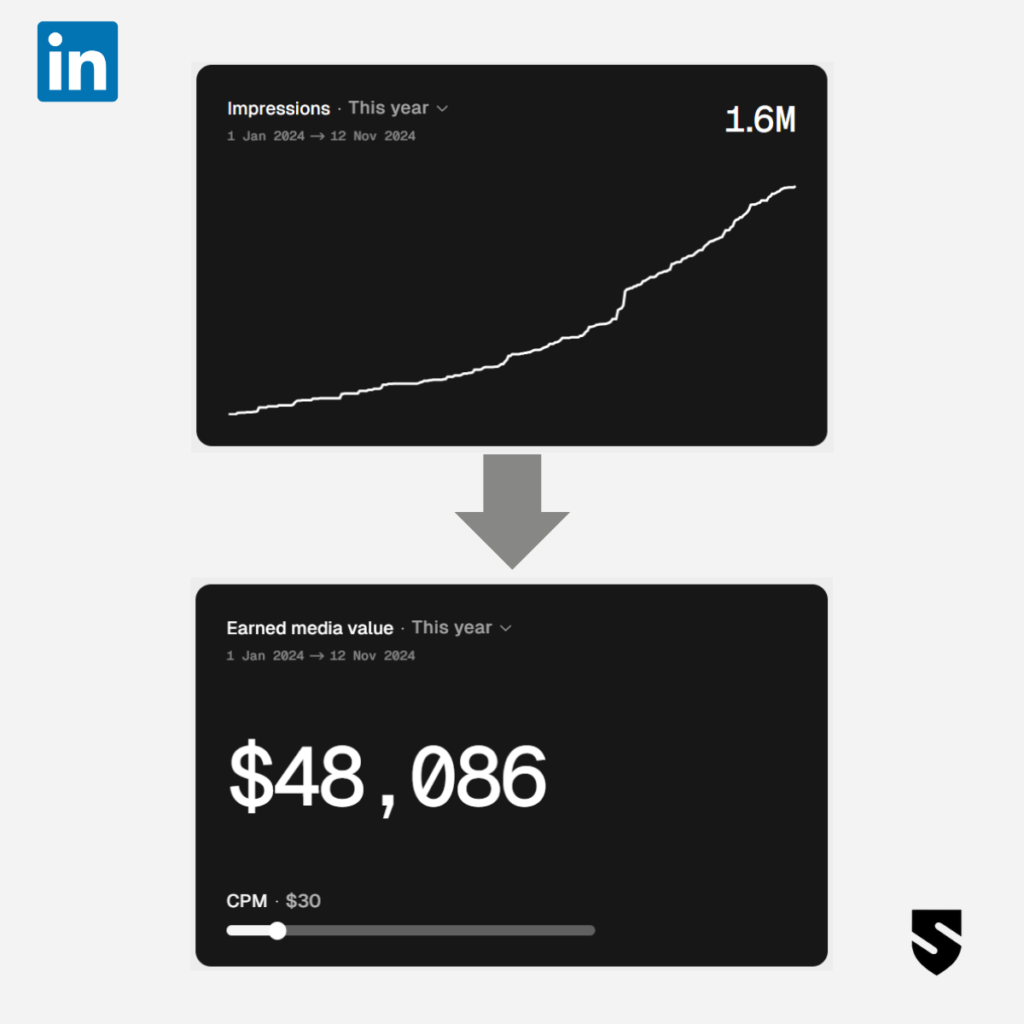
    My audience started to grow. Much faster than what I ever experienced on Twitter. At some point, due to the poor analytics that LinkedIn themselves provide, I chose to pay for a 3rd party tool, Shield Analytics. The most important feature turned out to be the ability to search for my past posts (yes, LinkedIn is terrible with basic content management). As a nice bonus, it draws charts on how the engagement levels are doing compared to previous time periods. You could even simulate what a similar audience reach would cost you if you paid for it via sponsored content campaigns rather than just writing catchy posts.
    Social media companies are not your friends, though. They aim to own the content that is created by the users and choose how/when it is presented. More importantly, they want to own your network – so that they can charge money for selling it back to you, should you want to reach them with your message. Connections, followers – those are just numbers shown to keep you hooked on the potential audience.

    Newsletters, on the other hand, are about forming the direct connection between the publisher and the subscriber. Algorithms won’t determine who sees what – the humans on both ends get to choose that. I think it’s a much healthier basis for communication, rather than relying on the gamification mechanisms in social networks that can change on a whim.

    While the themes that I write about may be the same regardless of the channel, the newsletter offers me a way to think deeper. I’ve developed the habbit of looking at what I personally react to online, what my network is saying, what type of social posts I create – then analyzing it from the different perspectives as part of writing my long form Perspectives into the newsletter.
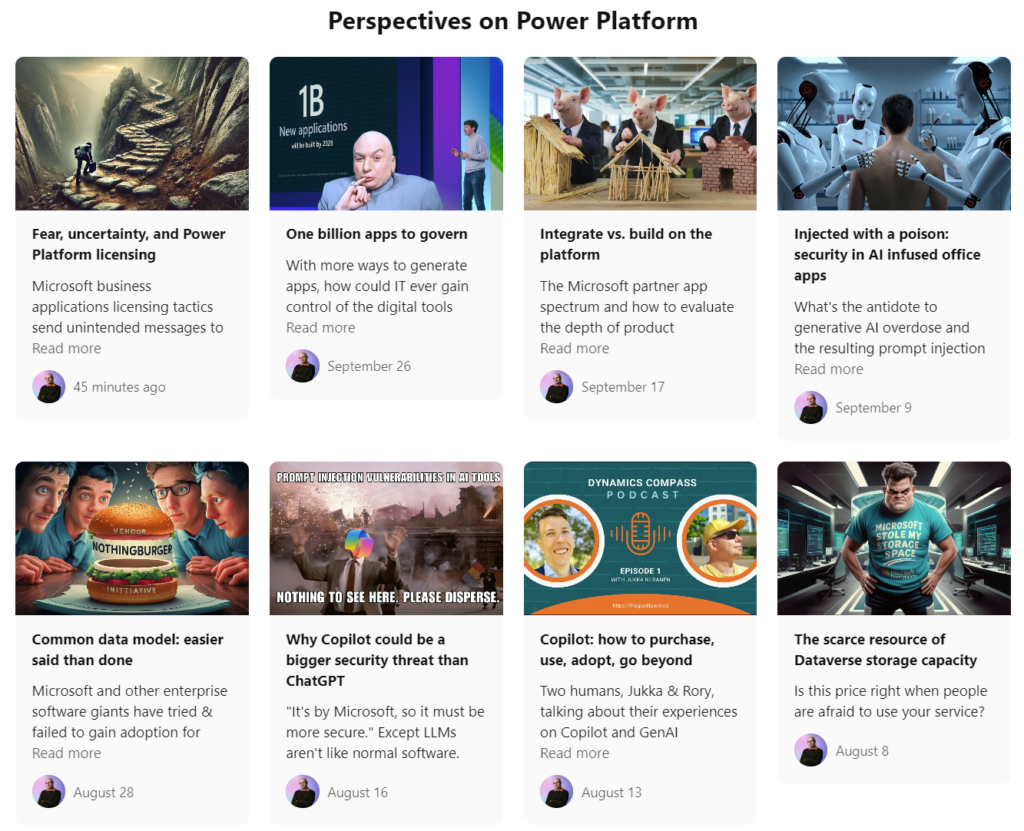
    I feel that it’s started to work pretty well. I’ve allowed myself to take time in exploring new themes around GenAI and cybersecurity, as well as reflecting on the past/present/history of Power Platform. Many of the topics are either the result of talking with new people or they have resulted in new connections being formed. Those are crucial KPIs in the end. 1) Does it feel meaningful to myself? 2) Does it activate others to do something new? And last but not least: 3) does it gain traction from the online audience in general?

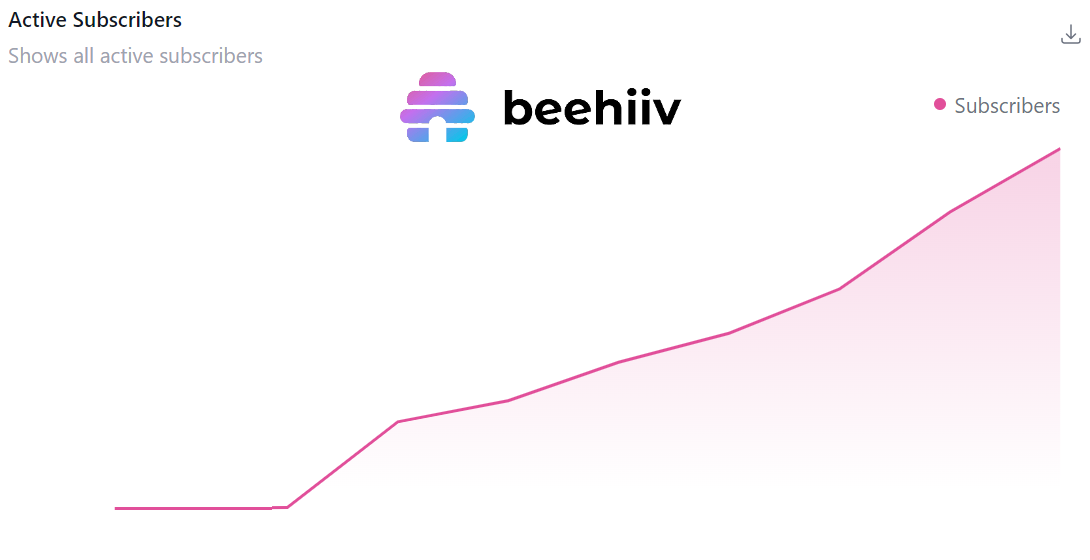
    I’m not going to disclose the exact stats on how many readers there have been for the newsletter. Let’s just say that I’ve been delighted to see a constant flow of new subscribers that have intentionally said “yes, please, send me more emails like this”. It feels special, every single time.❤️
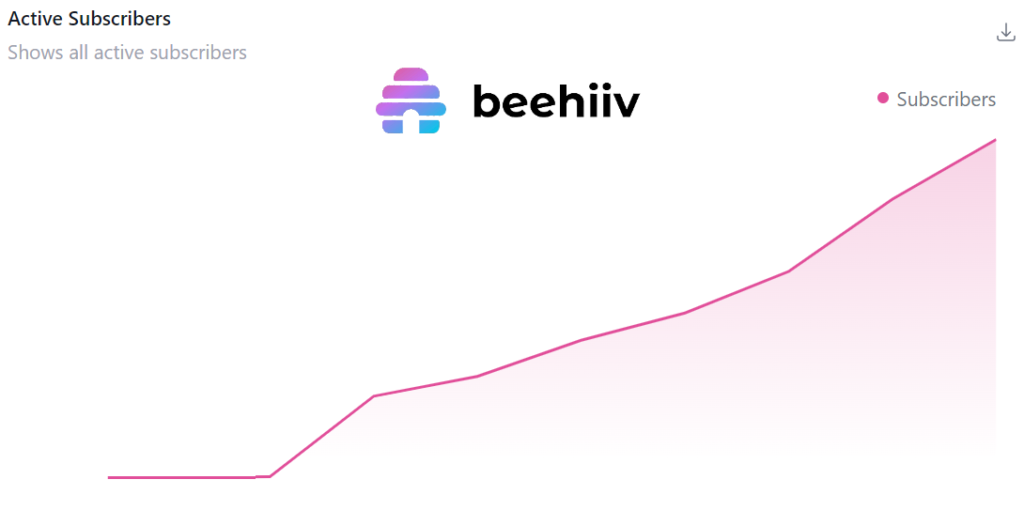
    More recently I’ve had the courage to say “if you want to read this article, please do me a favor and create a free subscriber account”. After all, this ability to stop just any AI bots from scraping your content and using the data for providing answers without zero attribution to the original source was one stated reason why I chose to transition from blogging to writing a newsletter.

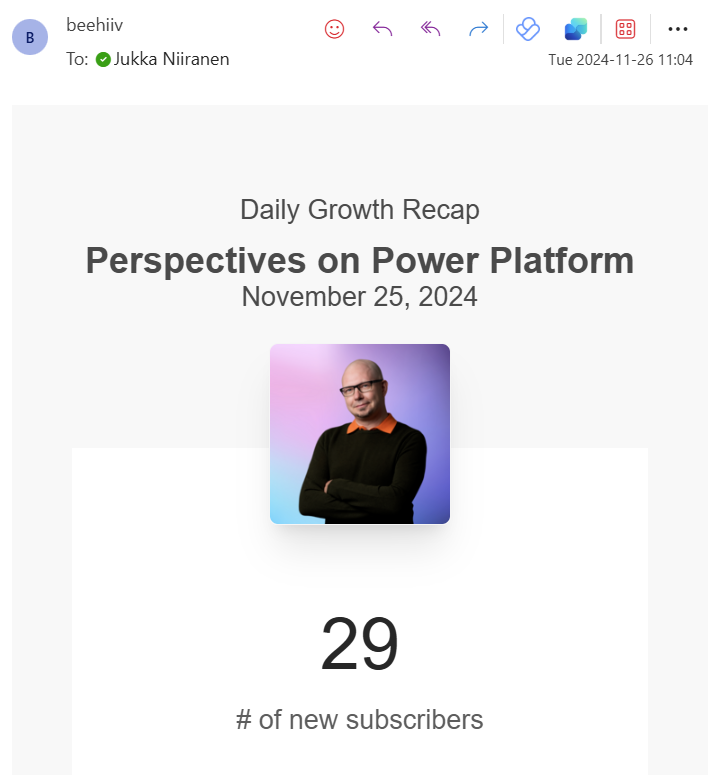
    The conclusion is: these walls do work. If on a normal day I’d get a beehiiv daily growth recap message with 2-4 new subscribers, requesting a login can make that grow 10x.
    Is AI really eating the tech blogging world then? I believe it is happening on some level. This insighful article from MVP Tony Redmond who runs sites like Office365ITPros.com explains the impact that LLM generated answers to tech questions are having on website traffic. If you used to have a business that relied on people discovering your site via “how to” queries on Google, that model is becoming less and less viable every day.

    The tools that shape us

    Regardless of what we as individuals think about generative AI, it exists. It changes the world around us, whether we use it for a particular task or not. I haven’t yet fallen in love with Microsoft 365 Copilot, but I talk a lot with my ChatGPT every single day. It has become a virtual personal advisor in exploring areas that are less familiar to me in technology, business and life. It would be difficult to live without it. But does it replace online searches, though?

    I have already mostly abandoned Google. However. I did not replace it with AI, but rather a search engine that I pay for with money – not with my data and privacy. Kagi has been an awesome experience that not only meets my everyday search needs; they also sent me a beautiful yellow T-shirt! I’ve learned that an ad-free search engine that doesn’t try to actively deceive me into clicking sponsored links is still highly useful in the year 2024.

    These shifts in user behavior resulting from advancements in the field of AI will mean more & more people question whether their de facto digital tools they’ve relied on are the right choice anymore. This is happening all around me. Even on this very place where I am now writing this text and you are presumably reading it (unless you are one of the remaining RSS feed fans): WordPress.

    I have been a WordPress user for as long as I remember. Well, okay, so I do still remember my initial blogging experiments with Blogger and Drupal. Once I went with WP, though, there was never a true reason to look elsewhere. It did everything I needed, and was able to adapt to whatever new requirements I came up with. Not only did it serve as a personal blog engine, it also powered many professional websites along my journey.

    When all you’ve got is a WP hammer, every problem looks like a blog post nail. While being a versatile and broadly used platform means there is a huge community around it to give tips, build plugins and sort of keep all your options open – you are still thinking within that WP box. You keep publishing openly available blog posts as web pages, like you’ve done for 16 years already. You can’t just stop doing what you’ve always done, right?

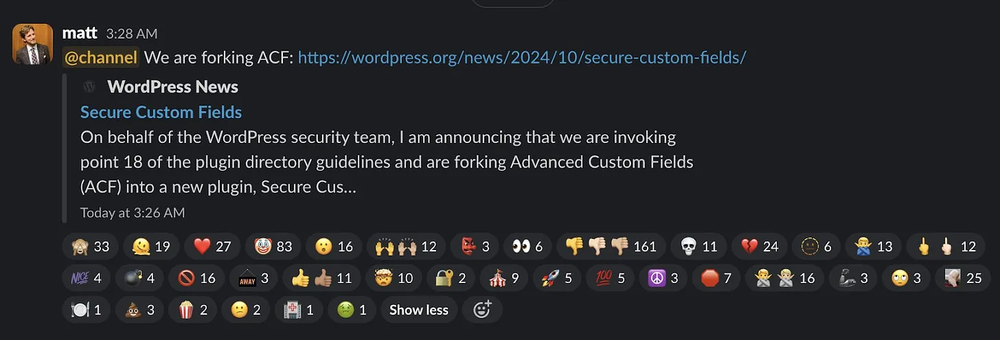
    The big wake up call for WP bloggers came from the mothership. The founder of WordPress has shown that even though the wordpress.org side is operating as a non-profit, the commercial arm of wordpress.com has the ultimate control over the software. The public dispute that Matt Wullenweg started in September by calling WP Engine “a cancer for WordPress” has since escalated into a complete collapse of trust in WP.

    Automattic (the creator of WordPress, led by Matt) and WP Engine are both big hosting providers for WP sites. Now, they’re only talking through lawyers, with WP Engine having sued Automattic for “abuse of power, extortion and greed”. In response, Matt and Automattic decided to literally steal a commercial plugin developed by WP Engine and publish it as their own. It’s the craziest thing I’ve seen in the CMS space yet the proof is everywhere in the source code.
    With beehiiv, I had already taken the first step to publish content somewhere outside of the WP kingdom. During the past few months, there’s been a steady stream of product updates that make me miss the WP ecosystem less and less. Most importantly, I feel that the mechanism of a newsletter is providing a better connection not just between me & my subscribers – it also makes me want to write more. That’s not exactly a plugin you could just add to a WordPress blog. It’s about a whole different product design approach.

    Will I still be maintaining this WP blog then? That’s a good question. Since my regular content posting is on the newsletter site anyway, I technically could get everything I need from a static website. Briefly exploring the world of SSG’s (static site generators), I tried spinning up a Hugo site, running on Netlify. However, I very quickly realized that the Git repo driven content management workflow was not something I would replace my WP site with.

    I decided to give this SSG approach a go in a different context, though. When developing an alternative way to visualize the release plans for Power Platform and Dynamics 365 than what Microsoft’s own Release Planner site offers, I ended up publishing releaseplans.net as a Hugo website. Now, that site lives as a GitHub repo for the source code, while I do the content updates in Visual Studio Code.
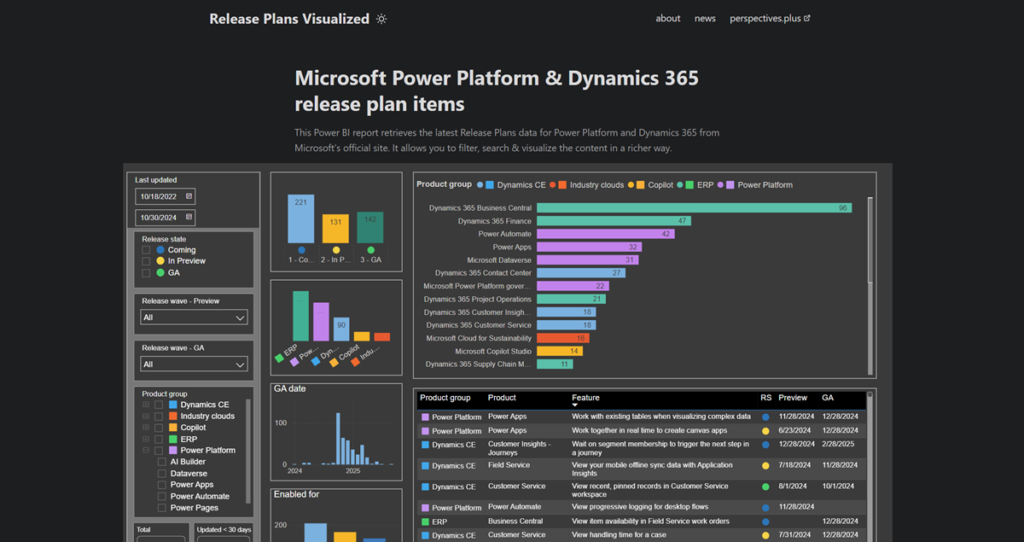
    I have of course already covered this topic in my newsletter:

    I’m in the process of creating a “proper” website for my company, Niiranen Advisory Oy. That will also not be a WP site but something different. Stay tuned for an update in the not too distant future.

    What’s coming next

    The idea behind the domain perspectives.plus was always to make space for something more than just a direct replacement of this blog. Today, that idea has reached the state where Perspectives Plus is a real thing anyone can subscribe to:
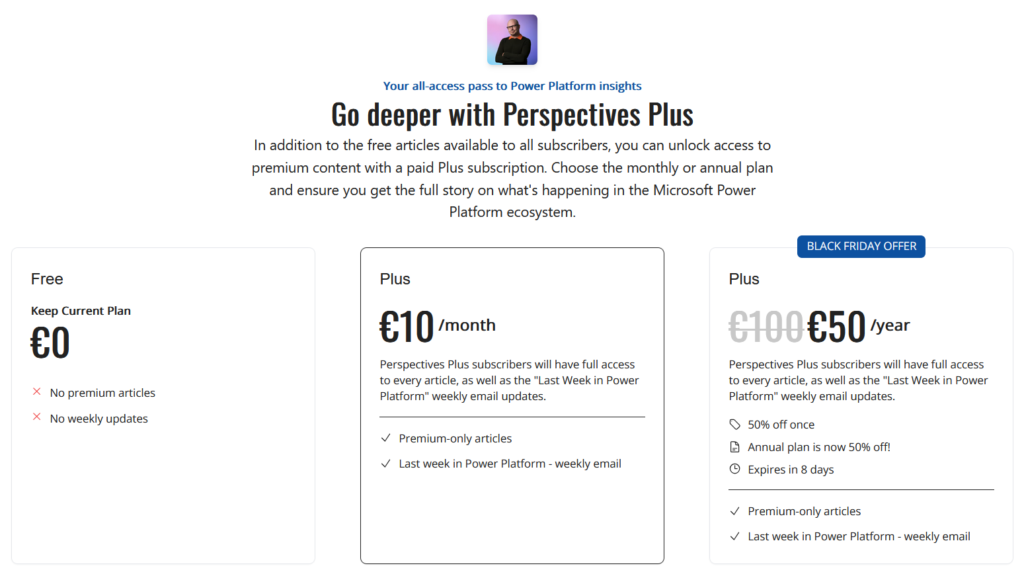
    There will always be a free version of the newsletter available. In addition, I will keep on sharing as much as humanly possible on social media channels like LinkedIn, Mastodon and Bluesky. Because that’s just who I am and how I work: with extreme transparency.

    What the paid version of Perspectives Plus offers is a commitment from me to the subscribers. Rather than merely using these publishing platforms as my own strange form of public therapy, I will now aim to deliver something worth paying for. Right now, it will consist of weekly emails covering recent news and events in our ecosystem (see free example issue). There will also be premium-only articles that dive deeper into the persistent challenges and possibilities in and nearby Microsoft Power Platform. Leveraging my lessons learned and observations made during my 19 years with this ecosystem.

    It is again the start of a new phase for me. Previously it wouldn’t have been either possible or sensible for me to launch a paid newsletter. Now it is, so it has to be done. Then, make adjustments along the way as you learn more about what the audience wants and what I can deliver.

    This is also the first time ever since I can launch an actual Black Friday offer!🎉 For a limited time, you can get 50% off the annual subscription price of Perspectives Plus. Tell your friends and family that this is the perfect Xmas present for them (if they happen to work with Microsoft technology, that is). Use this offer link.

    One final tool related thing. In the last 4 years that I was in charge of creating the everyday visuals for social content of a boutique consulting company, I learned to enjoy Canva. It’s a great example of a citizen tool that allows people with little professional skills yet enough determination to create graphics for whatever purpose. So, to close things off for this blog post, enjoy the promotional video clip I created for spreading the Black Friday offer message in my social feeds:

  • This blog is now part of the Fediverse

    This blog is now part of the Fediverse

    I have been blogging quite a while in terms of calendar time. One year ago I did some math on how much time has been spent on the blogging activity itself. This data can be found in my post “Is blogging worth it?”

    The online world around me has gone through many waves of changes. The most recent one involves the term you see in this post title, which may or may not be familiar to you. I certainly didn’t know about it a year ago. Today, I am making (or at least attempting to make) my first WordPress blog post that goes out into the Fediverse via ActivityPub!

    To put things into context and explain what & why I’m doing, let’s look back a bit on the road that lead to the rise of the Fediverse.

    Humble beginnings

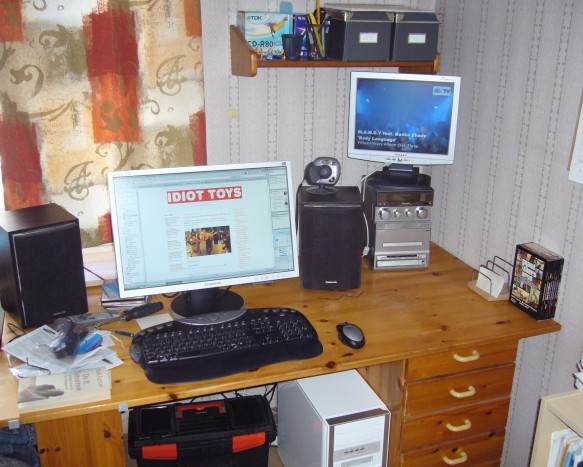
    I started my first blog over on Blogspot sometime in 2007. That blog doesn’t exist anymore, yet recently Google reminded me of the image files they’re still hosting related to that blogging activity. Including this wonderful photo of the actual corner in my bedroom from where it all began:

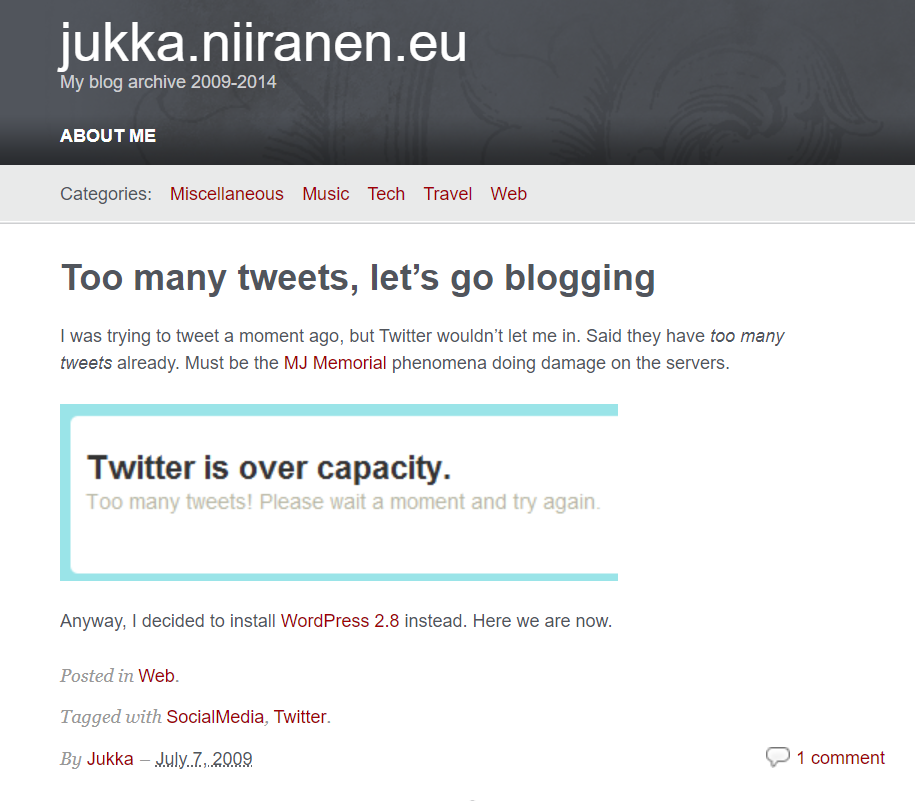
    After I found the Blogspot cloud service too limited, I decided to go on-prem and install a version of Drupal on a hosted server somewhere. That site doesn’t exist anymore either (at least I hope it doesn’t). In 2009 I figured Drupal wasn’t designed for my purposes and moved my personal blogging onto WordPress. That specific blog is still online and this is the first post I found on it:

    That post’s content was a surprise for myself. I would not have recalled that I had originally joined Twitter for the same reason as the masses did: to follow what celebrities around the world were sharing about their life (140 characters at a time).

    A bit earlier, in 2008, I had already started another WordPress blog called “Surviving CRM” which eventually evolved into the blog you are reading right now (“Thinking Forward” at jukkaniiranen.com). The core WP enginge has remained the same behind the scenes (with countless version updates, of course) and the main contents of all the blog posts is also still available.

    Everything else about the blog has changed several times (pages, topics, visual theme, plugins, features, linked services), yet fundamentally it’s the same digital object that was born 15 years ago. With a few domain redirects that I put in place, you could have even started following my blog via its RSS feed back then and still today see this updated that I posted.

    If someone would still be using RSS feeds, that is.

    Social media boom and bust

    My inspiration for starting to write blog posts naturally came from following other bloggers. The method for this was RSS (“real simple syndication”). I started trying out different feed reader software & services (like Netvibes) before Google Reader took over the feed aggregator market.

    Then Google did what Google usually does, meaning killing its products. Presumably the monetization model for online media consumption based on open standards like RSS wasn’t lucrative enough compared to other ways Google could turn user data into something to sell to advertisers. When the hugely popular Google Reader was discontinued in 2013, no similar feed aggregator service took its place.

    The online masses turned to social media services instead. Blog posts were no longer a dedicated feed, now they were just a part of the updates presented via the social graph of users you followed. The likes of Facebook and Twitter owned this graph and realized how much more profitable it was for them to control it – rather than just showing a chronological feed and allowing users to categorize content. Enter the age of the algorithms deciding what the users were seeing.

    Today, the social media as we came to know it in the golden age of Facebook and Twitter is slowly yet surely dying. I had remained an active Twitter user for over a decade, despite of the decline in organic network content and the rise of algorithm pleasing clickbaits and political outrage filling the feed. After seeing the massive damage that Elon Musk managed to create when taking over on October 27th 2022, I decided to stop posting new content on Twitter on November 18th.

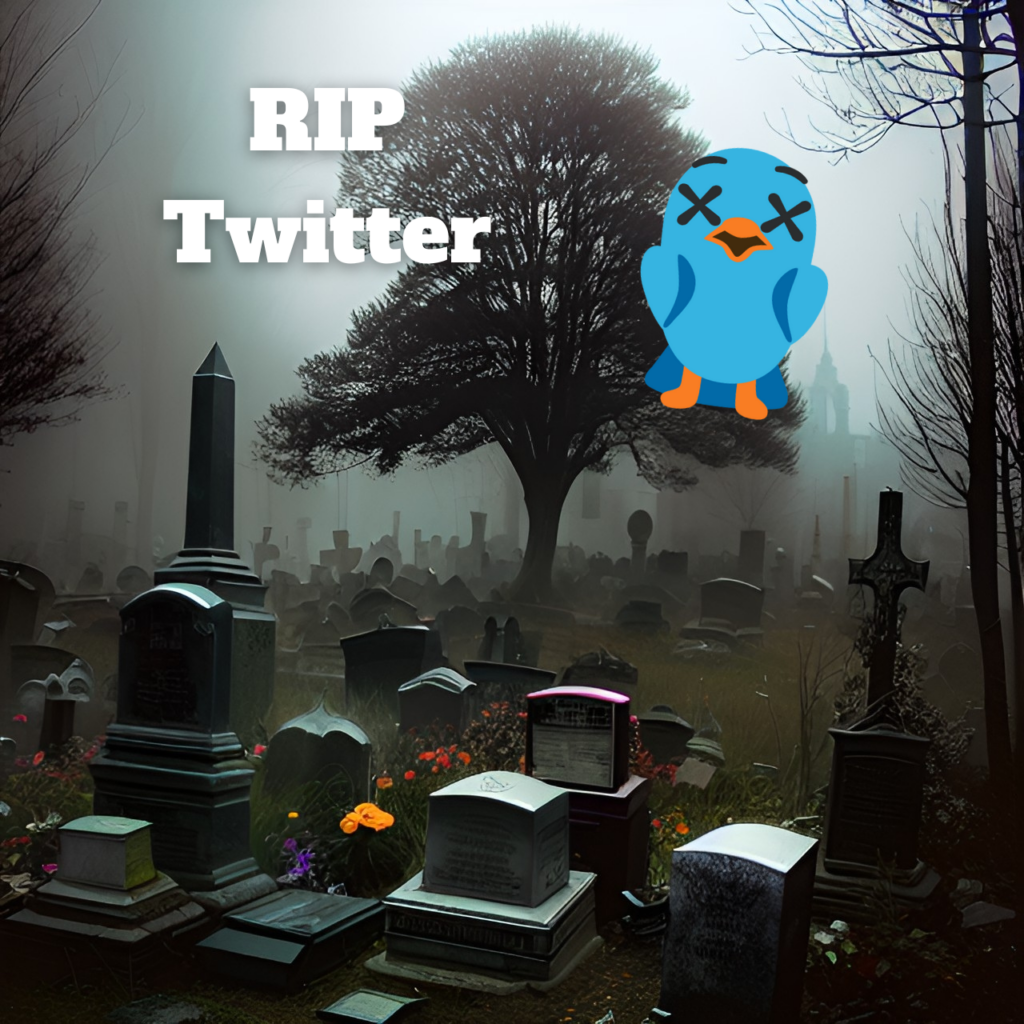
    I knew that the things which had been broken in the process, primarily user trust and the sense of community, would be unlikely to ever get fixed again. To make it easier for everyone, Musk eventually decided to kill also the Twitter brand and replace it with X. That cross shape is a very fitting symbol for the graveyard where the blue bird was laid to rest.

    I’m kind of happy to see this, as it draws a clear line between what Twitter was and what its new owner wants it to be. I wouldn’t want my online identity to be associated with the latter one. No, I haven’t deleted my account nor tweets, because I also don’t believe in changing the world by erasing the past. We can only move forward in this life.

    What comes next?

    Just like there wasn’t a new Google Reader to take over the service that was killed, I don’t believe there will be a new Twitter to take the place of what is now called X. Sure, many will be attempting to build the exact same thing, including the earlier Twitter CEO, or the established social networks like Instagram and TikTok.

    “Insanity is doing the same thing over and over and expecting different results.” So what if some new mobile app comes along and captures the market share for the time that we used to spend on Twitter? The chances of history repeating are high, thanks to the natural life cycle of online platforms that leads to enshittification.

    “Here is how platforms die: first, they are good to their users; then they abuse their users to make things better for their business customers; finally, they abuse those business customers to claw back all the value for themselves. Then, they die.”

    Cory Doctorow on “Tiktok’s enshittification”

    The early days of blogging did not provide everyone an easy onboarding experience nor an streamlined UX for casual content consumption. Yet there was none of this shit. In exchange for all the convenience and endless dopamine shots that the global, proprietary online platforms give us, they will also serve you an ever growing daily dosage of shit on a golden plate.

    At the same time, blogs haven’t technically gone anywhere. No, you’ll never have every TikTok user create their own blog. That is not the goal because there is no one to set the goals but us. If you’re like me, you never even set any goals in life to begin with.

    As long as there is a sense of community being established and ideas are exchanged between people who you wish to interact with – that’s a pretty good life to live online.

    Yet not everything can be a blog post. We can’t pretend to be professional journalists working for major newspapers, writing formal and polished walls of text as the only means of communicating with the outside world. The idea behind social networks isn’t fundamentally broken – only the business model that leads to their inevitable enshittification. What was once commonly called “microblogging” in the distant past has certainly proved its value in the act of idea exchange and information dissemination through peer networks.

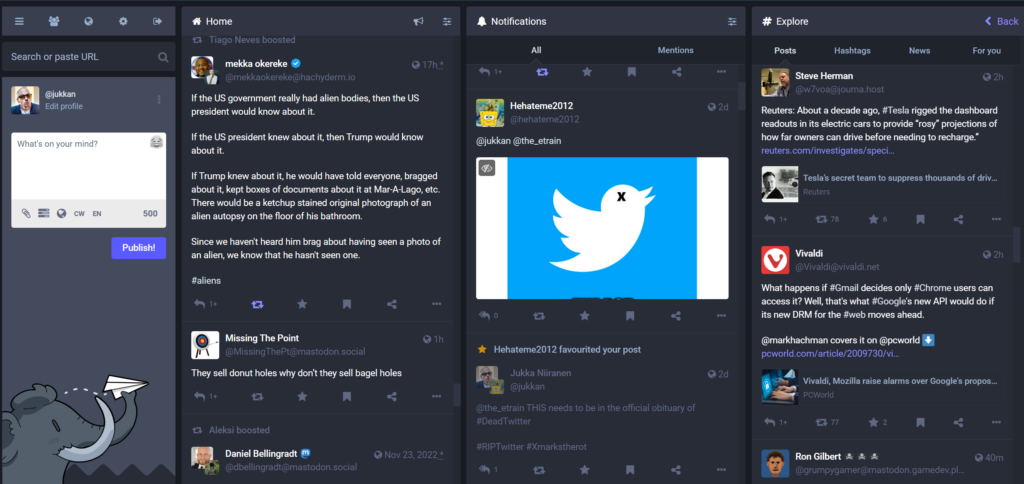
    Once I realized that Twitter was over for me, there was a proper incentive to think about what other tools are there for this type of communication. I saw my network exhibit interest in Mastodon and decided to give it a go. I managed to get past the infamous “pick a server” question, created my user account, searched for other interesting accounts to follow and gradually settled in. Today, it feels like a very natural home for one of my many online identities.

    Mastodon has around 2.1 million monthly active users. As such it won’t be a threat to any of the networks run by publicly listed tech giants. Also many VC funded startups in this market may well be able to burn cash for user acquisition in ways that Mastodon will have no possibility to match – by design.

    In the end, it’s a decentralized social media platform that no single deranged billionaire can acquire. It’s just a bunch of regular folks running a few servers that facilitate the federation of user feed content between them. There are no ads to be found in Mastodon feeds because the whole concept does not exist in that technology. Content isn’t shown to users based on any algorithms because again, that’s not a thing in Mastodon. In both good and bad, what you follow is what you get.

    Hello ActivityPub

    RSS is a protocol. Twitter at some stage talked about their ambition of becoming a protocol for the internet, but quite obviously they didn’t move into that direction. Now, ActivityPub that powers Mastodon and much of the Fediverse is an official web protocol with a W3C stamp on it. It has also gained interest from commercial players like Meta and WordPress.

    Protocols are cool because they are not dependent on any single organization. You can send email from your Microsoft 365 Outlook to a Gmail address and all of the core message content will be similar in both services. The UI, the features and the email experience in general can be different (especially with both MS and Google “reimagining” office applications with their own flavor of generative AI). You can innovate on product development and also the commercial model while still preserving interoperability with other services that use the same protocols.

    So, if ActivityPub is the thing that allows you to both read and publish content on a social network like Mastodon, how does it relate to blogging? Is it just like Twitter you still had to tweet out the links to your new blog posts and make them visible to the followers of your Twitter profile? Well, it’s a bit different – and it’s also still very much work in progress.

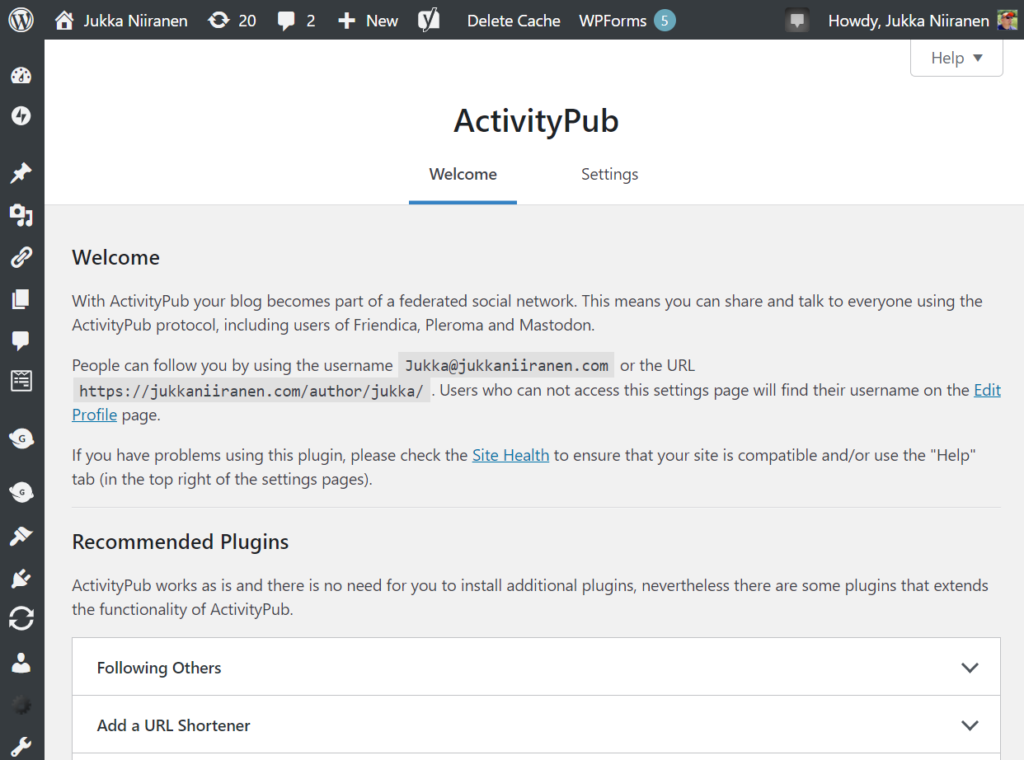
    In March this year the ActivityPub WordPress plugin was acquired by Automattic, the folks behind WordPress.com (and also Tumblr). Presumably the experience will become much more integrated with WordPress in the future, but we can already deploy the ActivityPub plugin on our self-hosted WP instances. Here’s what the settings look like on the admin side for my blog:

    "People can follow you by using the username Jukka@jukkaniiranen.com or the URL https://jukkaniiranen.com/author/jukka/"

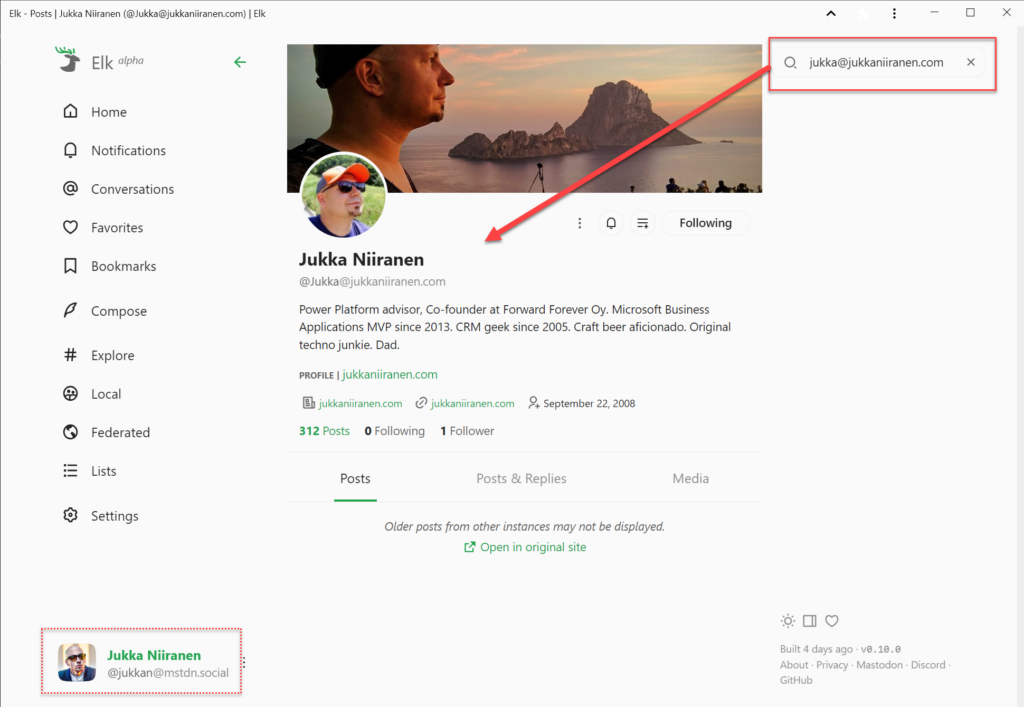
    What’s that all about? It means that when using a service like Mastodon, people can find this blog by searching for “Jukka@jukkaniiranen.com”. As an example, when using the Elk web client for Mastodon and logging in with my @jukkan@mstdn.social account, I can perform this search in the app and land on a profile that represents my blog. It’s an independent thing on the Fediverse that users can follow, even if they don’t care about the rants I post on my “main” profile and just want the long-form content like this blog post.

    It’s kinda cool and confusing at the same time. Which is a lot like setting up a blog was 15 years ago, or what Twitter was in 2009 when I signed up for it. That’s part of the reason why I’m excited about the recent rise of federated online services. You don’t have to be a geek to start using them, but it definitely helps.

    Is ActivityPub the replacement for RSS then? I don’t quite see it that way today. However, for the majority of the current online population who have never subscribed to an RSS feed to begin with, I see a lot of potential in this new protocol to revitalize the social web. To take back control from the mega platforms that are doomed to follow the path of enshittification. To spark up new innovation in both the established web players (WordPress, Mozilla, Medium etc.) as well as make room for new projects to find an audience outside the walled gardens of X, Facebook and the likes.

    Things won’t magically become better with decentralization. Sustainable business models or consumer grade UX aren’t easy to come by with no direct ad revenue. If the popularity of a decentralized service grows, many problems like content moderation or infrastructure scaling will certainly be as hard as on the centralized side. From Twitter to Mastodon, from Instagram to Pixelfed, from Reddit to Lemmy, from YouTube to PeerTube – if the same people move from one technical platform to another then so will the problems caused by people.

    We should not stop moving, though. We should not accept that the one party who holds the most data (generated by the users) gets to decide on the rules. We may not be able to avoid using many closed systems with ad revenue based business models. Yet we must ensure that our content is not captive inside only such systems.

    Evolution is all about competition, about having a choice. For us users of the web to have that choice, we must A) use the power of owning our content, and B) put in the effort to learn and support new tools.

    The best time to start a personal blog was 15 years ago. The next best time is now. The best time to join Mastodon was before the Bird died. Today is another fine day for it. Learn about it from Fedi.tips and follow me (@jukkan@mstdn.social) and this blog (@jukka@jukkaniiranen.com) if you get there!