Tag: training

  • New Courses for Learning Power Platform & Dynamics 365

    New Courses for Learning Power Platform & Dynamics 365

    Microsoft announced in December 2018 that they were retiring many of the Dynamics 365 exams that previously were part of the MCSA and MCSE Business Applications certifications.

    Shortly after that, there was a brand new set of certifications and their associated exams announced. The exams are:

    • Microsoft Dynamics 365 Customer Engagement Core (MB-200)
    • Microsoft Dynamics 365 for Sales (MB-210)
    • Microsoft Dynamics 365 for Customer Service (MB-230)

    By passing the exams you can claim the following certifications:

    • Dynamics 365 for Sales Functional Consultant Associate (MB-200 + MB-210)
    • Dynamics 365 for Customer Service Functional Consultant Associate (MB-200 + MB-230)

    Just today I took the new MB-200 Core exam as beta and I have to say the content has evolved nicely into a much more rich format than what the previous “pick 1/2 out of 4” questions types were. There’s a lot to cover in one exam, as this new MB-200 essentially combines the earlier Online Deployment and Customization & Configuration exams into one. Still, these are all essential skills for anyone who’s working on this ever evolving business application platform from Microsoft.

    So, where does one go to learn these skills for passing the brand new exams? While Microsoft did release the list of new courses that link to these exams, there wasn’t an online learning option made available initially. Traditionally the content would have been published via the Dynamics Learning Portal (DLP) that has been limited only to Microsoft partners (and notoriously difficult for gaining access to). However, going forward the DLP course catalog will not be updated, based on the notification shown on the portal:

    Great, lets head to Microsoft Learn then! Except that this isn’t where the course material for the Dynamics 365 certification exams seems to be landing. You see, Microsoft has also been publishing newer online learning materials on an open platform called edX, like this Power BI course.

    Oh, but that’s actually a different edX than the one we’re talking about here. While edX.org is a platform common to many training content providers, there’s a dedicated Microsoft site at openedx.microsoft.com which served as the hosting platform for the first non-DLP Dynamics 365 course one year ago:

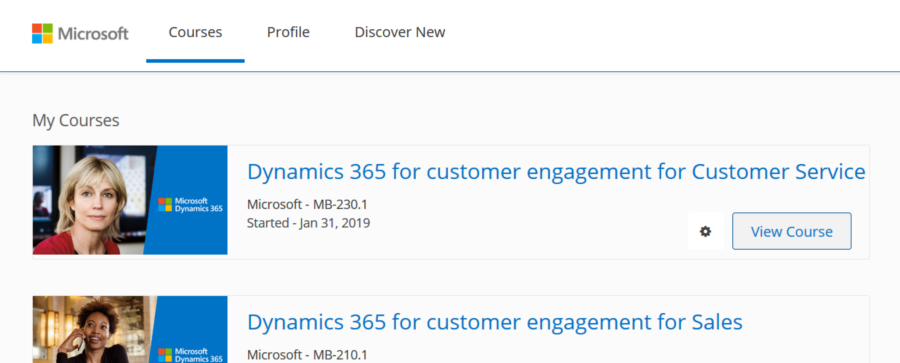
    At the moment there isn’t a visible catalog of the new Dynamics 365 and Power Platform courses on that site yet, but it is fully possible to sign up for the courses via direct links. Here’s what my dashboard at openedx.microsoft.com looks like after picking all the new courses:

    Here are links that should work for accessing the online courses:

    • MB-200T01: Dynamics 365: Power Platform applications
    • MB-200T02: Dynamics 365: Power Platform automation
    • MB-200T03: Dynamics 365: Power Platform integrations
    • MB-200T04: Dynamics 365: Power Platform test and deploy
    • MB-210T01: Dynamics 365 for Customer Engagement for Sales
    • MB-230T01: Dynamics 365 for Customer Engagement for Customer Service

    What’s interesting is that due to the open nature of Open edX, there appears to be a whole network of training service providers that have partnered with Microsoft and distribute these same courses on their portals. As an example, the Finnish IT training company Sovelto has these courses available for free on their SoveltoX portal:

    We may get more clarity on the roles of each channel in the future, but since so many Dynamics 365 professionals are eagerly looking to start preparing for the latest exams, here’s at least a way for everyone to quickly get started on their learning journey. Refer to this post by Mark Smith for a more comprehensive list of links regarding the Dynamics 365 & Power Platform training and exams in 2019.

  • Getting Your MCSE Certification for Microsoft Business Applications

    Getting Your MCSE Certification for Microsoft Business Applications

    No matter if you’ve been in the Dynamics business for over a decade, there inevitably comes a time when you’re unqualified for your job. Not necessarily from a real life competence perspective, but by not having any valid certifications for the Microsoft product you’re working with. This was the fate that I was facing as the year was coming to an end and my CRM 2016 era certificates were about to become worthless in the eyes of MSFT.

    Not that there’s anything wrong with a fine product like Dynamics CRM 2016 yet, but if you’re working for a partner organization then the exams for that particular version no longer count towards your company’s competency eligibility. It’s Dynamics 365 all the way now, no more CRM. It shall be interesting to see how the validity of these certifications will be defined in the new world without any year numbers in the product name, but let’s not worry about that just yet. If like me you are in risk of becoming uncertified, then here’s a bit of information on how to turn things around.

    Welcome to Cloud Business Applications

    Since CRM isn’t a thing for Microsoft anymore, also the competency that MS partners now need to target is called Cloud Business Applications competency. Compared to the earlier and soon retiring Cloud CRM competency the requirements for number of certifications as well as certified professionals have gone up significantly. Silver requires 5 individuals with in total 15 exams passed, whereas Gold is a whopping 15 & 45.

    Alongside this change there has also been a formal MCSE certification introduced for Business Applications. The way this works is that you’re supposed to first take the two required exams for MCSA: Microsoft Dynamics 365 certification: Online Deployment (MB2-715) and Customization & Configuration (MB2-716). Then you have a choice of completing one of the application exams, either Sales (MB2-717) or Customer Service (MB2-718). Now, this conveniently aligns with the Cloud Business Applications competency requirement, so you could simplify them by stating you need 5 (Silver) or 15 (Gold) MCSE’s working for your organization to qualify.

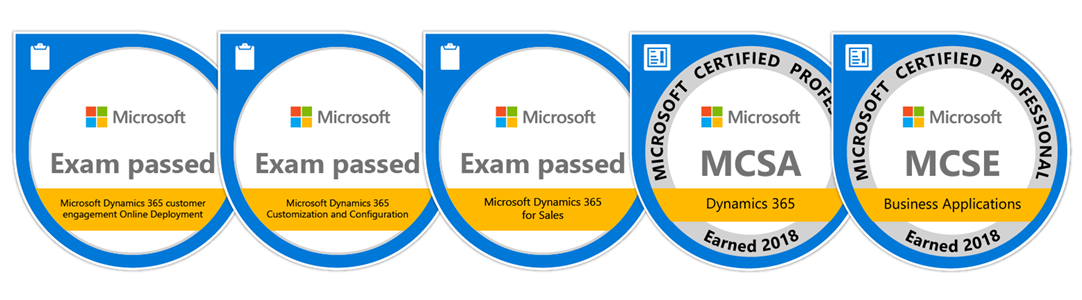
    I chose to complete the first three exams and was automatically awarded both the MCSA and MCSE during the process. Compared to the last time when I did Dynamics CRM exams, there’s now an integration between Microsoft’s exam records and the Acclaim badging platform (yes, that’s an actual thing in today’s world). This means you can easily set up a public profile page displaying all those Microsoft certifications you’ve earned. For example, if you for a second doubt that I might have Photoshopped the above image of my MCSE then HAH! There’s the proof!

    (It’s nice to discover that I now have bonus skills I didn’t even know about, like Dynamics AX.)

    Find Your Way Around DLP

    We now know the why (attain competency) and what (MCSE Business Applications) so let’s talk about how. Dynamics Learning Portal should be familiar to anyone who’s done any homework about how the Dynamics 365 training courses are offered these days. If not, read the friendly FAQ. Now, once your organization has arranged you to have access to DLP, the next hurdle will be how to find the relevant material from this ever growing maze of training content.

    Searching with the exam code like MB2-715 is one convenient way of finding what you’re after. Another nice shortcut is to use a Learning Plan that someone has built and shared with you. Here’s an example of a Sales based Learning Plan that contains the courses for achieving MCSE: click here to add it to your plans.

    Another route to MCSE would be to complete the MCSA foundation courses and choose the Customer Service track instead. That is also available as a shared Learning Plan built by me, which you can access via this link.

    One nice thing about those Learning Plans is that they also show the total duration of all the videos in all the courses that prepare you for the MCSE. In these examples the Sales track contains the Introduction to Microsoft Dynamics 365 course, the Service track doesn’t. The net weight of these packages are 34 and 37 hours. One week’s worth of just watching the course video materials. No practice included.

    Passing The Exams

    That’s probably what you’d really want to learn from this post, right? Unfortunately, no one can be told what the right path to MCSE is. You have to see it for yourself.

    Obviously if this is the first time you’re studying for the exam area there’s going to be a lot more to digest compared to just refreshing your certification to the latest version. If you haven’t even touched the features in an actual Dynamics 365 / CRM environment before, then be sure to reserve a lot of time for poking around the application UI, entering dummy data, changing configuration options and examining their impact, building brand new areas into the application via customization tools, managing user and environment settings, installing solutions, browsing through the documentation, and so on. That’s how you actually learn the skills, not via memorizing the course material contents.

    Even people who have extensive experience on working with the XRM platform are unlikely to do well in the exams just based on the customer projects they’ve worked on. There’s going to be questions about features so ancient and so rarely used that you may not have touched them for 10 years, like discount lists. Then there’s the new stuff that’s still in Preview mode but included in the exam area anyway, so you’ll also have fairly little experience on using it in real life projects, like Relationship Insights. Those are the areas where even an experienced consultant will have no choice but to spend time studying how the product actually works.

    I’ll admit that I didn’t watch the videos while studying for my MCSE, since the areas in my chosen path (that include the Sales certification) were something I’ve spent quite a lot of time with – both in Preview programs exploring and testing the new features as well as designing and implementing solutions to meet customer needs. This meant that I was able to collect the information I needed from reading through the slide decks of each course, as well as glancing over the companion guides providing the text from the videos. These documents can serve as a “refresh pill” for your mind to help you recollect the things you’ve already encountered earlier, but they are obviously not designed to be a full user guide. You cannot replace a healthy learning diet with these pills alone.

    There’s The Exams – Then There’s The Real World

    The application exams are always the ones where I find myself drifting furthest away from my everyday work tasks. The reason is that they sometimes describe an alternate reality where customers actually use the built-in CRM features in a very deep way, with no mention of the customizability limitations and user experience challenges that in reality will steer many organizations away from them. Well, actually it’s the implementation consultants that get burned by an OoB feature and then THEY steer the users away from ever even knowing it exists.

    Making these two worlds collide is actually a positive thing in the end. In the midst of busy project work you rarely get to explore the way that Microsoft designed the application to be used, so you’re likely to focus a lot more on the limitations and differences to the customer’s specifications, not so much on the opportunities hiding within the product. I bet if you never study for the certification exams with the DLP materials then you’re going to miss out many areas where standard features could be applied to solve a real life problem – even if a bit of creativity would be needed in crafting the end solution.

    With multiple choice questions to measure the amount of knowledge crammed into your head, there’s unfortunately going to be some questions in the exams that focus on details you’d normally have very little need to memorize. With a customizable platform it’s not very essential to know a list of default views included or the specific terms used in the (English language) UI – unless you want to get your MCSE certification. In that case you’ll be partially evaluated by how well you recall theses type of details, not only based on what’s your understanding of the big picture and the context in which these details appear in the XRM platform. Oh well, such is life. You’re only going to need a score of 700/1000 to pass the exam anyway, so perfect memory is not a requirement.

    Probably the biggest challenge with the certification system is the pace at which the cloud platform is evolving. There’s just no way that the exam content could target the very latest release available for Dynamics 365 with the way new functionality is rolled out. As the platform and the applications on top of it are further separated from one another (App/Plat separation), potentially leading to an ever more agile delivery practices for new features, this will very quickly make the DLP course content details in conflict with what’s the actual product functionality that (new) customers have available to them. Solving this dilemma would require Microsoft to also move to a more agile process in delivering training materials as well as measuring the skills of the MCSE candidates, since regardless of the DLP delivery channel the exam format still remains very much founded in the era of on-prem software. It remains to be seen if new innovations in this area could eventually transform the certification process in a more profound way than merely making existing the classrooms and test centers virtual via tools like DLP and online proctored exams.

    Imagine All The People, Sharing All The World ?

    If you’re working on the customer’s side of the business, then Dynamics Learning Portal won’t be accessible for you. Sorry, this is a private school that doesn’t accept just anyone interested in Dynamics 365. One reason behind this must be that DLP is also the primary portal these days for Microsoft to deliver partner presales training courses and product announcements.

    There is another way to get to many of the Dynamics 365 training courses, though. Not many people might have heard of the Microsoft Imagine Academy, but now that it’s been featured on the prestigious CRM Tip Of The Day blog, I’m sure eager students are lining up behind their login page door already.
  • Know your application: the MB2-868 exam for CRM 2011

    You pass! That’s a sight for sore eyes after staring at 75 grey screens full of Microsoft Dynamics CRM 2011 Applications certification exam questions for almost 2 hours. I received 750 points out of the required 700 minimum, so not exactly a walk in the park, but who’s going to care about the detailed statistics of how you acquired your MCTS certification?

    During the test I did have to go back to some 15 questions I marked for review during the initial round and spend a fair amount of time rolling the virtual dice in my head. Well, not exactly like that, but rather trying to reverse engineer the process of how the people at Microsoft might have designed the application to function in different scenarios and what reasons and practical limitations lead them to these choices. While many of the questions could well be taken from real life use cases, the way in which you need to be able to solve these problems in the exam is quite far from the normal routines. In real life you experiment, investigate and iterate, whereas here you’ve only got a few words to work on; each of them possibly containing a hint towards the right answer, or alternatively loaded with the malicious intent of leading you astray.

    Just because you’ve been working with the Dynamics CRM application on a daily basis for several years, doesn’t guarantee you would pass the MB2-868 exam. Even MVP’s have failed on their first attempt, so beware! The amount of product information covered in the Applications exam is growing all the time as new features are introduced and with CRM 2011 there’s a lot to read, let alone to try out in the application itself. At least when I was going through the training materials, the most time consuming part was when I constantly kept coming up with new ideas about “hey, this is something we must also set up for our presales demos”. Even though I had started digging deeper into the new version functionality already before the beta of CRM 2011 was released (and compiled my findings into two “what’s new” presentations you can find here: pt1 and pt2), preparing for the Applications exam made me realize how much of pre-2011 functionality you also need to keep in mind at the same time.

    So, tell me then, how important is it to remember by heart from which menus a particular standard report can be executed, when they’re A) all available from the Reports menu anyway and B) usually available in the right context for the user? Or what about studying all the different record statuses in which certain actions can be performed, when we’ve got a graphical, context sensitive ribbon persistently available in the UI, gently reminding us of the things we can and cannot (greyed-out/hidden buttons) perform at any given time? Like it or not, this is the direction that these multiple choice exams tend to drift towards: detailed information that’s perhaps nice to know, but won’t matter much in terms of real life skills required while actually using Dynamics CRM.

    If we look at Microsoft’s target audience definition for this exam, it reads:

    This exam is intended for individuals that plan to implement, use, maintain, or support Microsoft Dynamics CRM 2011 in their organization.  The exam is also intended for service schedulers, administrators, office managers, CEOs, and consultants who want to demonstrate foundational understanding of the application functionality.

    Quite a broad definition then. If you as an end-user or administrator are interested in learning details about the default functionality available in Dynamics CRM 2011, by all means do attend the training courses and download the training manuals from CustomerSource. They contain a wealth of useful information and some nice exercises you can try out in, for example, your very own 30-day trial environment of CRM Online (which may offer you quite a different “vanilla” training environment than your customized production CRM server). However, don’t worry too much about “demonstrating foundational understanding” of Dynamics CRM through the MB2-868 exam. The system is far easier to use in everyday life than how the exam questions portray it, so you’re better off in directing that time and energy towards exploring the possibilities that Dynamics CRM gives you in customizing the system to fit your business data and to automate your business processes. That’s where the real ROI of your CRM system is hiding, after all.

    Microsoft Dynamics CRM 2011 Applications courseware


    For those of you who need to take the exam due to MS partner competency requirements, the MB2-868 exam page section “skills measured”  is a useful document to keep by your side when browsing through all the CRM 2011 applications MOC courseware. Checking the topics enables you to better balance your study efforts, to make sure you’re not just diving deep into one module and neglecting another. This is how everything counts:

    • Marketing automation: 27%
    • Sales management: 30%
    • Service management: 24%
    • Service scheduling: 19%

    For example, service scheduling and service contract management have been standard features of the Dynamics CRM product for a long time, yet I find it hard to discover real life use cases of customers having deployed these processes into production use. Either the organization has initially tried using them, but later given up due to the mismatch of the built-in process flow and solved their problem with custom entities instead, or then they’ve gone down the customization route directly. As a result of this, it’s not necessarily an area that CRM consultants would be too knowledgeable on, when considerably more of their time is spent configuring and training the sales process in CRM.

    Does this then mean that these modules should have less emphasis in the exam? Well, at the end of the day, probably not. If you look at things from Microsoft’s point of view, it is in their best interest to have CRM consultants be aware of all the different functionality that their product contains out of the box. Precisely because their common tendency might be to focus on what they already know best and leave out the rest of the story when discussing with potential and existing Dynamics clients, it’s actually a fair exercise to make these specialists step outside of their comfort zones for a while during the certification process. Sure, you may not need the information in the projects you’re working on right now, but you need to have the ability to get up to speed quickly when duty calls.

    Finally, here’s a few practical tips from me on how to prepare for the CRM 2011 Applications exam:

    • Goal management: understand what values are recorded on which entity, the impact of ownership, fiscal year settings.
    • Teams and queues: this is where most of your answers based on experience from CRM 4.0 will guide you down the wrong path, so forget what you know and learn the new CRM 2011 way of working.
    • Charts and dashboards: what the user can do vs. what the admin can do, this should actually be pretty much 101 stuff if you’re well in grips with the solution management side of things. However, you shouldn’t forget about SSRS entirely: open each default report at least once and try them out, just to refresh your memory.
    • Marketing lists: Try building a few dynamic marketing lists to see how they’re different from the traditional static ones, and also how to mix’n match them.
    • Scheduling: you’ll need to understand how capacity management and resource selection rules work from the service and the resource perspectives, there’s just no way around this.
    • Record statuses: trust me, things that require no attention from you in everyday life will be very important here, so play around with as many different entities as you have time for and examine what actions are available on the ribbon in which record status.
    • RTFM: knowing how the system works is not good enough, as some of the questions are clearly derived from how the use cases are described in the training material, and in these kind of exams every word in the questions and answers is significant. So, don’t just play around with the fun tools built into CRM 2011 or trust what a lecturer tells you – also read through the MOC PDF’s.

    And just to close things off, some useful links for seeing what others think about MB2-868:


  • Microsoft Dynamics file exchange system

    Reinventing the wheel rarely produces a perfectly round object. This is also the case with Microsoft’s attempt to enhance the basic operation of downloading a file from a website.

    If you have Software Assurance for Microsoft CRM, then you will probably also have the rights to use Microsoft Dynamics Customer Source. I know, figuring out how to even gain access there in the first place can be a challenge, but luckily our tech guys had already done the hard part in my company. So, assuming you’re in, you’ll notice that the friendly people at Microsoft have put most of their training course materials on the site, ready to be downloaded. While the course ware designed for classroom training may not ideal for self learning, they are still a great resource for looking up CRM administration related details as you go.

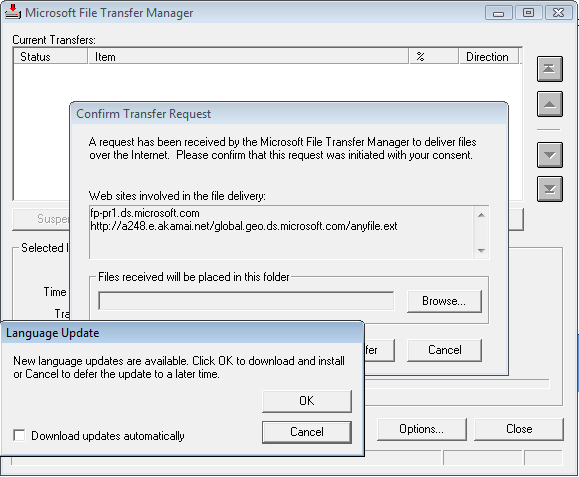
    Instead of the usual download procedure, MS has decided to force everyone to acquire the materials through a  download manager application called Microsoft File Transfer Manager. It’s a tool for providing some controls over the file downloads from Akamai servers, like resuming a broken download. The main question is, why do I need to bother? The downloads are typically a few megabytes in size, nothing I would need to worry about on a company network, since it’s year 2008 and we’re not on 56k modem anymore.

    Compared to the usual “do you want to save the file” prompt, the user now has to run an ActiveX add-on for IE, peform a bewildering amount of clicks and watch a number of pop-up screens to achieve a simple download. The add-on which I just reluctantly installed on my computer is asking for a language update installation only 10 seconds later.

    There is not a single positive feature about this forced process that I can think of, it only masks a simple download operation into something that needs a whole lot of arbitrary “managing”. Kind of reminds me of Microsoft CRM at times. I guess that’s why they’ve chosen the Dynamics users to be the guinea pigs.

    Microsoft Filte Transfer Manager