Tag: R8

  • More rumors on Dynamics CRM browser and mobile support

    While we wait for the official Release Preview Guide for the next Dynamics CRM update, let’s add some more water into the rumor mill. I came across an interesting blog post titled “What’s the status of Microsoft Dynamics CRM 2011 R8 (Update Rollup 9)” on the SyncraTec Solutions blog, which included the following piece of news:

    The Safari browser is not going to work on the iPad.  Instead, there will be a “specific mobile companion application” that won’t be available until post Fall 2012 Release.  This (device-) specific mobile companion application will be based on html5 and work with any of Windows 8, iPad, or other tablet-type devices (e.g., Android).

    So, not only will we be getting a new Refresh UI for the browser experience as well as the inevitable Metro CRM app, there’s also a third in-house CRM client in the works for mobile and tablet devices. Although the deal with making CWR Mobility’s CRM client available with Microsoft’s branding appears to be still in the works, this gives a whole new perspective on speculation for the reason why the mobile clients were delayed together with the cross-browser support. Why put the whole CRM Anywhere concept on hold just because the IE-specific scripts would have caused issues to PC and Mac users on an alternative browser? Well, seems like there’s more to the whole “companion” client story than slide below from WPC 2012 would have lead us to believe.

    I’ve never been fully convinced that it’s a good idea to use a similar CRM client app both on the small smartphone screen and the 10″ screen of a typical tablet device (read: iPad). The use cases for these devices tend to vary quite a lot, at least in my personal experience. The upcoming Metro UI of Windows 8 seems to fit very well with the tablet scenarios that aim to replace traditional laptops as the devices which you take with you to the meeting rooms and other temporary workspaces. However, there are currently zero tablets out there running Windows RT (at least in the hands of end users) and a growing number of iOS and Android devices. Since Metro will make many Microsoft apps exclusive to Microsoft platforms again, how do you capture the audience that needs a mobile CRM solution but doesn’t want to replace all their hardware the very moment Win8 becomes generally available?

    It appears now that this is a market Microsoft intends to go after, by building a HTML5 based client specifically designed for the smaller screens. Based on the above quote, we’ll see an app that is platform specific, but will they take the same route as Facebook did with their iPad app and just embed a browser view into the UI chrome of iOS and Android operating systems? Or will there be more native features used in each platform, which would be the opposite approach to the responsive design paradigm that’s become trendy with public websites nowadays? And what will remain as the domain of the existing iPad app that was promoted so much back in Convergence 2012?

    Another question that arises from statement of “CRM on Safari browser will not work on iPad” is whether this means Dynamics CRM is not officially supported on that browser/device combo or if Microsoft will actually actively block the usage of the browser client on a tablet device? Earlier this spring the message was that the browser support matrix published would indicate which platforms would fall under Microsoft’s customer support plans, but other devices like Android might still work OK. Although the Dynamics CRM browser user interface that has been designed to be used with a mouse would surely not be optimal on a multi-touch tablet, the initial reports from running the UR9 / R8 beta on the iPad Safari browser were saying the experience wasn’t actually that bad at all.

    Returning back to the R8 discussion, we now have confirmation also from a Microsoft representative that the following features will not be published this summer but instead be delayed until Q4 2012:

    • Custom workflow activities on CRM Online
    • Activity Feeds solution update with view filters

    Bummer. Many developers and ISV’s were really waiting for the possibility to start utilizing custom code in workflow processes, but now with CRM Online still not supporting them and 2/3 of new Dynamics CRM customers choosing the Microsoft hosted cloud platform, there’s not much opportunities to release commercial solutions with custom workflow activities until later this year.

    Why the Activity Feeds update is not released either is difficult to understand. While testing the R8 beta the new filter features seemed like a very welcome addition that would surely make it easier to deploy Activity Feeds into the day-to-day operations of CRM users without worrying about how to get the users to follow relevant records. The only sensible explanation for this delay could be that Microsoft has decided to pull back some of their own feed functionality and try to merge them with the Yammer platform’s capabilities. Given the relatively short time frame until Q4, I’m not sure how much integration could actually be developed between Yammer’s feeds and the MS stack of business applications, but let’s see how this thing develops.

  • Dynamics CRM Fall 2012 “Refresh” UI first impressions

    Last year the Microsoft Word Partner Conference gave us a first look at the Activity Feeds solution and other R7 feature enhancements. This year in WPC 2012 we got a taste of things to come in Dynamics CRM on not just one but two client UI’s. Although the Metro CRM app is surely a more significant step in the long run, the updated browser UI will initially have an impact on a much wider user base. That’s why I decided to blog about these news first before jumping into the world of Windows 8.

    The screenshots in this post are taken from the recording of the WPC session titled Microsoft Dynamics CRM — Now and in the Future, in which Bill Patterson presented the future roadmap of Dynamics CRM. We’ll be getting an updated Release Preview Guide soon which hopefully goes into more detail about the changes and new features, so consider this just a sneak peak into what’s coming in the next Dynamics CRM update.

    After the R8 / Q2 2012 release contents on the browser front were rescheduled, we’ll now be getting visible changes also on the Internet Explorer user experience in the Fall 2012 release (in practice the Q4 2012 Service Update). The new “Refresh” UI will take the classic browser experience closer to the Metro look & feel, but it is not the same thing as the Metro app. Point & click mouse interaction is still the focus here, although with cross-browser support you will at least theoretically be able to run this on a tablet with a touch UI.

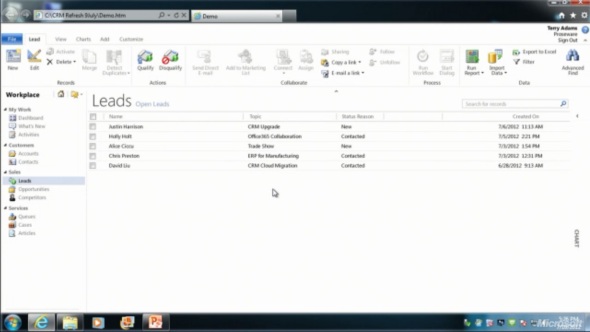
    The changes in the main screen of Dynamics CRM browser client do not appear to be functionally significant, rather just small tweaks in the colors, fonts and other details. We’re moving from the Vista style Aero UI into a simplified, flat Metro UI, which will be visible in all Microsoft products very shortly.

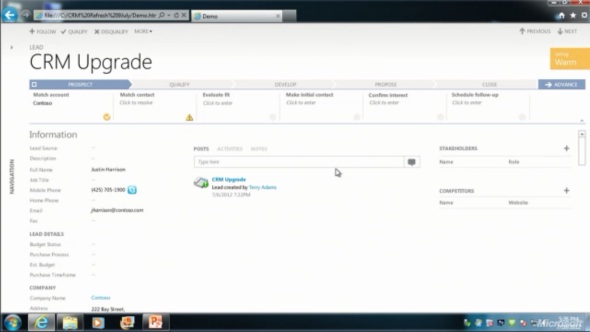
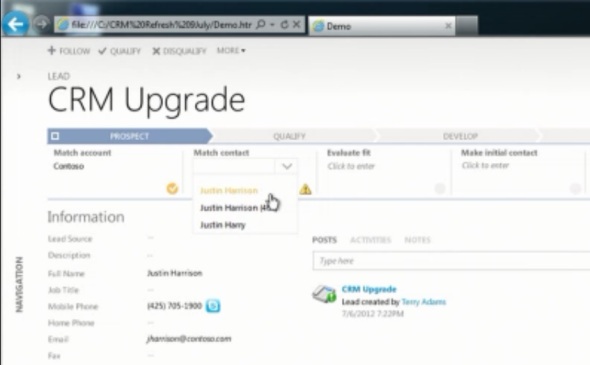
    The entity form windows will experience a much more significant update. Please note that one of the focus areas in the Dynamics CRM roadmap for Fall 2012 is developing the application functionality specifically for opportunity and case management, so I expect these changes will not initially impact all the entities. The demo at WPC covered lead and opportunity forms, below is a screenshot of how the lead form appears in the “Refresh” UI:

    Wow! We’ve come a long way from the CRM 2011 UI. Where should we start with going through the changes?

    Let’s take the ribbon first, or more specifically the lack of it. Although the main window of CRM will still present the full application ribbon, at least on the lead & opportunity forms the ribbon will be minimized by default. Clicking the “More” button will presumably reveal the ribbon, but we didn’t see this in the demo, because the intention of Microsoft is to hide it away as much as possible.

    “Hey, didn’t we just get the ribbon 1.5 years ago?” Yes, we did, but it doesn’t fit with the Metro design principles anymore, which state: only deliver the right information to the user at the right time, don’t overwhelm them. Touch UI on tablets and phones makes this even more important, which is quite easy to understand. For the power users (most of the readers of this blog, I’d imagine), the wealth of functionality presented on the ribbon must have felt like a welcome addition back in Office 2007 or CRM 2011, but this doesn’t necessarily mean it’s the right design choice for a CRM application. Results of the usability research Microsoft has conducted can be summarized in the following quote from Patterson:

    “Ribbon is great for the power user, but the everyday user just wants the file menu back.”

    Well, that’s it then. RIP ribbon 2011-2012, it was nice to know you. While the reality may not be quite as black & white, anyone designing solutions on top of the XRM platform should definitely take the inevitable fate of the ribbon into consideration.

    If we don’t have the ribbon there to guide the user anymore, then what can we use instead? The answer is: processes. What is called the Process Driven UI in the development roadmap will in practice manifest itself as a graphical, interactive process stage indicator on the top section of the entity form.

    According to Patterson, the new UI is built on the Dialog Process foundation established in the original CRM 2011 release. Presumably the arrow titles will then come from process stage names. Each stage can contain multiple steps that the user needs to complete (although they don’t appear to be mandatory, at least in the lead qualification demo). Logically these would then be created with the Prompt and Response pairs available in current dialogs. The user can progress from one stage to another manually by clicking arrows on the far right corner of the process graph, but presumably there will also be support for creating conditions for automatic rules to update the stage of a record.

    Without knowing much about the features and initial limitations yet, the Process Driven UI looks like an excellent addition to the Dynamics CRM application. Workflow and dialog processes have so far been almost invisible to the user, which has made CRM look like just a static place for entering, reading and updating fields on a form. By bringing the process thinking into the foreground, the barrier for using CRM to really automate business processes will become significantly lower, which in turn can make the application a much more valuable tool for the organization using it.

    Moving on with the UI review, into the main form sections, we can see another welcome addition: the built-in follow-up activity functionality is back! When the form assistant was deprecated in CRM 2011 we lost the ability to quickly create follow-up actions from the previous activity form (unless you built a custom process for this, as I’m sure many organizations have), but now it returns into the  core Dynamics CRM application.

    These follow-ups, like any other related record presented on the form, are fully editable directly on the parent entity form instead of a separate pop-up window, which has been a paint point that Microsoft is working hard on trying to eliminate. Modern web apps don’t have popups and modern devices (tablets and smartphones) don’t support them, so inline editing is the only sensible way going forward.

    Notice how the traditional form fields of a lead are all stacked up on the left side. With the related entities navigation collapsed by default, this single column approach actually looks pretty good. Must be because the iPad and Metro apps are teaching us that fields don’t exist side by side but on top of each other. But what do you then fill the rest of the screen with?

    The answer: related records. In the opportunity form example there are subgrids of stakeholders (Connections), Competitors and pursuit team (possibly new team management related entity, or just a Connection type?), although they barely look like subgrids at all since the Metro style form design blends these seamlessly into the entity form. In the middle there’s a combined list that shows Activity Feed Posts, Activities or Notes, depending on the selected tab. Another design choice that sure feels better than spreading these records into a wall web resource, subgrid and a notes/attachments list as they are in the current CRM 2011 UI.

    Also pay attention to the top right corner of the form, where there is a highlighted section of entity fields, in this case the opportunity probability, rating, estimated close date and estimated revenue. Whether these are business required or business recommended fields that get automatically promoted into this section of the UI remains to be seen. It’s like a form header section that is actually editable, which could be another possible implementation method. As you may or may not have noticed yet, the header and footer section of the lead and opportunity forms are now history, with no apparent way of bringing them back, unlike the ribbon with the “More” menu.

    All in all, what the WPC 2012 demo showed us is almost like a whole new application. The way in which the lead-to-opportunity process now flows within the same window, without a single pop-up window is nothing short of revolutionary, if you compare it to the current Dynamics CRM UI logic. The navigation paths in the application have remained fairly static from v3.0 to 2011, with the latest major version adding a large amount of new UI components (ribbons, charts, subgrids, filters) into the mixture but not really changing the core concepts. Now with the Fall 2012 browser client update and the Metro CRM app looming in the horizon, all of a sudden the  Dynamics CRM user experience is about to get redesigned in a major way.

  • Dynamics CRM roadmap for Fall 2012 release and beyond (the road to Metro)

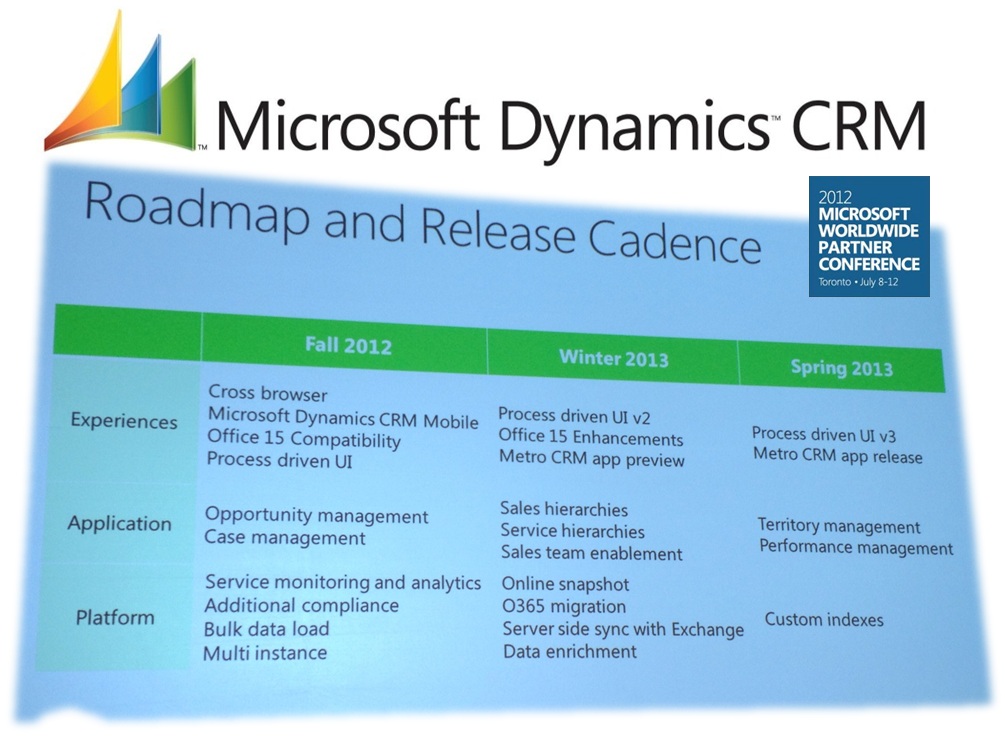
    After the unfortunate delay announcement of R8 / Q2 2012 Service Update planned functionality into Q4 2012 (cross-browser and mobile, read it all here), we have some more upbeat news regarding the future of Microsoft Dynamics CRM. As of now there is no official document available on this information, but the screenshots from World Partner Conference 2012 (WPC) already give us plenty of new information and reasons to get excited about the road ahead. Without further ado, here’s what the future releases of Dynamics CRM are planned to contain:

    Click here for a bigger version of the picture. Now, let’s break this roadmap slide down into pieces so we can better digest the contents.

    No more references to “Q4 2012 Service Update”, R9 etc. Instead we now have the functionality placed into Fall 2012, Winter 2013 and Spring 2013 updates. Whether this is the official new naming policy for Dynamics CRM updates remains to be seen.

    “Refresh” UI coming to the browser client presumably in Fall 2012 update. These UI changes have now been merged with the cross-browser support, which was delayed from Q2 2012 to Q4 2012. The new UI will have a Metro feel to it, but it won’t be an actual Metro app. Simplified appearance with less colors seems to be the way to go here. If you’ve seen the leaked Office 15 screenshots, that’s probably where CRM is going as well.

    Office 15 (Office 2013) compatibility in Fall 2012, enhancements during Winter 2013. Since we don’t have a beta of Office 2013 available, the future functionality is unconfirmed, but I’d imagine CRM to integrate with the Agaves feature, for example. Making the CRM client compatible with Outlook 2013 should be an obvious deliverable here.

    Process driven UI, to be launched in Fall 2012 update and developed further in consecutive releases. The demo from WPC shows a persistent process “timeline” graphic on top of the lead form, which visualizes the stage the record is in and he information & actions required in that stage. What’s interesting is that this process in the demo flows seamlessly from a lead record onto an opportunity record. This looks like a highly interesting new feature that will hopefully allow us to make workflow and dialog processes as well as status reason data easier for the CRM user to understand and interact with. Also notice how the lead entity form in the demo presents fields and subgrids in several columns side by side, with the form navigation collapsed.

    Metro CRM app preview in Winter 2013, full release in Spring 2013. Yes, the real deal, not just a generic Dynamics app we’ve seen in the keynote demos in Convergence 2012 and now WPC 2012. CRM reimagined.

    Application functionality updates. Opportunity management and case management enhancements in Fall 2012, presumably to go alongside the process driven UI. Sales & service hierarchies, sales team enablement in Winter 2013, providing some of the team functionality visible in the Metro demo. Territory and performance management in Spring 2013.

    On the platform side there’s plenty of new things lined up. For Fall 2012 we have:

    • Service monitoring and analytics (á la Office 365 Trust Center)
    • Additional compliance (more certifications for CRM Online?)
    • Bulk data load (improved data import wizard?)
    • Multi-instance (?)

    Winter 2013 promises us:

    • Online snapshot (can we download a copy of CRM Online database as self service?)
    • Office 365 migration (is this the move from CTP to OSDP, finalizing the “better together” story for existing customers?)
    • Server side sync with Exchange (R9 rumor from Convergence now confirmed, no more Outlook client dependency)
    • Data enrichment (could be Azure Data Market, InsideView or something similar for filling customer details from external databases & networks)

    And finally “custom indexes” for Fall 2013. A lot of questions arise from a single roadmap slide, but that’s what the upcoming Q4 2012 Release Preview Guide will hopefully address once released during the summer.

    A big shout out to CRM MVP Mark Smith from Magnetism for sharing the pictures he grabbed during the WPC 2012 sessions. You can find his WPC album on SkyDrive, filled with Metro goodness. I’ll close off with another beautiful scene from the Metro CRM and start counting the days to when I can get my hands on a Windows 8 slate running the preview app.

  • CRM Anywhere not here yet, Q2 2012 Service Update functionality delayed until Q4 2012

    The big question on the minds of many Dynamics CRM customers and consultants has lately been: when is the Q2 2012 Service Update / R8 / Update Rollup 9 / “CRM Anywhere” update going to be released? Even though Microsoft has a policy of not announcing any official dates for new software releases beforehand, the agile release policy they announced back in Q2 2011 as well as the name of the update announced in February 2012 were all indicating that a release was imminent before the end of Q2 2012. Since then, we’ve seen Q2 turn into Q3 and no news has been shared regarding the planned schedule for the release. Until now, that is. On July 6th 2012 we finally received an announcement on what’s going on. Let me quote the important bit for you:

    On July 19th, as we committed, our Q2 release will include Microsoft SQL Server 2012 support, Industry templates and certifications for our online service. After listening to the feedback from our customers and partners we are delaying availability of Microsoft Dynamics CRM Mobile and cross-browser support. These were previously scheduled to be delivered in the Q2 2012 Service Update, and we now plan to deliver them in the service update scheduled for Q4 2012.

    In short, “CRM Anywhere” has been postponed from Q2 2012 to Q4 2012. A six month delay on using Microsoft Dynamics CRM on Chrome, Firefox, Safari and any non-PC hardware. Well isn’t that just splendid. I’m sure none of the Microsoft partners had started selling the Dynamics CRM product to any Macintosh shops in preparation for Q2 2012…

    OK, I won’t bash MS about this any more than the above comment, because I fully understand the situation they are facing. To be honest, I’ve had some serious doubts about how the cross-browser support would have played out if delivered in Q2 as planned. Even though the standard UI of an out-of-the-box Dynamics CRM implementation can surely be transformed into a standards compliant version if given enough resources, it’s a very tricky situation when it comes to customizations and extensions created by the CRM ecosystem. VAR’s, ISV’s, sysadmins, basically anyone with access and know-how on tweaking Dynamics CRM to do what is required of it have been doing just that for several years now. As a result, there’s a huge amount of unsupported scripts out there that simply would not work in the brave new cross-browser world.

    Sometime ago (2 weeks ago, actually), the CRM team released a Custom Code Validation Tool that was designed to help these same people to resolve breaking script issues when upgrading to the next release of Microsoft Dynamics CRM. That’s certainly a great help in proceeding with the task at hand, but unfortunately it was a bit too late when compared to the original target schedule of “CRM Anywhere”. If you run the tool on even the official CRM Demo Builder environment created by Microsoft, it won’t pass without “red” and “blue” errors either. In short, there are not very many environments out there right now that are capable of demonstrating Microsoft Dynamics CRM on an Apple OS X machine running Safari, at least with any impressive customizations and integrations to external data sources.

    Would you have felt comfortable with releasing an update into the wild that would have wreaked havoc in many customer and demo environments? Would that have really conveyed the proper image of “CRM Anywhere” to the potential and existing customers? Most likely it would have not. There are times when you need to be able to announce breaking changes (like with current Windows Phone 7 devices not being able to run Windows Phone 8 apps due to a shared Win8 core architecture, as we’ve recently discovered), but probably this was not one of those times really. Ultimately, I think the decision that Dennis Michalis and his team has made must be the right one, as they certainly would not have made it lightheartedly. The business benefits of a CRM system must triumph the technological benefit of cross-browser support and the customers would presumably agree. Could the announcement have become sooner? Definitely it should have, but it didn’t, and that’s what we now need to adjust to now.

    Still, one may ask how did we end up in this situations? It’s a design decision Microsoft has made back in the days (as I’ve blogged about earlier) and now they’re paying the price for it. So, that’s how it is and that’s just life. You could find some resemblance to the situation from Dynamics CRM ISV’s and VAR’s investing their efforts on developing Silverlight add-ons and then finding out last fall that Windows 8 Metro browser would not be supporting any plugins (including Silverlight, but excluding Adobe Flash). Life, as we know, goes on nonetheless as the ecosystem will find ways to route around the problems, much like the Internet as a fault-tolerant system was originally designed to do.

    What’s up with the mobile support delay then? After all, CWR Mobility has built clients for iPhone, Android iPad etc. and has been selling them throughout the whole 1H/2012. In fact, since the Microsoft Dynamics CRM Mobile product delivered and supported by Microsoft was only going to cover CRM Online customers, not on-premises or hosted environments, it’s perfectly justified to present the question “what do you mean it’s delayed until Q4”? What exactly did the mobile client announced in Q2 2012 Release Preview guide contain from a functional perspective that customers couldn’t already acquire directly from CWR Mobility? If you ask me, this is more about adjusting the commercial story of “CRM Anywhere” rather than physical limitations, but we can of course hope that the Q4 2102 launch will bring us significant functional improvements as well as a more coherent process for customers wishing to deploy the mobile clients.

    How about the rest of the mobile/social/local/etc. CRM market in general, will that just run over Dynamics CRM now as a result of this? I personally don’t think so. If you look at some of the competing CRM products out there, we’ve seen Salesforce.com announce their Touch client for mobile and tablet devices already last September, but it remains in beta as of now. After all, it’s quite easy to create great looking concepts of the way the social business of the future should operate, but very rarely is there a chance to start from a pure, clean slate. If you have no legacy processes and apps to worry about, you probably have no valuable, long lasting customer relationships either, which sort of undermines the whole effort.

    Let’s remember another important aspect here: Windows Reimagined a.k.a Windows 8 is one of the biggest gambles Microsoft has ever made and it’s due out in Q4 2012 (unconfirmed, as usual, but you get the drift). If the next Dynamics CRM Service Update is scheduled to be released in the same timeframe, then do you think that there would be any chance of receiving an actual Metro client for CRM at the same time? We can always hope of course, and the Worldwide Partner Conference 2012 to be held next week could well shed some light on this topic, one way or another. Personally I think it’s a bit of a long shot still to make it into the same time frame as Windows 8, but even a preview/beta would be way cool. I guess we’ll learn about that soon enough as WPC 12 kicks off.

    Finally, if cross-browser support has now been delayed to Q4 2012, then I think there’s one favor that we can ask from the Dynamics CRM product team: could you please enable also the customization part of the UI to be cross-browser by the time Q4 2012 Service Update rolls out? It’s not that I have anything against Internet Explorer as such, but I think the #MSDYNCRM community deserves a tiny little upside in all this, don’t you think?

  • CRM adventures in Azure: SQL Server 2012 updates

    CRM adventures in Azure: SQL Server 2012 updates

    Windows Azure Pricing Calculator for Virtual MachinesAfter Microsoft announced their latest enhancements to the Windows Azure service catalog in the beginning of June (although still in a preview phase), I wanted to test the Azure Virtual Machines for running a Microsoft Dynamics CRM 2011 server instance in the Microsoft hosted cloud. Since we now have an excellent step-by-step tutorial available from Shan McArthur / AdxStudio, it was a breeze to get going with the installation process. You should also check out the Gold Coast blog by @devkeydet for some really helpful articles, such as Building a CRM 2011 dev box using a Windows Azure Virtual Machine. With high quality community content like this available, who wouldn’t want to build a CRM server in Azure?

    Hopefully I’ll get a chance to write some of my own experiences on working with Windows Azure in the future, but the first issue I ran into is actually more related to SQL Server in general.

    Side-by-side was not on my side

    In addition to Azure, I also wanted to utilize the latest SQL Server 2012 version to investigate what new reporting capaibilities it might offer compared to the trusted old SQL 2008 R2. The SQL 2012 installation went through without any errors but after I tried to launch the CRM installation I discovered that Reporting Services was not running. In the application log I had the following errors:

    Service cannot be started. System.IO.FileLoadException: Could not load file or assembly ‘ReportingServicesNativeServer, Version=11.0.0.0, Culture=neutral, PublicKeyToken=89845dcd8080cc91’ or one of its dependencies. The application has failed to start because its side-by-side configuration is incorrect. Please see the application event log or use the command-line sxstrace.exe tool for more detail. (Exception from HRESULT: 0x800736B1)
    File name: ‘ReportingServicesNativeServer, Version=11.0.0.0, Culture=neutral, PublicKeyToken=89845dcd8080cc91’ —> System.Runtime.InteropServices.COMException (0x800736B1): The application has failed to start because its side-by-side configuration is incorrect. Please see the application event log or use the command-line sxstrace.exe tool for more detail. (Exception from HRESULT: 0x800736B1)
    at Microsoft.ReportingServices.Library.ServiceAppDomainController..ctor()
    at Microsoft.ReportingServices.Library.ReportService.OnStart(String[] args)
    at System.ServiceProcess.ServiceBase.ServiceQueuedM…

    Activation context generation failed for “F:\SQL\Microsoft SQL Server\MSRS11.MSSQLSERVER\Reporting Services\ReportServer\bin\ReportingServicesNativeServer.dll”.Error in manifest or policy file “C:\Windows\WinSxS\manifests\amd64_microsoft.vc80.atl_1fc8b3b9a1e18e3b_8.0.50727.4053_none_8a1a02152edb659b.manifest” on line 0. Invalid Xml syntax.

    After a bit of googling I landed on a blog post on SQL Server VC++ Installation voes, which seemed to describe the exact same issue I was facing. I tested the sxstrace tool and the System File Checker (SFC) referenced in the post, reproducing the same results as the author was getting. It turned out that this side-by-side (SXS) error was caused by a manifest file that was empty. A similar discussion was also found in the Windows Azure Virtual Machines for SQL Server MSDN forum, so figured I must be on to something.

    Just before I was about to start modifying the manifest file properties and copy pasting the content there, I noticed that there was one detail which stopped me from proceeding: both of the posts were referencing an x86 processor architecture file (x86_microsoft.vc80.atl_1fc8b3b9a1e18e3b_8.0.50727.4053_none_d1c738ec43578ea1.manifest), whereas my error was related to the amd64 version (amd64_microsoft.vc80.atl_1fc8b3b9a1e18e3b_8.0.50727.4053_none_8a1a02152edb659b.manifest). So, I needed to hunt down the correct manifest file content for the 64-bit version with the proper hash value, but unfortunately this was where my googling came up short.

    After being a bit more creative with my search terms, I discovered the Microsoft knowledge base article 2688946: FIX: Error message when you install SQL Server 2012: “The identities of the manifests are identical but their contents are different”. The article also said that the fix for this issue was released in Cumulative Update 1 for SQL Server 2012. So, off to KB 2679368 then to request a download link for the CU1 file. Looks like MS doesn’t want just anyone installing these, so they make you fill in a form with your email address + captcha in order to get the file, but luckily that’s all there was to the process.

    I was a bit puzzled by the fact that the CU1 installer said “This installation provides updates for the Community Technology Preview (August CTP)“, but apparently it’s fully valid for the RTM version, too. I guess the components in SQL tend to be less strict about versions, since the SQL Server 2012 Reporting Services Configuration Tool still has “SQL Server 2008” in the process description… Anyway, after applying CU1 I was able to start the Reporting Services service and proceed with the CRM installation. Success!

    The lesson: there’s always an update hiding somewhere

    When building your development or demo environment, it’s important to be aware of the fact that what you get from the MSDN subscriber downloads site is mostly RTM bits. Especially when going for SQL Sever 2012 as the database for Dynamics CRM 2011, you should not use these files at all, because the installation won’t work. Just grab the product key from MSDN, but go to Microsoft Download Center here (direct download link to CRM 2011 Server) to get the new version that includes Update Rollup 6. Otherwise you won’t be able to configure the Reporting Extensions and will get the error “Unable to validate SQL Server Reporting Services Report Server installation. Please check that it is correctly installed on the local machine.” See this thread on the CRM Forum for some more info.

    Shortly after completing the CRM installation I discovered that there is in fact already a Cumulative Update 2 for SQL Server 2012, too. Wow, things move fast nowadays! Didn’t SQL 2012 get released just recently? Well, it turns out that actually the first cumulative update to SQL Server 2012 was released only 9 days after the general availability (GA) of SQL 2012. Let’s have a look at the Incremental Servicing Model of SQL Server in a bit more detail to understand what’s going on.

    It looks like also the SQL Server team have adopted a fairly agile release policy that mirrors the Dynamics CRM release roadmap concepts to some extent. What they call a Cumulative Update (CU) seems to correspond to the Update Rollup (UR) in the Dynamics CRM lingo, meaning they are both collections of hotfixes, released on a bi-monthly target schedule. However, unlike CRM Update Rollups that are nowadays delivered through Windows Update / Microsoft Update, the SQL CU’s won’t be delivered through this mechanism, because those updates need to fall into the General Distribution Release (GDR) category as defined by Microsoft (you didn’t think it was going to be that simple, now did you?). So, that’s why after installing SQL 2012 + CRM 2011 on a new Windows server you’ll automatically get Update Rollup 8 for CRM, but no updates for SQL. If you need the latest hotfixes, you should acquired the Cumulative Update package through the KB pages.

    Finally, yes, there will also be a Service Pack 1 for SQL Server 2012 released eventually, as many people will refrain from deploying a production database on a new version until this traditional MS software milestone has been reached. Whether the SP1 for SQL 2012 will be a similar release as the Q2 2012 Service Update for Dynamics CRM (to be released sometime in Q3) I’m not so sure, since in the world of CRM these Service Updates contain significant new functionality in addition to the previously released hotfixes. The latest information on SQL updates can be found from the SQL Release Serivces Blog. Note that there are no Service Packs available for Dynamics CRM, so the terminology used in describing the release policies will likely remain different from other Microsoft products like SQL or Windows. For a more detailed description of the CRM update terminology and delivery mechanisms, please see my previous post on the topic.

  • When will my cloud get updated? CRM Online and Update Rollup status

    The benefits of running your Dynamics CRM application in Microsoft’s cloud is that you don’t have to worry about installing update rollups to your server, since MS takes care of all that maintenance. The downside is that you can’t be sure when exactly the updates take place. As we’re coming closer to the expected release date of Dynamics CRM R8, it’s a good time to reflect on the past update schedules of CRM Online.

    As of mid-June, CRM Online organizations are still running only the Update Rollup 5 version (at least on the EMEA CRM4 data center), while on-premises environments may already be running Update Rollup 8. No matter if you use an existing environment or sign up for a new trial organization, the version you get is 5.0.9688.1561. This corresponds to roughly the build number of on-premises UR5, which is 5.0.9688.1533, whereas Update Rollup 6 is 5.0.9690.1992 already. How can you check the version of your CRM Online application? Simple: on the browser client just click File – Help – About Microsoft Dynamics CRM. You’ll see version from the top of the pop-up screen.

    So, where do I go to translate those ten digits into a human readable version name? For the list of detailed build numbers, related KB articles and other information, be sure to bookmark this page on the Dynamics CRM In The Field blog: Microsoft Dynamics CRM 4.0 and 2011 Update Rollup Release Dates, Build Numbers, and Collateral. That page is being updated as new rollups are released and it also has in the past contained projected release dates of upcoming updates as well. Has, since at the time of writing it no longer does. Also note that the CRM Online build numbers and release schedules can and will differ from on-premises, as we’ve already seen.

    How to check the Update Rollup version on CRM Online

    Back when Update Rollup 7 was released on March 22nd, the accompanying post on the CRM Team blog promised the CRM Online Datacenter update schedule to “Mid to Late April, 2012”. This was also the information on the related article KB 2600643, but things have changed since then, as now all the post UR5 KB articles read:

    For online customers Infrastructure improvements are being made to CRM Online. Because of this, update rollups will not be applied to servers until the improvements are complete. Through the System Notifications page for the system maintenance window, you will be notified of when your organization will be updated to the new infrastructure. The latest updates will be applied at that time. 

    It’s no secret that Microsoft is working on bringing the Dynamics CRM Online and Office 365 clouds onto a single platform and unifying many of the surrounding components, such as subscription management or user authentication. This has apparently caused the planned schedules of Update Rollups to CRM Online get changed from those earlier communicated. When UR5, also known as the Q4 2011 Service Update, was released, it was deployed first to CRM Online environments before becoming available for on-premises and hosted environments. Since then we’ve seen UR6, UR7 and UR8 all get released to the on-premises environments first, with CRM Online remaining in the “UR5+” status for quite some time. Note that the builds are not exactly the same and there are likely to be differences in what the terminology means for different platforms. For example, UR6 brought support for SQL Server 2012, but we’ve already heard Microsoft say that CRM Online was running on SQL 2012 long before that.

    What the current status of updates to the Microsoft hosted cloud means that CRM Online customers are not yet able to leverage enhancements brought in UR6-8, such as the read-optimized forms introduced in Update Rollup 7. Also any server side bugfixes and functional changes beyond UR5 must be assumed to be lacking from CRM Online organizations, although we can’t know for sure what may have been applied as hotfixes. For example, problems with connections not merging when deactivating duplicate records was fixed in UR7.

    On the client side things are a bit different, since all the Update Rollups are rolling onto CRM Outlook clients through Microsoft Update. There is no longer a separate client version for Online and on-premises, so everybody gets the same hotfixes. Even though Microsoft recommends that the client and server Update Rollup versions should be kept close to one another, they don’t need to be identical. Here’s what it says on the CRM In The Field blog:

    The general rule of thumb is to try to keep the versions in sync as much as possible. However, it is permissible (though not recommended as a long-term solution) to run mismatched Update Rollup versions on Outlook client and server, as Microsoft does do some testing of such combinations.

    So, since the CRM Online version difference is obviously well known by MS, the UR combinations shouldn’t be an issue for Outlook users who’ve deployed the latest Microsoft Update packages. Even if you’re using the offline database in your CRM Outlook client, I assume compatibility between the CRM Online database has been taken into consideration. Of course in the field of IT, you should never assume anything, rather you should test any Update Rollups in a dedicated test environment, but smaller CRM customers may not always have that luxury. Which gets us to the following rule of thumb: don’t ever be the first one deploy the latest Update Rollup once it’s released. Wait a few weeks and check out the CRM forums and blog posts to read about the experiences other users have with the latest update, only then decide to deploy the update onto production devices (first onto your own test servers and clients, if you have them available). The Dynamics CRM community tends to be quite effective in reporting new issues that arise with UR’s, so leverage the wisdom of the crowd and save yourself from some unpleasant surprises.

    The big question that many people are searching for an answer to is: when exactly will Dynamics CRM R8 / Update Rollup 9 / Q2 2012 Service Update be released? (In case that previous terminology trio made no sense to you, be sure to read my explanation of the “Dynamics CRM update & version madness”.) I wish we knew, but in reality only Microsoft has that information and it hasn’t been publicly communicated. We’ve got less than two weeks to go on the Q2 of 2012, which makes it a tight schedule to keep if also Online organizations would need to be updated in addition to releasing the on-premises bits. We need to remember that R8 is a very significant update due to the added cross browser support, which will surely keep many CRM developers busy with fixing legacy scripts, so any issues that the R8 beta program may have revealed certainly need to be thoroughly investigated and I’m glad if Microsoft is taking extra time to get the whole CRM Anywhere experience right with UR9.

    Status update 2012-06-20: As reported on XRM Services blog, the US data center CRM Online organizations were updated to 5.0.9690.2174 on June 19th, which translates to Update Rollup 7+ but still a bit below the Update Rollup 8 available for on-premises environments. A similar update has been scheduled to take place on EMEA data centers one week later, on June 26th. Since it’s quite unlikely that there would be several maintenance breaks on consecutive weeks, this appears to indicate that at least for CRM Online customers the long awaited R8 release, also known as Microsoft Dynamics CRM Q2 2012 Service Update, appears to be delayed from the original schedule and now seems to become “Q3 2012 Service Update”. It is of course still possible that the on-premises bits for Update Rollup 9 will be released before the end of June.

    Status update 2012-07-04: It’s Q3 now and we know for sure that the release of R8 has been delayed from Q2 2012. The service break for CRM Online on June 26th in EMEA didn’t actually bring any updates to the CRM application, but now there’s another maintenance break scheduled for July 11th. Since the US data center went from UR5+ to UR7+ in the previous round, this may just be EMEA catching up on the delayed Update Rollups.  I’ll update the post again as we see the results or hear announcements from Microsoft so watch this space.

    Status update 2012-07-07: Finally we have a release date of July 19th for CRM Online. However, the “CRM Anywhere” functionality has been dropped from the update and will not arrive until six months later in Q4 2012. Read my analysis on the announcements from this blog post.

  • Activity Feeds in R8: from follow to filter

    One of the functional areas to receive an update in the Dynamics CRM R8 release in Q2 2012 will be the Activity Feeds, which were originally introduced as an optional solution in the previous R7 release. In R8 we’ll get the ability to filter the content of the feed, but what are the implications of this enhancement in practice? Bigger than you might imagine at first.

    While the concept of a wall with an activity feed fits well within a modern business application that must not only provide a method to enter  & query data but also allow users to discover relevant information and comment on it, there was a slight handicap in the initial version of the Dynamics CRM Activity Feeds. This was the requirement that you had to explicitly tag the records you wanted to follow, before anything would show up on your wall. What may initially appear as a convenient way to select the updates you’re interested in seeing on your personal feed can soon become difficult for the users to actively manage.

    Let’s imagine a scenario where a user is interested in regularly monitoring the activity feed posts around prospect accounts that have open opportunities. How would the Activity Feeds functionality meet this requirement? Before R8 you would have needed to perform Advanced Find queries on the records that match a certain criteria, then select all (max 250 at a time) and click the “Follow” button on the ribbon. Of course if any new records were created or modified after your search, you wouldn’t have seen updates related to them unless you performed the query again and again. The most advanced users could of course have created a workflow rule that adds the follows based on new events in the database, but a process like that would hardly be obvious for the majority of CRM users. Automating this with a centrally managed workflow or plugin to automatically generate follow records for the appropriate audience on the other hand requires the type of top-down information system planning that doesn’t fit well with the whole idea of social business and its empowered end users.

    In R8 all this will change. The system now allows you to define dynamic filters for retrieving posts regarding records that meet the filter criteria. Rather than individually cherry picking records on your follow list, you can now look at the available Activity Feed posts which reference records of a particular type, such as the aforementioned “prospects with open opportunities”.

    In short, you don’t need to follow records anymore. It’s now optional.

    Ok, so anyone can then go and create a filter for exactly the types of records that they want to see posts from, set that as their default posts view and just enjoy the feed, right? Well, unfortunately not quite. Only the system administrator or system customizer can create new system views and promote them to become available filters for Activity Feed posts. So, how do you create a new filter for Activity Feeds then? Here are the steps:

    1. Go to the Customizations menu, open a suitable solution with the entity you wish to create filters for.
    2. Build a new system view and set the filter criteria of the view to match the filter you want to apply on records from which the related Activity Feed posts should be available. Publish your customizations.
    3. Go to the Activity Feeds Configuration menu and open the Post Configuration record for the corresponding entity (if one doesn’t exist, create a new one with the schema name of the entity).
    4. From the Filters subgrid, select your new view and click Show on the ribbon. No need to publish anything, as this is configuration data (not metadata) and the changes will take place  right away.

    It looks like any new Activity Feed filters published will become visible in the selector menu on the wall by default. The user has the option to click “modify this list” and access a view called My Filters. If any of the filters made available to the whole organization are not relevant to them, this is where the users can set to hide them from their Activity Feeds menu. As a little extra touch, the sort order of the filters can be also adjusted.

    While this means that the users have some level of control over the filters visible to them, the same will not be true for the actual system views that need to be created and published for the whole organization to see, in order to make the filters available to the users who may need them. Personal views will not appear as Activity Feed filters, at least not in the R8 release.

    All in all, it may not be the most elegant solution for the problem of filtering Activity Feed posts, but it definitely does make the whole feature considerably more useful. The pain of getting users to go and follow records in CRM is reduced, as is the need for creating workflows or writing plugins that add the follow records automatically based on some business logic. Also, the benefits of the Activity Feed will be much more apparent for a user who is simply browsing the system contents, as he or she will be able to access a list of account related posts with the simple selection of one filter.

    Looking at the rest of the Activity Feed functionality, there is no further automation regarding the creation of auto posts in the R8 update as far as I know. Default entities have Activity Feed Rules available but for custom entities or events not included in the out-of-the-box rules, you’ll need a workflow or plugin to create the post. One thing that’s important to understand is that the Activity Feeds are not about showing all the updates taking place regarding a record. That’s what auditing is for. Unless you have configured yourself an auto post to be added whenever a record X of entity Y is created, nothing will show up on your wall, regardless of the new filtering capabilities.

    In R8 the follow limit in CRM Online will be increased in R8, but there’s still a hard limit of maximum 1000 follows per user. On-premises servers will have the possibility of increasing this limit, but performance impact is to be expected at some point due to the complex nature of the underlying Fetch XML queries used in constructing the result views for the walls. A very welcome new feature is the ability to enable also organization owned entities for Activity Feeds. This means you can add a wall on a competitor entity form, for example, which was previously not possible.

    What we’re still lacking is the ability to perform searches on the content of Activity Feed posts. Even though the underlying data is in a way structured by containing references to the related records, we’re not able to use any keyword in the actual post text content to perform searches on posts. OK, in theory we are able to perform Quick Find searches on the data if we manually add the post entity into the sitemap, but we’re unable to open the post and comments from there, as the post entity does not have any form that could be used for viewing the content outside of the wall (“the walled garden of activity feeds…”).

    Click to vote for the feature enhancement suggestion on Microsoft Connect

    I find the lack of a search feature on the social content stream quite a strange oversight from Microsoft’s part, considering this is already a v2 release of the solution. If any ISV’s are looking for a new product to develop, then how about creating an Activity Feeds Search solution that offers a custom UI to browse the content of the posts? For the others, why not log in to Microsoft Connect and vote for my product suggestion to Allow Activity Feeds post content to be searched. Thanks for your contribution.

    (For any of you wondering where to get the new, updated version of Activity Feeds, you’ll need to wait for the R8 to be officially released, as described in my previous post. The post here is written based on the R8 beta functionality.)

    Update 2012-07-30: even though the updated Activity Feeds functionality in R8 seemed quite polished, it now looks like these new features have also been postponed by 6 months until the Q4 2012 release, alongside cross-browser and mobile support. I find this decision particularly hard to understand, since the only thing you would need for the new Activity Feeds solution to work in an Update Rollup 8 environment would be a few expansions to the database schema, as far as I can see. Could there be some implications from the recent Yammer acquisition that have forced the Dynamics CRM team to halt any updates to their home brew feed functionality, that’s something we’ll probably never know for sure.

  • Dynamics CRM update & version madness explained

    Things used to be simple back in 2005 when I started working with Microsoft Dynamics CRM (known as only Microsoft CRM back then). You pretty much knew that there would be a version update every 2-3 years. In between, there would be a number of hotfixes created to address software bugs, which were packaged as “Update Rollups”. CRM 3.0 received in total three such packages. CRM 4.0 things kicked up a notch as we started getting these Update Rollups (UR) based on a regular schedule, one update every 2 months (until they were put on hold after UR21). CRM 2011 adopted the same UR release schedule, but in addition to that, Microsoft announced that they would adopt a new agile release model.

    Exactly one year after the announcement we find ourselves in situation that may seem quite confusing to the casual observer. There are new releases in the horizon on a continuous basis and it’s easy to lose track of what exactly is meant by which update. Well, here’s my shot at explaining what’s going on.

    What’s the “R” in R8?

    R8 means Release 8. OK, so what are the previous seven versions then? They don’t refer to CRM 1.0, 1.2, 3.0, 4.0 or 2011 (there never was a 2.0, as some of you will remember). This R-based naming policy comes from the CRM Online product, which used to have its own release schedule with no UR’s and a slightly different code base from the on-premises product. The first R was presumably released when CRM Online was announced in April 2008. Things changed when Microsoft Dynamics CRM 2011 was released on January 15th, 2011, after which both the Online and on-premises version have pretty much gone hand in hand.

    The “Rx” naming signifies a new functionality release and should never be used to refer to Update Rollup versions. Don’t shorten UR8 to R8, because the two are not the same (even though they are intertwined as we’ll later see). The Update Rollup version numbers always start from 1, so there’s been an Update Rollup 1 for both Dynamics CRM 2011, CRM 4.0 as well as CRM 3.0. Makes googling for information all the more merrier, eh? The Rx releases are a product of the cloud era and until we reach the next era beyond cloud apps, I don’t expect Microsoft to start the numbers from R1 all over again.

    What’s the Q2 2012 Service Update?

    Since it would have been confusing for on-prem customers to first release Microsoft Dynamics CRM 2011, then follow it up with a “Release 7” all of a sudden, Microsoft decided to come up with a different naming policy for these new, agile releases. Unfortunately, the naming policy they chose gave us monsters like “Microsoft Dynamics CRM 2011 Q4 2011 Service Update”. Wow, how catchy, and only 50 characters long! As a result of this, what was originally supposed to be just internal jargon became the preferred option for human communication and we learned to know the update as R7. 50 vs. 2 chars, which one would you expect to fly in the age of Twitter? ‘Nuff said.

    Most of you must surely be already familiar with the contents of R8, the next release, and if you’re not, here’s a link to the Release Preview Guide. The real catch is in how the promised new features will actually be delivered. The correct answers to this question are:

    • In multiple Update Rollup versions
    • As solution files
    • Through Microsoft hosted, subscription based services or 3rd party licensing
    • In other Microsoft products

    A, B, C, D – tick ’em all. This is the reason why there will not be any single place where you can “download R8”.

    What will the Update Rollup 9 contain?

    The official release announcement of Q2 2012 Service Update will most likely coincide with Update Rollup 9. However, if you study the contents of the Guide, you’ll find features that have already been released before UR9. Rapid View Forms were introduced in March as part of UR7 and re-labelled as Read-Optimized Forms. The same is true for SQL Server 2012 compatibility.

    As we know from the previous R7 release, Activity Feeds are delivered as a solution package that you will need to download from the Dynamics Marketplace and configure manually. The Activity Feeds solution is not a part of the “core” Dynamics CRM product. However, there are parts of it that have been built into the platform, which is why at least Update Rollup 5 is required in order to install the solution. Similarly, you will need to get an updated version of the Activity Feeds solution after installing Update Rollup 9, otherwise you won’t see the new features.

    A key deliverable of Update Rollup 9 will be the cross-browser compatibility that makes Dynamics CRM available on Chrome, Firefox and Safari. Since this is such a significant change to the platform, Microsoft has been kind enough to grant access to the R8 beta release for anyone who’s willing to follow these steps. Please note that the beta bits available for download cannot be upgraded to the final release of R8, so use them in a test environment only.

    Extended browser support is completely separate from the mobile device support promised in R8. While you will be able to run CRM on an iPad Safari browser, the mobile UI demoed by Microsoft in numerous occasions is only available as 1) a subscription service from Microsoft, if you’re running Online or IFD, or 2) a perpetual license to be purchased from CWR Mobility if you intend to host the required service on your own server. Trying to access your Dynamics CRM environment after UR9 installation with an iPhone will most likely just give you the simplified Mobile Express user interface already familiar from the CRM 4.0 days.

    Oh, and do note that the Microsoft Dynamics CRM Mobile released for Windows Phone 7 back in Q4 2011 Service Update is a completely separate product, even though it carries exactly the same name as the new offering developed by CWR Mobility and later on re-labelled by Microsoft. Since CWR Mobility didn’t have a Windows Phone client, this mobile app will likely remain on a separate development roadmap from the CWR-based offering.

    What’s the role of SQL Server 2012 in all this?

    If you haven’t seen the cool drag & drop report designer or the animated bubble chart demo of Power View, take a look at this video:

    Wow, wouldn’t that look nice on a Dynamics CRM dashboard! Well, even though Power View is listed as one of the R8 features, there’s a couple things you should know:

    • It’s not available in the cloud. Sorry, CRM Online users. Maybe in R9 then?
    • CRM dashboards are a different data visualization technique that will remain “as is” for R8, not integrated with Power View.
    The pre-configured Power View templates promised in R8 will be delivered as a Dynamics Labs solution, probably as a download from the Dynamics Marketplace. The same goes for the PowerPivot models to be included. Note that if you want to publish these PowerPivots to your organization, you’ll need an on-premises SharePoint Server 2010 with Enterprise CAL’s to view their contents on a browser window in your intranet.

    In addition, if you plan to use SQL Server 2012 for hosting your Dynamics CRM database and Reporting Services, it’s good to know that you can’t achieve this configuration with the RTM bits for Dynamics CRM 2011. Update Rollup 6 has established a new baseline for CRM and you’ll need to download the server installation files from Microsoft Download Center, otherwise you’ll run into the following error while trying to install the Reporting Extensions:

    Unable to validate SQL Server Reporting Services Report Server installation. Please check that it is correctly installed on the local machine.

    What time is Metro?

    Putting things into perspective, Dynamics CRM is a small fish in the tank compared to the big whale that is Windows 8. Since R8 will be out well before Windows 8, there isn’t yet a 100% support provided for the Internet Explorer 10 browser provided with it. Hopefully the remaining issues will be addressed by upcoming UR’s as Windows 8 is nevertheless just around the corner. Presumably we’ll see a proper Metro app for Dynamics CRM once R9 is released later this year. After all, the Windows RT tablets will not be able to run Outlook and we’ll need some solution for activity tracking to and from CRM.

    When it comes to Windows Server 8, official support has not been announced. However, that doesn’t mean you couldn’t install Dynamics CRM 2011 Server on a Windows 8. Daniel Cai has done just that and offers a tutorial for anyone wanting to test R8 on the very latest Microsoft products available.

  • Cross-browser support implications for CRM developers and users

    Soon the R8 update of Microsoft Dynamics CRM will be upon us and the application will officially open up to browsers other than Internet Explorer. What this means is CRM will also be accessible through different devices than just Windows PC’s: Macs, Linux machines, iPads and other tablets. Exciting times for all CRM geeks around the world, myself included, which is why I already wrote some of my thoughts on the topic after the Q2 2012 Service Update contents was revealed (see the post “To the eXtreme, part 2: The future of the web caught up with IE and Dynamics CRM”).

    More supported browsers & devices will inevitably mean more work for CRM developers, as testing your application on IE alone will no longer be enough. As we get closer to R8 go-live before the end of Q2, the need for more detailed information on the practical implications is surely growing. Luckily XRM Virtual had managed to get Karun Krishna from Microsoft to give a webinar on the topic of cross-browser development on May 1st. The Live Meeting recording is now available for viewing at the XRM Virtual site. Apparently also Karun’s slides were shared during the live session, but since the recording didn’t contain them, I decided to write down a few notes of mine from the contents of the presentation.

    First up is the detailed browser support matrix seen below, which expands the list previously provided in the R8 release preview guide. Included are new yellow boxes for Internet Explorer 10 on Windows 7 and Windows 8, which indicate a “supported but not full fidelity” user experience for Dynamics CRM. Also the Firefox support on Mac OS X appears to have fallen onto this level where some display/functionality bugs will exist.

    Microsoft Dynamics CRM 2011 cross-browser support matrix

    In his presentation, Karun explained that while the CRM team tried to use HTML5 compliant techniques wherever possible, there were still some areas where an alternative approach had to be used in order to replicate the existing Dynamics CRM functionality across non-IE browsers. Any IE specific APIs have been removed, but as the w3C standards are still evolving, there isn’t necessarily always one single right way to implement a specific functionality in the cross-browser world. Therefore a feature detection approach for checking for browser capability differences is recommended over developing for any specific browser version. The webinar included examples and best practices on API’s and XML processing, so be sure to view the recording for details.

    It was announced already earlier that using browsers other than Internet Explorer for the administration and customization menus of Dynamics CRM would not be supported. Sorry guys, you’ll still need to boot into Windows on your MacBook if you intend to do any customization work. Some additional information was now provided on features that will not be supported on other browsers than IE. These include:

    • Workplace calendar
    • Services (scheduling) and service calendar
    • Editors for workflows and dialogs
    • Lync based presence information

    One thing to note is that the old crmForm object API from CRM 4.0 days will continue to work only for Internet Explorer. Therefore if you have any scripts in place that have not been updated to use the Xrm.Page methods, these won’t work for users on Chrome, Safari or Firefox.

    Finally, while iPad 2 support with iOS 5 is provided, it’s important to note that this is simply the support for usage through Safari browser, not a dedicated application optimized for the tablet environment. For the premium UX you’ll need to acquire/subscribe to an add-on app like the Microsoft Dynamics CRM Mobile for iPad, of which you can view screenshots in this post. The browser experience on an iPad 2 will have the following known limitations/issues:

    • No popus. Since Dynamics CRM by default opens a wealth of windows and dialogs, this doesn’t match well with the “flat” UI’s of tablet apps.
    • Touch events compared to mouse events will cause some lack of functionality (no right click, double click)
    • iFrame scroll bars may be missing.
    • Window closing has issues due to a focus related bug in the .close API
    • No Silverlight. Well, no surprise there…

    Edit 9.5.2012: The long awaited R8 release for Microsoft Dynamics CRM 2011 is now available as a beta version! PartnerSource login is required for the beta program sign-up and download (CustomerSource might also work) at http://bit.ly/crmr8beta. If you want to test your Dynamics CRM solutions in a cross-browser environment (Safari, Chrome, Firefox) before the official release of Update Rollup 9, then this is the program for you. Please note that the beta version of R8 will not support an upgrade to the final version of R8, so you should apply it to a dedicated test environment only.

  • Convergence 2012 in a (virtual) nutshell

    Full disclosure: I didn’t actually physically attend Microsoft Convergence 2012 in Houston, Texas. However, that doesn’t mean you have to feel left in the dark, thanks to the immersive experience that is the social web of our times. With live webcasts, near-live blogging and some 6000 tweets on the #CONV12 hashtag, keeping up with the online buzz has never been easier. Here’s my summary of what the event looked like through the eyes of a virtual attendee and some thoughts on where Microsoft and its Dynamics product line appear to be heading based on the announcements at Convergence.

    Microsoft Convergence 2012 keynote summary on StorifyKeynote

    The opening keynote is where the stage is set for the rest of the event, so watching the live broadcast on Monday was definitely on my agenda. Sure, it’s all about building up hype for your products by telling how great you’ve done so far, how excited you are about your future roadmap and showing off with future concept demos that have little to do with the current reality. So what! You need a little show business alongside your business applications conference.

    Having the luxury of my PC keyboard & mouse at my disposal during the event allowed me to experiment with Storify, a social media storytelling tool. I captured the best tweets, photos and screenshots during the keynote and compiled them into my Convergence 2012 story. If you’re anything like me, the mental barrier for sitting down and watching a recorded conference event for 1.5 hours is quite high, so why not glance through the highlights of the show on the Storify summary? After that, you can decide if you want to read the full transcript or watch the recording on the Virtual Convergence site.

    Some notes picked up from the opening keynote included:

    • The Dynamics CRM momentum now stands at 2,250,000 users in 33,000 customer organizations.
    • “There are no happy Siebel customers in the world, there just aren’t.” – COO Kevin Turner on Microsofts internal journey from Siebel to Dynamics CRM.
    • Nearly half of the deals won by Microsoft over Salesforce.com have been due to the on-premises option and the hybrid model.

    Metro

    It’s Windows reimagined time all across Redmond now as we’re nearing the launch of Windows 8 later this year. This means everything that can be shown as a Metro style app running on a tablet, will be shown precisely that way. The fictional Contoso Electronics scenario of the big keynote demo used a highly customized UI built for the retail store experience only. A much more interesting demo was the project management Metro app that looked so realistic you could imagine it becoming an actual UI to some future Microsoft product to be rolled out at Windows 8 launch.

    We didn’t get any official screenshots of a Dynamics CRM Metro app yet, but luckily Garth Knutson was able to snap & tweet this picture of a UI concept presented in one of the sessions. Just imagine if assigning users onto a Dynamics CRM opportunity record would look like this, how much higher would the user adoption of a CRM system be among sales people? Ah, CRM reimagined…

    Microsoft Dynamics CRM and Metro UI

    But the road to metro is paved with Apples. The actual tablet product Microsoft had to show at Convergence was the Dynamics CRM Mobile client for iPad, which meant that Apple devices were well presented in many of the Convergence sessions. Funnily enough, during the conference an internal email leak revealed that Microsoft was banning the use of company budget to buy any Apple products for its Sales, Marketing, Services, IT, & Operations Group. Oh well, guess we won’t be seeing many iPads on stage anymore in the following events. For those of you who haven’t seen the current client yet (developed by CWR Mobility), see my previous post on Microsoft Dynamics CRM Mobile iPad screenshots.

    Microsoft Dynamics Metro app running on a Windows 8 tabletAn important aspect to note is that the move towards Metro apps and tablet devices does also have an impact on traditional desktop usage of Dynamics CRM. Back in November I speculated that the legacy of Outlook could not be carried over to the world of Windows 8 tablets in its existing form. Since then this assumption has only been enforced by the announcement of Windows on ARM (WOA) tablets with no classic Windows application support and no sign of Outlook in the list of Office apps promised for these “iPad killers”. What this means is that the functionality exclusive to Dynamics CRM Outlook client must be moved to the cloud. At Convergence, the following functionality was more or less revealed to be included in the R9 release later this year:

    • Direct synchronization of activities through Exchange (instead of Outlook)
    • Support for “track in CRM” functionality in Outlook Web Access (OWA client)

    Woo-hoo! It’s been a long time coming, but to me this is a clear sign that Dynamics CRM is definitely on the right track in terms of becoming more compatible with the habits of today’s mobile workforce; how they manage their activities and messages on multiple clients, not just the single Outlook on their work laptop. Making the CRM features available through new channels, such as the Office 15 Agaves, is very important for making Dynamics CRM a relevant tool for knowledge sharing as the applications and devices surrounding it are evolving.

    (more…)