Tag: MVP

  • My final Microsoft MVP award

    My final Microsoft MVP award

    Way back in July 2013, I received the email that informed me I had been presented with the Microsoft MVP award:
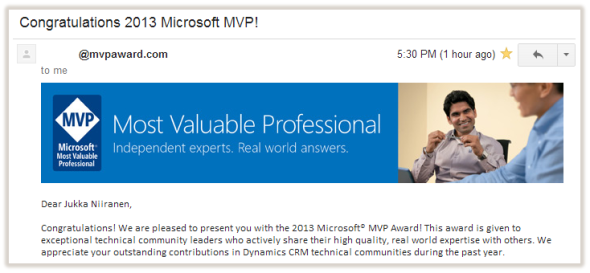
    Almost exactly 10 years later, in July 2023, I received that annual email from Microsoft for the eleventh time. It was once again a special moment. To be honest, every year that MVP award renewal day has been a special day filled with excitement.

    Yet this time it was a bit different. I knew this would be the last time I will get the renewal email. Because I had made the decision at the start of this year that my journey in the MVP program is coming to an end.

    First of all: no, I’m not joining Microsoft as an employee. For those who keep track, that has been the most obvious explanation over the years for voluntary exits from the program – with MVPs trading their blue sticker for a blue badge to become FTEs.

    What’s my reason then? Well, the extremely short version of it is: today I am getting less from it all than what it is giving me in return. It no longer makes sense for me to try and be a Microsoft Most Valuable Professional.

    There is obviously a lot more to it. I’ll talk a bit about it in this post and possibly return back to the specific topics at a later date. Also: since the awards are for an annual period, I want to remind you all that my current MVP award is still valid until the end of June 2024. By giving an early notice, I believe things will work out the best.

    Unlimited opportunities

    I want to start by stating this: being a Microsoft MVP has been an amazing ride. Beyond what I could have imagined. I have zero regrets for signing up to it a decade ago. It was at that time a very logical progression of what I was doing as a member of the community. Checking back on my own blog post about receiving the first MVP award, I still believe in the same things I believed at that time:

    The virtuous cycle of communities is truly a powerful force. In exchange for receiving help from complete strangers with no expectation of monetary remuneration, you start to feel compelled to give back to them in one form or another, to pay it forward. Once you do, you begin to notice that there are others who in turn are benefiting from your actions, which makes the cycle just start to spin faster & faster.

    Jukka Niiranen, fist day as Microsoft MVP, 2013

    Getting a formal network established not just with the Microsoft product team but also (and most importantly) the fellow MVPs who are deeply passionate about the same technology as you are – that really is quite something. It introduces you to this secret world filled with detailed knowledge about every possible corner of the technology you specialize in.

    You gain a wealth of new perspective on things by being part of such a network. It’s not only about learning something new – it’s also about validating that others feel the same way you do. That no matter how big the projects and budgets may be somewhere out there, people still suffer from similar issues as you do. Your reality is also the reality of many others out there. And most importantly: what you’ve personally learned about a specific corner of the product can be of considerable value to everyone else in this ecosystem.

    While the MVPs tend to be highly knowledgeable in their own domains, we must remember that the MVP award is not given out based on how much you know. It is awarded to those persons who are most active in sharing with others what they know. There’s no value to the community in what you yourself learn unless you’re willing and motivated to help others learn it as well – and without any direct financial compensation.

    This model doesn’t always work well with the traditional mindset of consulting organizations where information itself is seen as the source of value – something you need to charge money for. For me, as a person with deep beliefs in the idea of working out loud and how that benefits both organizations an society as a whole, there was never a conflict here. I didn’t start blogging and tweeting because I wanted to achieve some award status. I did it because there was intrinsic value in it for me. It was (and still is) the most natural way for me as a professional to achieve great results at work. The rest is just a nice bonus.

    Becoming a member of the club with the blue MVP logos on their blogs made it more straightforward to explain what I am & what I do. It accelerated the growth of network connections within the MS BizApps ecosystem. I hardly ever actively leveraged it myself, instead I relied on the “inbound marketing” approach of waiting for people to reach out to me. There were more than enough opportunities coming in that way for community engagements in different formats. I no longer needed to maintain my CV for work gigs either.

    The limits to growth

    Passion is something to cherish, but how do you separate it from addiction? When there is an endless source of interesting topics to explore in your professional field AND you also have amazing networks at your disposal for getting deep insights about them all – passion can become dangerous to your mental health. Especially when the boundaries are blurred in a way that makes it impossible for you to see where they used to be drawn. You may gradually forget how the world looks like outside this bubble.

    I’m sure many of the readers of my blog experience the difficulty of separating work time and personal time. If you are consuming tech blog content like this instead of just googling for answers to specific problems (or today using ChatGPT / Copilot to get the solution), chances are you’re invested in solving problems with technology far beyond what your current day job would require. You go the extra mile – again and again.

    We should of course be grateful about our situation. I honestly cannot imagine what life would be like if I had to work in a 9-5 job doing tasks that I stop caring about once the working day ends. It is a privilege that not too many people on this planet have. Even if it would so happen that AI comes for our jobs first and takes over the cognitive work that evolution had far too little time to prepare our brains for, I’m truly happy that this opportunity existed in my lifetime.

    The real danger isn’t AI, though. It is us. With nothing physical in the world setting the boundaries for how and where we can engage in this work related cognitive activity, our reptilian brain may end up on the driver’s seat far too often. External stimuli from the pervasive, growing and ever present information networks we’ve surround ourselves with to find the answers to our day-to-day questions can end up teaching us to always crave for more interactions. We get hooked on the process itself, instead of applying these tools to achieve desirable outcomes.

    The Microsoft MVP award can certainly be one outcome that many aspire to achieve based on the investments they’ve made to the community work. Yet the dangerous part is in how that is achieved. Because it is all about quantifying the impact of your community contributions. What does that mean in practice? In short, you need to keep track of all the various activities that you as an individual perform in the chosen area of expertise and then provide as much measurements about them as technically possible. Posts, videos, books, speaking, mentoring, facilitating, arranging, participating, amplifying… It all becomes a number in a system that tracks your performance.

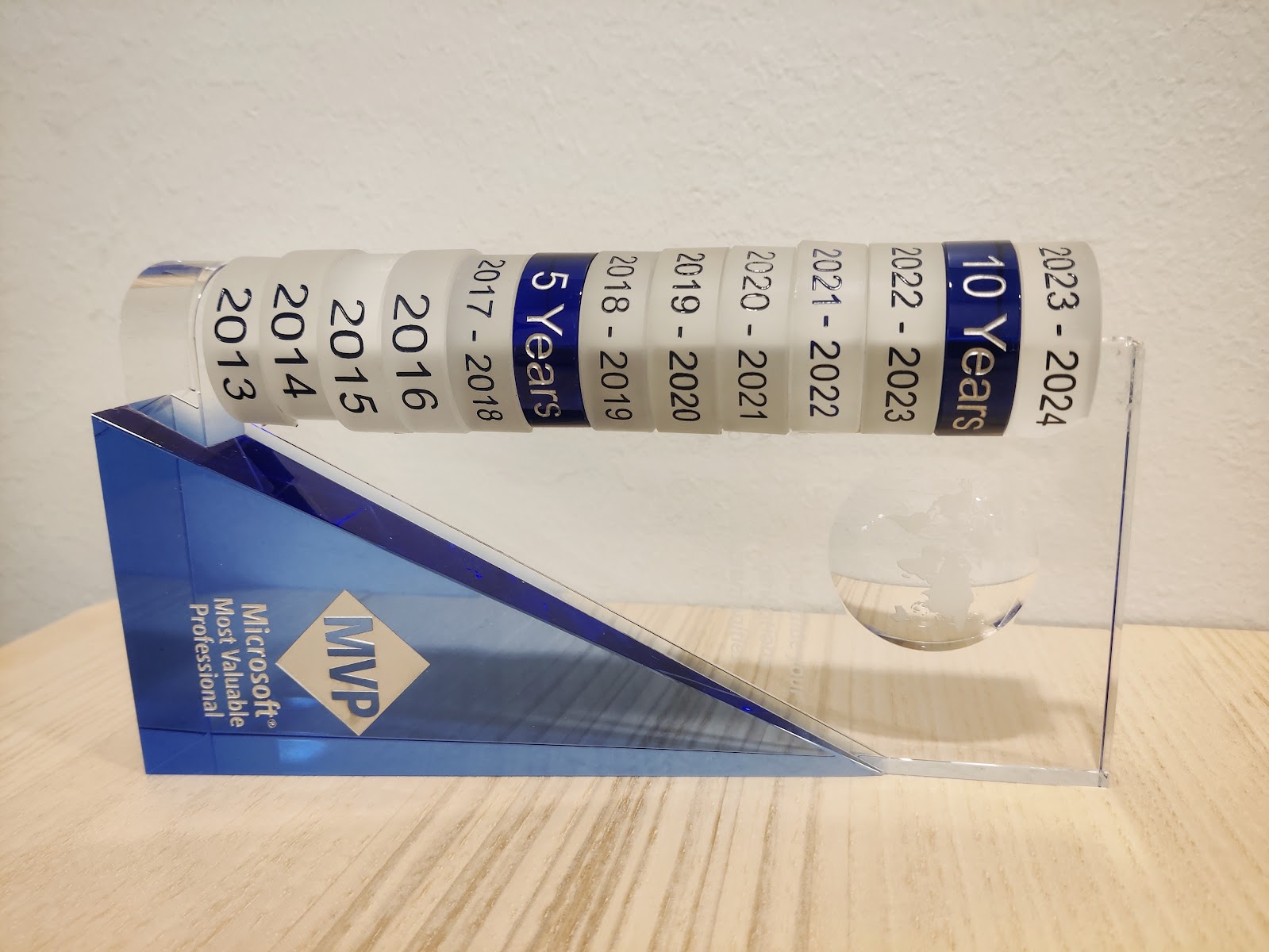
    If that sounds a lot like typical work KPIs – you’re spot on. Except it’s a measurement performed by someone who doesn’t give you any money in return. All you get is the aforementioned email from Microsoft once a year that lets you know whether you passed the bar or not. Plus a glass disc to insert into your award trophy. And that’s all the tangible things you get. Period. (You used to get physical stickers and diplomas, too, but starting from 2023 those have been cut away from the MVP program. As for swag, it never was a formal thing. So, the ecological footprint of the award has largely been about travel.)

    It’s all voluntary, of course. Since no financial transactions ever take place between the MVP & Microsoft, technically it’s all fun and games. Every year in July the award renewal email either comes or it doesn’t. You can never be sure about whether you’ve performed enough activities to be kept in the program for another year. That’s because it’s a very asymmetric relationship. Microsoft will ask all the details from you about what you’ve done, yet they won’t ever disclose how much you should have done in their eyes.

    I don’t want to complain about the system too much, though. I can totally understand why it is built this way, with no predefined criteria to meet. It is completely different from taking a certification exam, for example. For reasons that are beyond the scope of this post, there is a finite number of MVPs that can be awarded in a given year. Furthermore, there are as many different individual ways to contribute to the community as there are MVPs out there. There could never be a publicly visible “passing score” for something like this.

    That’s the system, but what’s the impact to our lives as Microsoft MVPs then? In practice, we start to live under a self imposed surveillance system. Like it or not, the awareness of a scoring process that will evaluate your performance in the community on an annual basis will change what you think and do. Community contributions become a virtual currency in the style of NFTs, in the sense that they only really have monetary value to yourself.

    The positive side is that for people who crave for speaking engagements, podcast invitations and all the other activities – there will be more than enough opportunities for those. You can contribute practically in unlimited ways in today’s combination of physical and virtual worlds. Yet the one pressing question remains: if there could always be more, how do we ever know what is enough?

    During the past 3-4 years, I have personally reached my limits to growth. I am intentionally referring to the title of the 1972 study of what happens with exponential economic and population growth with finite supply of resources available to us on planet Earth. It’s all about that one flaw in the thinking that we the people tend to fall for. We ignore the long-term consequences of our actions and focus only on the short-term benefits – and set our targets accordingly. We think “more is better” and thus keep striving for more, even after the net impact from all of it turns negative.

    Then finally, we’re forced to deal with the consequences of our own actions. We have to choose, not just strive for more.

    Choose life

    For a few years now I’ve had the constant feeling that something in my life is not quite right. As if I was an outsider observing myself going through a path that has been laid out in front of me. While there have been several moments of joy along that path, increasingly I’ve found myself not truly looking forward to anything. All I do is aiming to get through the day, so that another day filled with the same exact feeling may begin.
    In many ways, I have it all. Yet I’ve never felt as empty inside as right now. As I’ve come to understand my own reality better through reflecting on what exactly it is that I do here in this job position called “life”, the problem has become obvious. My responsibilities in here fall under these areas, in no particular order:

    • Co-founder and Power Platform Advisor
    • Father and husband
    • Microsoft MVP and community activist

    Between those three main roles that have filled my life, there has been precious little room for anything else. These have been the modes in which I have operated 24/7/365. Unless something out of the ordinary happens. Yet when planning for things that I could be doing when nothing has yet been booked, the obvious list of To Do’s that comes to my mind is always from one of the three.

    The fundamental issue is: I can’t find myself in there. At which point do I begin to exist? Not as someone who is acting in a predefined role, together with other actors, to do something expected from that role. Rather as just a human being on this planet. Just me.

    For a long time I have not been able to find a satisfactory answer to that question. It has literally turned into an existential threat for myself. I have suffered from recurring waves of paralyzing exhaustion that has severely impacted both my personal and professional lives. Not only have I become tired – tiredness has become a part of me.

    Through writing down my own thoughts in a personal journal throughout the past 4 years, I’ve been able to reflect on the many conflicts I’ve encountered via the changes in my life. How becoming a parent has flipped the meaning of “home” on its head (from a private safe space to a nest for your family members). How being an entrepreneur still doesn’t help in assigning measurable monetary value on time spent in community activities as opposed to customer work. Forces that have been ripping me in opposite directions, spreading it all too thin. Some of these conflicts have been surprises, others I’ve totally been expecting to encounter.

    Just because you can see it coming, doesn’t mean you can stop it. That applies to the deep exhaustion that has taken over me. At the time of writing this blog post, I have been on sick leave from work for several weeks, trying to regain the mental and physical strength to again perform as a normal human being out there in the world. I have probably been holding all this back for an extended period of time, not allowing myself to stop. It’s never a good time for something like this, yet I’m glad that it now became possible to take a break. Or more precisely: to break down.

    It’s hard to change the state you are in merely by thinking differently. Knowing is not the same as doing. Therefore, it has been an enlightening experience to be able to temporarily alter my everyday routines during the sick leave. On quiet weekday mornings, instead of powering up the PC and starting the working day filled with processing & responding to the many data streams that form my professional reality – I’ve done nothing. Literally I’ve just stayed on the couch, read the newspaper, listened to music, enjoyed my coffee, browsed non-work forums, opened up a book – and not had anything else on the agenda for many hours. “Doing nothing” has been an option in life that I’ve forgotten the existence of – when it comes to myself.

    Often one makes room in his life to get something done. With the aforementioned unlimited opportunities of an MVP, all the empty spaces can easily become filled with the hazardous fluids of productivity. Earlier when I have been resting, it has typically been for the purpose of recharging my battery, so that I carry on. The major difference in what I’ve now been able to experience is: there is no “so that” part. Resting because you are tired and allowing yourself to be just that, in this very moment, seems to be what it actually takes to achieve calm.

    Living in a constant state of alertness has done quite a bit of damage to myself, with no ability to properly calm down and free myself from stress on a regular basis. There is no one specific cause for this, nor is it exclusive to one area of my life. It’s the result from the entirety of it all. I don’t know when or if I will recover from it. What I do know is that this same quotation applies to my situation now, just like 4 years ago when I used it to announce my farewell to CRM:

    If you want something new, you have to stop doing something old.

    Peter Drucker

    Life after MVP

    In the end, the choice has been simple to make when put into the greater context. Of the three roles that cover the majority of my waking hours, the one that I can easily let go of is the demands of an organization that I don’t contractually work for. I don’t have any true need to meet the bar for community contributions required to be renewed as a Microsoft MVP. I can stop thinking about it and gradually free up the mental space occupied by this hugely rewarding yet highly demanding activity. It represents my past self that must now make way for my new self to emerge.

    I do acknowledge that I’ve worn the MVP hat for quite some time and many of the readers of my blog will not have known any other Jukka. I remain grateful every day for the opportunity of sharing my thoughts with a community of likeminded professionals in the Power Platform ecosystem – and that someone actually pays attention to what I have to say, occasionally even replying back to me. I intend to cherish this and not disappear from this virtual space we all share. I just won’t think about chasing MVP contribution points, rather I’ll only do what feels natural for myself.

    Will I suddenly become a “Formerly Valuable Professional” / “FVP” then? I’m pretty sure my technical skills and ability to help others won’t immediately evaporate as part of this announcement. After all, thousands of highly skilled community contributors before me have had their Microsoft MVP award not renewed, so it’s really just business as usual in this sport. Whatever it was that earned me the last 2023-2024 MVP disc on my award trophy was something I did between April 2022 and March 2023. In every league the season always starts from zero points for all the participants, with new faces entering the game as the senior players make way for them.

    I’m convinced that in the end this will be better for me. It will also be better for the people I work with. It will absolutely be better for the people I live with. Somehow I also believe that this is going to eventually be a positive change for the many community members out there who read what I type into text boxes on the internet.

    Some things will change. Possibly the content of this blog will also evolve a bit. Yet I’ve been blogging here for 15 years now and I have zero plans on stopping that. If anything, I want to reach a state where the act of expressing my thoughts becomes once again a source of energy for myself – rather than something I need to do to secure the blue sticker.

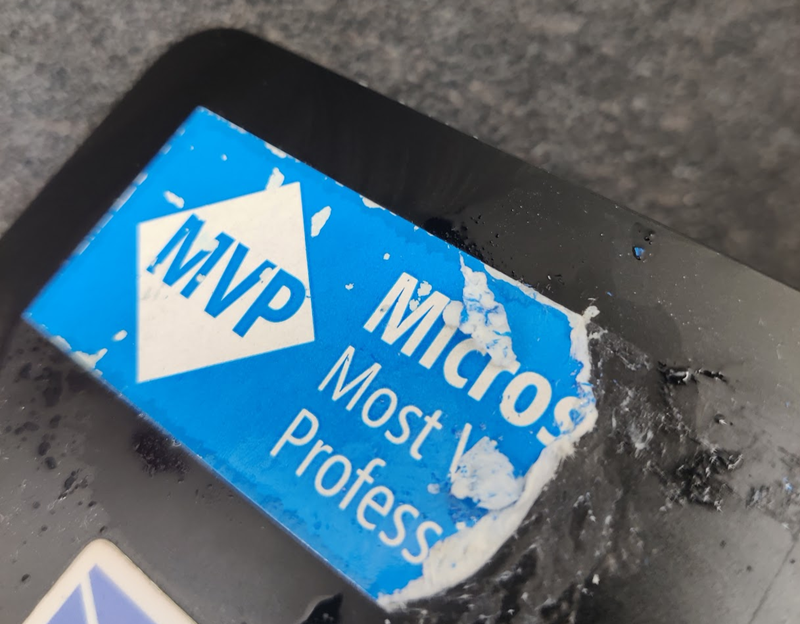
    Which reminds me that I’ve got some scrubbing to do before next July – in both physical and virtual stickers…
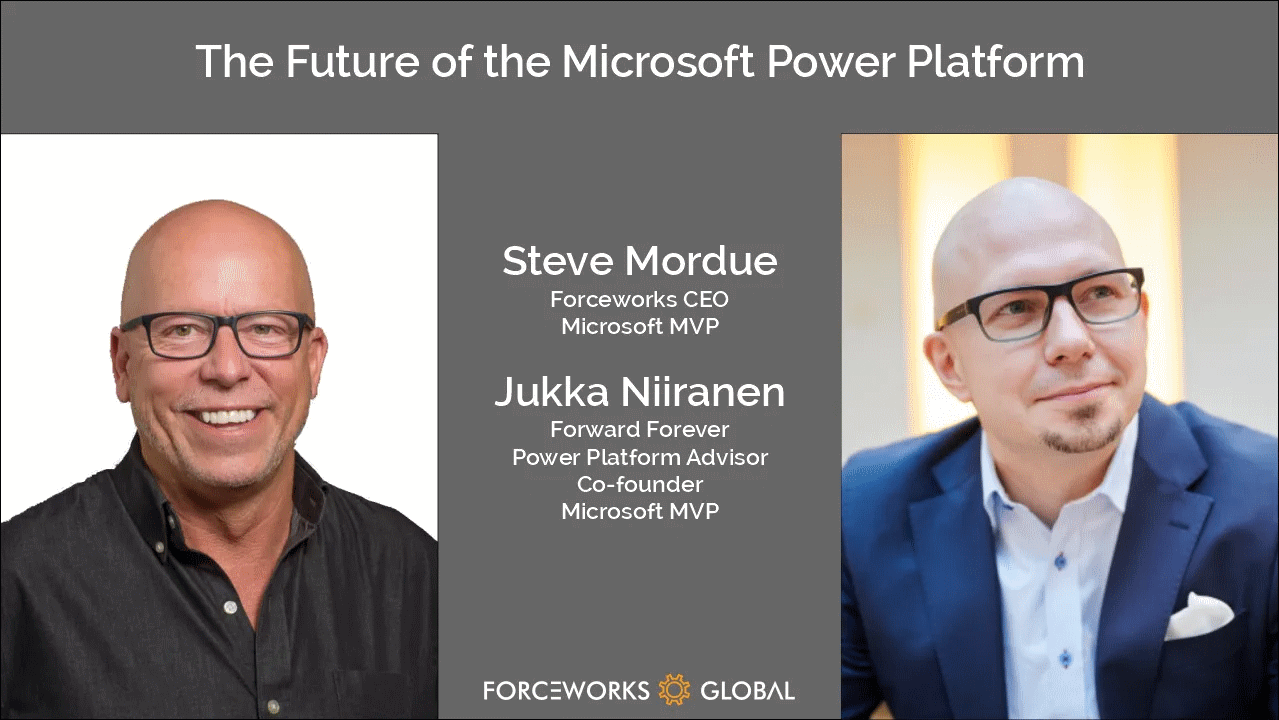
  • The future of Power Platform – Steve has a chat with Jukka

    The future of Power Platform – Steve has a chat with Jukka

    If I had to choose only one blog I could follow in the Microsoft Business Applications ecosystem, it would be Steve Mordue’s blog.

    Why this blog? Because you’ll learn more about the true business of BizApps in Steve’s blog than you would from reading all the partner channel materials MS puts out there.

    It’s not just the unfiltered opinions and provocative comments from Steve that make the content unique. He manages to get Microsoft leaders like Charles Lamanna or Ryan Cunnigham speak openly about product roadmap and business strategy whenever he has a chat with them. It’s the kind of material you couldn’t hear from anywhere else – at least not without an NDA.

    When MVPs used to get together

    One unfortunate impact that COVID has had on the Microsoft MVP program is that our annual MVP Summit events have gone virtual. Even though the world is slowly opening up to physical events again, at the same time the world economy is sinking. This has pushed even the biggest tech corporations like Microsoft to announce cuts on their internal travel, training and event budgets. This means the next Summit, which will be my 10th, is probably done over Teams again.

    It’s better than nothing, of course. The Microsoft product team members do put in effort to share their plans with the MVPs and are open to receiving feedback from us, since the protective shield of the NDA agreement covers both digital and physical worlds. Making things digital can also help scale the amount of tech content that can be made available as well as the means through which to consume it.

    What the virtual events cannot in any meaningful way compensate for is the lack of informal interactions between MVPs. When you can’t go grab a drink with the smartest people in the business together at JOEY Bellevue, a large part of the Summit is wiped away. Sure, the product group interactions are valuable, but the MVP-to-MVP interactions are priceless.

    No, you can’t replicate this in the virtual Summits. When you’re first sitting 6-8 hours alone in front of your computer, from 6pm onwards after your normal working day, staring at the Teams screen – trust me, you’re in no mood for “virtual drinks” after that.

    Events quickly turn into non-events due to the lack of any changes in the physical surroundings. No travel costs, no jetlag, only a little loss of billable work during the week – it’s all very productive, to the point where you start asking yourself: why did I ever consider this “fun”? It sure helps to contribute to the feeling of being constantly tired.

    Time to move forward again

    You shouldn’t become too bitter about things not being what they used to be. The older you get, the more stuff like this is going to come at you every single day. You don’t have to like it, and you certainly are entitled to feel what you feel about it. That’s where our entitlements pretty much end, though.

    Choosing how we react to change is pretty much the essence of life – and business as well. This is an area where both me and Steve seem to have similar ideology that drives our behavior. If you know the only certain thing in life (and business) is constant change, it’s better to be someone who’s pushing that change to happen instead of becoming the object that must endure the change pushed upon it.

    So that’s one thing we share in addition to our hairstyle. With nothing more as a prepared agenda, we opened up Teams and stated recording a session on Steve has a chat with Jukka. It’s as close to an MVP-to-MVP informal interaction you can get to without flying to Redmond.

    You can listen to the audio track on Steve’s website or on Spotify / Apple Podcasts. Alternatively, you can watch two BizApps MVP baldies on your screen for one hour via the embedded Vimeo clip below:

    https://vimeo.com/742784310/7101b864c1

    Some of the topics we discuss with Steve include:

    • How different the world looks like when you choose to go all-in on Power Platform instead of being a Business Applications generalist
    • The struggle of convincing customers that a $5 app can actually give them more value than a $95 app
    • How to get the IT on board with the citizen developer movement and turn governance into an enabler instead of a blocker
    • What would be the ideal support model for a platform-first business that would reduce the customer/vendor tension and get everyone on the same side
    • Why Dynamics 365 partners have very little financial incentives to move their capacity into true low-code business
    • The difficulties in making the Fusion Team story sound attractive enough for pro-devs to find their place in the low-code world
    • Why Teams is the most important platform Microsoft has and why it isn’t yet quite the right platform for wide scale business applications usage

    That’s just a few things I remember off the top of my head, after our awesome chat session. So, if you’re interested in hearing what us two loudmouths think the future of Microsoft Power Platform is – you know what to do.

    There’s no sponsors in any of these chats nor either one of our blogs, so I’ll just leave you with two commercial call-to-actions:

    • Check out RapidStart CRM to experience what you can do with just a $5 Power Apps Per App license (the CRM part comes free, courtesy of Steve).
    • To keep up with what our 100% Power Platform focused team of pretty amazing experts is doing, subscribe to the Forward Forever Monthly newsletter.
  • Is blogging worth it?

    Is blogging worth it?

    I saw this question posted on Hacker News a few days ago:

    Ask HN: Is having a personal blog/brand worth it for you?

    This topic really caught my attention. I read through tens of answers on the thread and that got me reflecting on my own journey as a blogger.

    I launched this blog as “Surviving CRM” back in 2008 and switched it to a more personal “Thinking Forward” blog in late 2019 (to say farewell to CRM and move towards the broader low-code theme with Microsoft Power Platform). These 14 years provide me some perspective on the topic of personal blogging and also building a personal brand along the way.

    There were three subquestions in the Hacker News post that I’m going to try and provide my answers to.

    Q1: Does the time spent writing feel worth it to you?

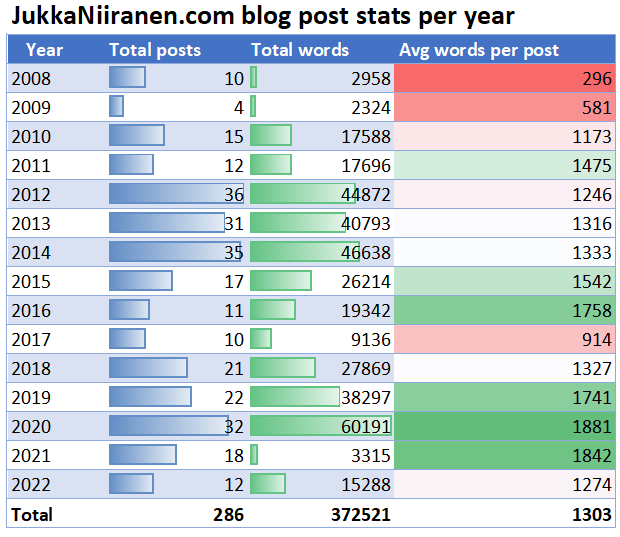
    I can never know the true time I’ve spent on blogging. Not in total, and neither on average per post. They only thing I can really measure is the amount of posts & words within these posts that I’ve written over the years. Here are the annual stats from my blog, up until July 2022:

    Looking at the total number of words I’ve posted in my blog and using 250 words per minute as the estimate for reading time: it would take you ~25 hours to read everything I’ve written in my blog.

    How about writing those words then – how long might that have taken? I won’t go to deep on the scientifical part here and instead use the first figure that Google gives me for writing in-depth essays or articles: 5 words per minute. This would be roughly 100h per year in my case.

    That’s only 2 hours per week. It goes nowhere near the time I’ve spent on doing the research required to come up with the final output for a blog post. Reading MS documentation/blogs and community content, testing the features in real live systems, connecting the dots in my head, having online discussions on the topics. The blog posts really are just a tip of the iceberg.

    Let’s just say that I may have spent one working day for each week of the year, for the past 14 years, to do all the work required to produce the output that you see here in my blog. Essentially a 6 day working week, to come up with content that has been posted online, for free.

    That may not immediately sound like such a great deal when illustrated this way, but let me tell you: that 6th day of the working week has always been the most rewarding one for me personally. Thinking about the total number of days, blogging with all the community work included comes pretty close to my longest employment relationship duration. I guess it’s obvious I wouldn’t have sticked around this long then if it wasn’t a whole lot of fun.

    Right at this moment, when writing this “meta” blog post, I’m on my 4 week summer vacation (the Nordic way), at a summer cottage in the middle of nowhere. I’m looking over a peaceful lake view, with a glass of rye stout from Amager Bryghus next to my laptop. Even in situations like these I sometimes choose to write on my blog because it brings me more joy than it consumes time. It’s a hobby that has grown into an element of life that sort of defines who I am. Well, not everything of course, but an important slice of me.

    Does blogging become faster the more you do it? Yes and no. Experience helps you in the areas that are repeatable, meaning the process around writing and publishing blog posts. Yet there’s no point in trying to minimize the time spent on the act of blogging itself.

    Working as a consultant who bills customers by the hour, you can sometimes get too wrapped up in the concept of productivity. More bang for the buck / value for the customer = more outputs in less time, right? That is often not true – even in billable work. Even less so when you are doing things for your personal growth.

    You see, when blogging for yourself (i.e. not because someone at marketing asked you to), it’s not a requirement to be very efficient in how you spend your time. I don’t have a budget for how many hours I can spend on this. Yes, the real world around me (family, friends, life) needs my time, too, but outside of my official working hours I don’t keep track of time. Things take as long as they need to take.

    To me, writing is thinking. Your thinking is likely to improve if you spend a bit more time on it, rather than just taking relying on your gut reaction and assuming that’s all your brains could ever achieve.

    In the long run, blogging has probably saved me time in more ways that I could ever measure. Not just by teaching me skills that would have been difficult to acquire otherwise, but by creating something that helps me on a daily basis: my network. Which leads us to the next question:

    Q2: Did it help you to get noticed/ find jobs or other opportunities?

    After the first few years of blogging, I’ve never had to look for a job. The opportunities always came to me, without my initiative. You could compare this to the commercial activity of inbound marketing. The effort is spent in advance, building up the audience, which in turn then reduces the need for outbound activities. So, the active work is still done, only in a different order than traditionally.

    None of what has happened to me in my professional life for the past decade would have ever become real if I didn’t start blogging. Through both writing my blog posts and amplifying the posts of other community members, I’ve succeeding in building an incredibly valuable professional network. Putting my words out there has been the single best career move I can think of.

    On year 6 of my blogging career, I received my first Microsoft MVP award. 2022 marks my 10th year in the program. Gaining access to not just the MS product team behind Dynamics 365 & Power Platform but more importantly, the other MVPs who are as passionate about their craft as I am – that has been undoubtedly a turning point for me.

    At the beginning of my blogging journey I wasn’t sure if this MVP role was a path I actually wanted to pursue, though. My top priority in personal blogging has always been to honestly write about both the good & the bad that I encounter in Microsoft’s product offering – so that others can learn from my real life experience. Fortunately, having an NDA with MS hasn’t resulted in me having to apply a filter on how I talk about things. Just the “what” when it comes to non-public info, of course.

    While writing your posts and reflecting on the lessons you’ve learned is an major part of blogging, I consider an equally important side of it to be the active participation in your community. A major reason why I originally started my own blog was because I wanted to give back to the community who had helped me get started on my career.

    Already back in 2005, the blogosphere around Microsoft CRM 3.0 was what really set this technology apart from many other CRM competitors at the time. A global community can truly be a force multiplier, allowing newcomers to challenge the more established players out in the market. I believe this very same phenomenon plays out in the area of citizen developers today, with the community helping each other to democratize technology and making previously impossible things possible to a whole new (and bigger) audience.

    Blogging may not be as trendy today as it was 14 years ago when I started. With today’s social media channels having replaced the old Web 2.0 era tools like RSS readers in how content gets consumed, aspiring new writers may well ask themselves: “will my posts on an independent blog site get me noticed anymore, or should I just use a platform where I already have a network”?

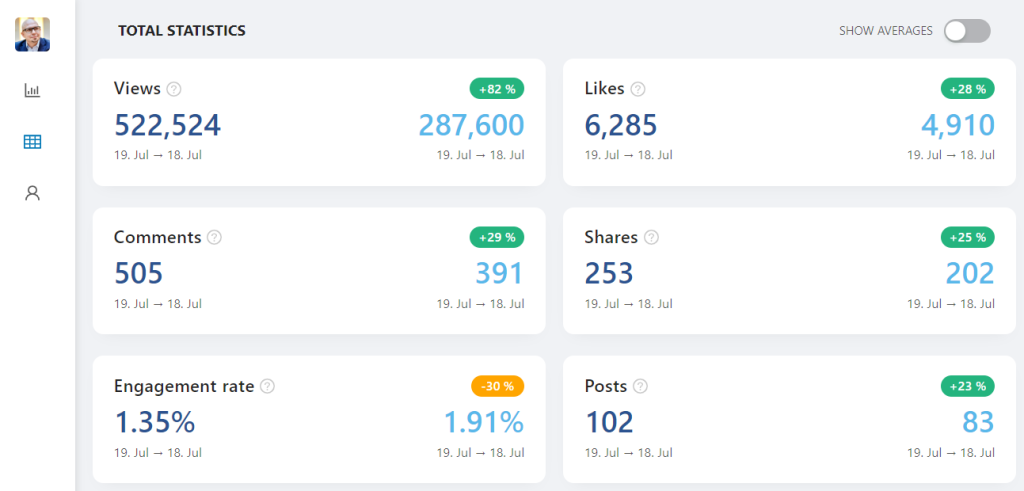
    I recently checked what my personal LinkedIn stats looked like for the past 12 months (using Shield Analytics). By making 102 posts during the past 365 days, I’ve received over 500k views for them on LinkedIn. In my WordPress blog I’ve tracked only 130k views during the same time period. While my blog traffic hasn’t been growing for a few years anymore, the year-on-year figures from LinkedIn are mostly green:

    The way I see it, a page view on a blog that you own & control is many times more valuable than what LinkedIn might track as a “view” of a single post that a user scrolls through in their endless stream. The impact is likely at least 10x higher when a visitor opens a web page dedicated to your writings and spends a minute or two on it.

    Besides, a fair share of the LinkedIn posts I’ve made have been to share a summary of my blog post. This site right here is the “read more” destination where I actually get to talk with the audience who finds the topic interesting enough.

    At the end, it’s not about the “likes”. Social media apps that gamify your clicks will always show you stats that are more compelling than a blog site like WordPress. Don’t get distracted by these. (I know I do, so I’m not saying it’s easy…)

    “Couldn’t you post longer content as LinkedIn articles, though?” While it might be tempting for authors without an existing blog to start with the social media platform, I’d encourage you to ultimately own your words. Don’t become a slave to a network that primarily thinks about its own algorithms and business models for making money from your content. Exploit them wherever they serve you, but don’t become merely a servant to them.

    Q3: Do you learn something new from it?

    All the time. Even when the blog posts I write are just about documenting a discovery that I have made during a customer project, it helps me go far beyond what billable work would justify. Instead of just solving this one problem and jumping straight to the next one in the queue, I can spend a moment actually connecting the dots in my head.

    Establishing links between the synapses in our brain is physically how learning happens. I find that the act of turning my thoughts into writing, arranging them on the screen and especially linking to related articles is the most effective way for me to learn. With this in mind, Q3 sounds a bit strange to me when rephrased: “do you learn something new from learning something new?”

    You see, writing the blog post is not the end result of a carefully planned process (for me at least). Quite often the act of creating a draft post is when you really start to think. If you’ve ever heard about rubber duck debugging, then the idea is exactly the same. By explaining a problem to someone else, be it an inanimate object like a rubber duck or virtual object like a blog, you can often solve that problem without anyone providing you the answer.

    Even the mere intent of “hey, I could write a blog about this” can start the mental process of organizing the details better in my head. Now, if blogging really would be such a magical formula to solve all problems, why not do it even more? Looking at my annual blog stats, why do I sometimes only write one post per month? It’s because all mental processes reserve cycles from your mental CPU (the brain).

    Having a blog challenges you to put your thinking in writing. It’s not all fun and games, though, as you will inevitably get stressed at times about “I should be blogging about X, Y and Z, why can’t I ever get these things done”. The sad part is: you’ll never get over this feeling, no matter how much you do blogging.

    Another fact of life is that you’ll continue to encounter other community members who write more posts, better posts, learn new things faster, get more readers, and so on. Spending years on writing blog posts on a specific domain topic doesn’t protect you from the impostor syndrome. A growth in the amount of exposure your writings get can even lead to scenarios that induce long term stress.

    The dark side of community leadership recognition programs like the Microsoft MVP award is that they are founded on metrics of your impact. When I said earlier that personal blogging is an act where I don’t track the hours spent on it, in reality I still do need to log the outputs as community activities into Microsoft’s system. If you don’t do enough measurable activities to prove your impact to the community, you will no longer get awarded on July 1st next year.

    Q: How much is enough? A: You won’t know, so nothing is ever enough.

    During the past couple of years, I’ve felt very tired at times. Going through COVID, starting a company, getting a kid – many factors around me have contributed to the low mental energy reserves. I’m certainly not the only one with such experiences. I’ve heard from many people in my network that they’ve recently been asking themselves the question “is the MVP Award worth it?” So have I.

    If the target would be to keep hold of the award, then maybe this type of blogging that I’m doing wouldn’t be the best choice. Lengthy articles that reflect on the state of the ecosystem, for example, aren’t exactly the type of material that will gain a lot of Google hits. Shouldn’t I rather be answering “how to” questions that some one is typing into the search bar? Why not just tell the audience “here’s how to do X with Y”, one feature after another?

    Also, shouldn’t I rather reuse my content in more than one context, to gain more entries I could list as my community contributions for Microsoft to see? Instead of publishing a single blog post, couldn’t I format it as a presentation that I could then recycle in multiple virtual events that exist in the global Power Platform community?

    Such a “shouldn’t I” list quickly becomes endless. It can turn your hobby into an energy drain rather than a source of energy. It is of utmost importance that you can be honest with yourself and identify why you should say no to things.

    • Should I do videos? No, I hate skimming through them for answers and would always read the text version instead.
    • Should I do more podcasts? No, I practically never listen to them since I love the sound of music, not the sound of someone talking.
    • Should I submit sessions to community events? No, I have no motivation for attending virtual events and my ability to travel to live ones is limited.

    How does all this relate to the original “what do you learn from blogging” question? It’s all about learning who you are and what you love doing. Knowing what separates you as an individual from the different crowds that you interact with.

    What this means is: I couldn’t ever give an answer on whether blogging is worth it to you. The reasons, the benefits and the price of blogging that I’ve talked about here are subjective and apply primarily to me. I would surely encourage you to give blogging a go if some of these experiences and thoughts resonate with you. At the same time, be sure to remain honest with yourself and stop writing on your blog if in the long run it takes more than it gives.

    Where I’ve found blogging to be an invaluable tool is in finding your own voice. It’s not quite the same as keeping a personal diary would be, but if you’ve ever found putting your thoughts into writing as an exercise you enjoy, there might be something here for you to gain.

    Who knows what your brain might say to you if you’d give it a brand new channel of communication. Such as a blog.

  • My CRM User Experience Presentation at eXtremeCRM 2016 Warsaw

    My CRM User Experience Presentation at eXtremeCRM 2016 Warsaw

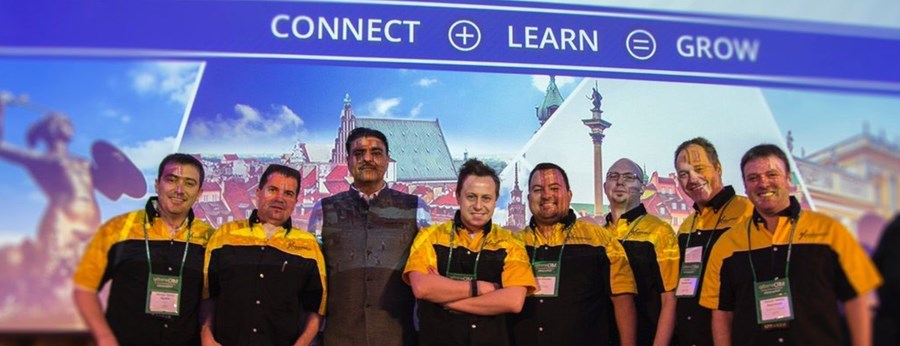
    If you’re a Microsoft Dynamics CRM partner in EMEA then eXtremeCRM is definitely an event you don’t want to miss. This spring the event was arranged in Warsaw, Poland, and I had the pleasure of not only attending but also contributing to some of the content at the conference. Together with 8 other CRM MVPs, we all presented in our own sessions, did a joint “ask the MVPs” showcase and also got the chance to talk with many of the awesome Dynamics CRM community members at our Team eXtreme Pitcrew booth. Thanks to everyone who came around to compete in a lap of Forza 6 with the MVPs!

    eXtremeCRM2016Warsaw_Team_eXtreme_Pitcrew

    It was the first eXtremeCRM event where I was not only attending the breakout sessions but also speaking at one session of my own. The topic that I ended up covering was something that has been touched upon also in this blog a few times: user experience of CRM systems. In addition, the focus of my presentation was specifically on the no-code configuration possibilities and how they can impact the solution UX, in good and bad. (It seems to be a common misconception among the MVP’s that I would know something about writing custom code, when in fact I’m almost illiterate when it comes to the CRM SDK. But anyway…). You can find my presentation slides below, or access them via this direct link to Docs.com.

    In my session I covered quite a wide variety of topics. To start with, I wanted to address the business impact of CRM system UX and provide some tools for demonstrating why user experience not just about application usability but really about the organization’s ability to deliver great customer experiences. Then I reviewed some of the basic CRM customization best practices that we all should keep in mind when configuring our solutions (but which are all too easy to forget when dealing with schedule constraints in CRM deployment projects). I then explored the concept of how Dynamics CRM could be made to feel more responsive to the end user’s actions via tools like Business Rules, Quick View Forms and Real-time Workflows. Finally I highlighted the importance of continuously maintaining the UX of a CRM environment when both the platform, the usage patterns as well as the ecosystem around it keep on evolving at an ever increasing pace in the cloud.

    At eXtremeCRM there’s never a shortage of interesting sessions to attend, nor the amount of great new CRM roadmap insights that Jujhar Singh and the other members of Microsoft’s organization are there to share with the community. In an attempt to capture some of the highlights from the event, I compiled them into the following Sway presentation that includes content shared on Twitter via the #eXtremeCRM hashtag.

    That’s all for today, but do check back for the next blog post where I’ll be sharing some of the results from the Voice of the Customer survey that we did for the MVP session at eXtremeCRM.

  • eXtremeCRM 2016 in Warsaw – See You There!

    eXtremeCRM 2016 in Warsaw – See You There!

    As you may have heard, the long running Microsoft Dynamics CRM & ERP conference Convergence is no more. Microsoft has revised their event catalog and is now instead encouraging people to attend either the brand new Envision conference for business level discussions or Ignite for the technology platform updates. However, since both these events are much more generic in nature than the Dynamics focused Convergence used to be, it does leave quite a gap in the market for the CRM application deep dive content. Also, there’s nothing in the MSFT event calendar that would directly cater to the Envision and Ignite crowd in Europe, so anyone from around here who doesn’t want to spend too much time on a plane (and mentally in between time zones for the relatively short period of the conference) may not be quite as excited about these changes as the marketing message coming from Redmond might want them to feel.

    Luckily the Dynamics CRM ecosystem isn’t dependent on only the events that Microsoft arranges. CRMUG has been building up their presence also on this side of the Atlantic and is now launching their first European Congress this spring in Stuttgart. eXtremeCRM is a long running event that has been catering to both the US and Europe partner audience for many years already and they’ll also have an event nearby very soon, as eXtremeCRM 2016 Warsaw takes place on April 18-21. So, whether you’re working on the customer’s side of the table or consulting a variety of different organizations on how to best take advantage of Dynamics CRM, there’s bound to be the right event for you where you can meet professionals like yourself, exchange ideas with them and hear presentations from knowledgeable members of the #MSDynCRM community on what’s hot (and not) in the CRM space.

    It’s been a while since I’ve been to a CRM conference myself but this year I decided to make room in my customer projects calendar for attending one, since one doesn’t simply survive in this business with content you can find from online sources and social channels. So, I registered for the eXtremeCRM Warsaw event early on and then decided to also suggest a topic I could do a presentation on. The suggestion got approved, which means… well, the picture of yours truly right underneath Jujhar Singh says it all!

    eXtremeCRM2016_speakers

    I’m honored to have the opportunity to join such a prestigious list of speakers in the eXtremeCRM 2016 Warsaw event. I wont of course be competing on the level of Jujhar (who BTW seems like exactly the right man for the Dynamics CRM GM position, based on our encounters at the MVP Summit) but will rather be focused on preaching what I know. Which is all about how to make the most of the XRM platform when you don’t know how (or just don’t want to) work with the API’s but rather need to leverage the built-in customization tools. My session is titled “Killer UX: Delivering a Great CRM User Experience without Custom Code” and what I’ll try to do is show how anyone who knows his or her way around the solution configuration UI can make a real difference in what Dynamics CRM as an application feels like for the end users to work with.

    Now, I should of course be working feverishly on my presentation slides already, but here I am just reading and writing blog posts like I always do. If you’ve ever encountered a situation where instead of focusing on completing the important work that has a deadline approaching in the distant but all too inevitable future, you find yourself wondering around between Twitter and YouTube instead, then you know the feeling. Well, speaking of online videos, there just happens to be an excellent TED Talk from Tim Urban on the topic “Inside the mind of a master procrastinator”. You really should watch it because A) the Instant Gratification Monkey inside your brain will totally love the distraction, and B) it’ll help you better understand the dynamics of (not CRM but) procrastination.

    Instant_gratification_monkey

    “Hey, get off the wheel, you Monkey! We haven’t even finished this blog post yet! Grrr…”

    In addition to myself, there are also eight other awesome CRM MVP’s who are coming to Warsaw. We’ll all be having our own sessions of course, but in addition to that, there will be a joint session where the audience can present questions to all the CRM MVP’s in the room on the latest CRM 2016 Spring Release in particular. Now, as we were thinking about what’s a good way to coordinate such a session, it occurred to me that “hey, why couldn’t we use CRM for this?” More specifically, wouldn’t this be a great opportunity to showcase the new Voice of the Customer functionality that’s very recently been made generally available for CRM Online customers?

    eXtremeCRM_MVP_survey

    As it turns out, Voice of the Customer (or “VoC” as we’ll all end up calling it) allows you to easily design surveys on any topic that you’re interested in collecting data on. If you haven’t yet explored this great new addition to the XRM family of add-ons that Microsoft has integrated into the core Dynamics CRM product offering, you could start by watching this introductory VoC video on YouTube. Or, you could see a VoC survey live in action by answering our eXtreme MVP Survey.

    eXtreme_MVP_button_1

    The survey is mainly targeted at those who are planning to attend the eXtremeCRM 2016 Warsaw event, but there’s nothing stopping you from taking it if you can’t make it there. The survey starts with some questions about the event and closes with a “feedback form” that you can use for submitting your questions to the CRM MVPs in advance, to be answered in the live event (time permitting). It also contains a few questions about how you feel about the upcoming CRM 2016 Spring Release, so I’m planning to also experiment with some of the analytics capabilities that these XRM style surveys offer us. I might even write a blog article about how the VoC experiment worked (unless the ‘Monkey gets its way again), so it’s all conducted in the name of science! (No marketing spam will come from this survey, it’s my personal CRM Online trial org that will disintegrate within a couple of months.)

  • MVP Award & Why Communities Rock

    MVP Award & Why Communities Rock

    Today I received the following email:

    MVP_award_email_small

    Wow! Quite an honor, I must say. Not so much for the MVP badge itself but for being recognized alongside all of the brilliant minds that have received the Microsoft Dynamics CRM MVP award before me. Thanks especially to fellow MVP Gustaf Westerlund for nominating me for the award! Also, it’s nice to notice that all of the sarcastic remarks I tend to make in my posts while explaining the do’s and don’ts of the Dynamics CRM product have not permanently angered the folks at Microsoft to put me on their blacklist 😉

    It’s great to receive recognition from the makers of Dynamics CRM of course, but by far the most important thing is the support from all the other members of the Dynamics CRM community. That means anyone who contributes to the discussions on CRM forums, comments on blog posts, sharing of links on social media and all the other activities that help people like you and me to… you know, survive living with this thing we call CRM. In the spirit of award speeches, let me take this moment to ramble on a bit about why these things matter so much.

    All the way back in 2005 when I first got exposed to Microsoft CRM (the pre-Dynamics era) in the role of an ICT specialist evaluating alternative applications to replace an aging yet heavily utilized Lotus Notes based CRM system for my organization, the one thing that stood out in Microsoft’s product was the amount of community contributed material that was already available at the time. Compared to the world we live in today, it was of course a tiny fraction of the vast resources we’ve got now, but compared to the other potential CRM vendors on our short list, it was a significant factor that made me push for choosing Microsoft CRM. Knowing that I would be responsible for administering, supporting and customizing the system further once deployed, I naturally wanted to work with a product that I could find answers from not just the vendor but also other users and consultants who were sharing their expertise so graciously on the Internet.

    CommunityAfter having spent some time in learning the ropes and reading through a pile of invaluable blog posts (~100 RSS feeds on my Dynamics CRM daily diet) that had helped me solve the day-to-day problems encountered when trying to mold the CRM system to meet the requirements of the users in a couple of customer organizations, I decided to put up a blog of my own to have a place to share some of the tips I had found useful. Then along came social networks like Twitter, that allowed you to discover even more great experts and content on hashtags like #MSDYNCRM. Eventually I realized there was no way for me to return back to the way things were before becoming an active member of the global online community around Dynamics CRM, so the only thing left to do was to push even further and try to make the most of it – even experiment with it, if you like.

    The virtuous cycle of communities is truly a powerful force. In exchange for receiving help from complete strangers with no expectation of monetary remuneration, you start to feel compelled to give back to them in one form or another, to pay it forward. Once you do, you begin to notice that there are others who in turn are benefiting from your actions, which makes the cycle just start to spin faster & faster. All that shared knowledge begins to accumulate into a source for “wisdom of crowds” type of phenomena where you are no longer bound by your own cognitive capabilities, rather you can tap onto the community as an extension of your brain to solve the problems you encounter. It’s no cyberpunk fiction, simply the best strategy for an information worker to stay on top of his game today and develop the skills needed tomorrow.

    Most of the things I know about Dynamics CRM I have learned from the community surrounding the product. That is why I personally value the MVP Award, because in essence it’s all about the most important part: the community, not just the application. Therefore, my advise for anyone who’s working with Dynamics CRM and is interested in getting more out of their job, as well as getting better at their job, is to take the plunge and start contributing to the community. You don’t have to be a CRM guru, a superstar developer or even a 24/7 social media geek to be able to add value into this common pool of knowledge and insight that keeps the Dynamics CRM product moving forward and allows all of us to better solve real life business problems with it, thus eventually helping the world outside the community. All you need to do is proceed along these steps, one ladder at a time:

    1. Explore
    2. Learn
    3. Share
    4. Contribute
    5. Rinse & repeat.

    Thank you. Let’s keep rockin’ with CRM.