
Tag: MSDYNCRM

  • Dynamics CRM Platform Evolution Revisited

    Dynamics CRM Platform Evolution Revisited

    MVP_year_2_cakeIn celebration of receiving my second Microsoft Dynamics CRM MVP award today (thanks to the whole #MSDYNCRM community for your support!), I’m publishing an article series on the Microsoft Dynamics CRM 2013 Customization and the Platform Evolution.

    For the regular readers of my blog this title may sound eerily familiar, and you are correct. This is indeed a re-release of my earlier webcast topic that I presented in May for MSDynamicsWorld.com. I’ve previously shared the links to the live recording and the slide deck, but this time I decided to put it all down in writing. I had a huge pile of speaker notes, so I tidied them up a bit and published them as articles on this site.

    Why bother revisiting the same old story? Well, it all comes down to my own behavioral patterns and personal preferences. You see, even though there’s an ever increasing number of webcasts, podcasts and other forms of streaming content published these days on highly interesting topics and shared all over the social networks I hang out at, I very rarely find myself actually consuming any of that content. Jeffry van der Goot nicely captured the underlying issue in his recent tweet:

    Stop_the_videos

    Recordings of people presenting on a topic that they claim to be experts in just isn’t a very effective method of online knowledge sharing, if you ask me. Sure, you might be able to convey your message a lot more effectively with the help of audio and video, but the problem is that I, the audience, have a difficult time in assessing whether the content you’ve prepared really is worth my precious time (my precious free time in most of the occasions, I might add).

    It’s not just that all of us can read much faster than we can listen. It’s the avenue of opportunities that a piece of information receives when it’s put down in writing. The audience will be given the chance the glance at the content from a higher level, scan through for highlights that capture their attention and, most importantly, easily revisit any of the words transmitted in this form of communication. The content producer, the presenter of words, also gets to enjoy the same benefits when reviewing his or her own thoughts in a structured manner and designing the detailed message that is to be delivered. Last but not least, written content is infinitely more discoverable via the tools we all now turn to when in need of answers to our everyday questions – the mighty search engines.

    Now that I’ve explained the “why” behind the content strategy, it’s time to return back to the “what”. The Platform Evolution article series is about exploring some of the key themes that are shaping the process of how we can deliver customized business solutions on top of the Microsoft Dynamics CRM 2013 platform. The discussion is broken down into four parts:

    • Part 1: The History. Where does Dynamics CRM as a product originate from and how did we get to where we are now with the CRM 2013 version?
    • Part 2: Mobile Computing. How has the evolution of client devices affected the CRM platform and what should you know about the new client options?
    • Part 3: Customizing CRM Today. What is the difference between a traditional CRM system and a modern business application built to match the CRM 2013 design language?
    • Part 4:  Delivering Responsive Solutions. How could we optimize the user experience of our application without diving into the sea of custom code?

    Hope you find something of interest in these articles, but as said, they are there for you to conveniently scan through and judge for yourself. Because life’s just too short for sitting at your computer, watching long recordings that in the end didn’t quite deliver what you had expected.

  • MVP Award & Why Communities Rock

    MVP Award & Why Communities Rock

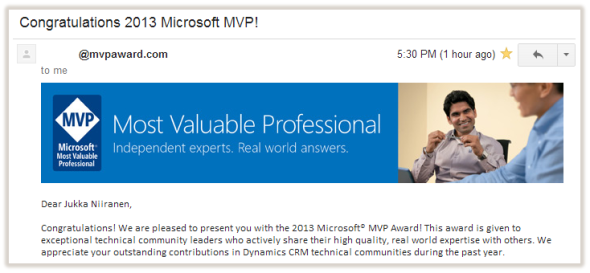
    Today I received the following email:

    MVP_award_email_small

    Wow! Quite an honor, I must say. Not so much for the MVP badge itself but for being recognized alongside all of the brilliant minds that have received the Microsoft Dynamics CRM MVP award before me. Thanks especially to fellow MVP Gustaf Westerlund for nominating me for the award! Also, it’s nice to notice that all of the sarcastic remarks I tend to make in my posts while explaining the do’s and don’ts of the Dynamics CRM product have not permanently angered the folks at Microsoft to put me on their blacklist 😉

    It’s great to receive recognition from the makers of Dynamics CRM of course, but by far the most important thing is the support from all the other members of the Dynamics CRM community. That means anyone who contributes to the discussions on CRM forums, comments on blog posts, sharing of links on social media and all the other activities that help people like you and me to… you know, survive living with this thing we call CRM. In the spirit of award speeches, let me take this moment to ramble on a bit about why these things matter so much.

    All the way back in 2005 when I first got exposed to Microsoft CRM (the pre-Dynamics era) in the role of an ICT specialist evaluating alternative applications to replace an aging yet heavily utilized Lotus Notes based CRM system for my organization, the one thing that stood out in Microsoft’s product was the amount of community contributed material that was already available at the time. Compared to the world we live in today, it was of course a tiny fraction of the vast resources we’ve got now, but compared to the other potential CRM vendors on our short list, it was a significant factor that made me push for choosing Microsoft CRM. Knowing that I would be responsible for administering, supporting and customizing the system further once deployed, I naturally wanted to work with a product that I could find answers from not just the vendor but also other users and consultants who were sharing their expertise so graciously on the Internet.

    CommunityAfter having spent some time in learning the ropes and reading through a pile of invaluable blog posts (~100 RSS feeds on my Dynamics CRM daily diet) that had helped me solve the day-to-day problems encountered when trying to mold the CRM system to meet the requirements of the users in a couple of customer organizations, I decided to put up a blog of my own to have a place to share some of the tips I had found useful. Then along came social networks like Twitter, that allowed you to discover even more great experts and content on hashtags like #MSDYNCRM. Eventually I realized there was no way for me to return back to the way things were before becoming an active member of the global online community around Dynamics CRM, so the only thing left to do was to push even further and try to make the most of it – even experiment with it, if you like.

    The virtuous cycle of communities is truly a powerful force. In exchange for receiving help from complete strangers with no expectation of monetary remuneration, you start to feel compelled to give back to them in one form or another, to pay it forward. Once you do, you begin to notice that there are others who in turn are benefiting from your actions, which makes the cycle just start to spin faster & faster. All that shared knowledge begins to accumulate into a source for “wisdom of crowds” type of phenomena where you are no longer bound by your own cognitive capabilities, rather you can tap onto the community as an extension of your brain to solve the problems you encounter. It’s no cyberpunk fiction, simply the best strategy for an information worker to stay on top of his game today and develop the skills needed tomorrow.

    Most of the things I know about Dynamics CRM I have learned from the community surrounding the product. That is why I personally value the MVP Award, because in essence it’s all about the most important part: the community, not just the application. Therefore, my advise for anyone who’s working with Dynamics CRM and is interested in getting more out of their job, as well as getting better at their job, is to take the plunge and start contributing to the community. You don’t have to be a CRM guru, a superstar developer or even a 24/7 social media geek to be able to add value into this common pool of knowledge and insight that keeps the Dynamics CRM product moving forward and allows all of us to better solve real life business problems with it, thus eventually helping the world outside the community. All you need to do is proceed along these steps, one ladder at a time:

    1. Explore
    2. Learn
    3. Share
    4. Contribute
    5. Rinse & repeat.

    Thank you. Let’s keep rockin’ with CRM.

  • Now blogging on MSDynamicsWorld.com, too

    Now blogging on MSDynamicsWorld.com, too

    In addition to the Surviving CRM blog right here, I have recently also published a few writings on MSDynamicsWorld.com. If you’re not familiar with the site yet, then I recommend you to take a look at their offering and subscribe to their newsletters. In short, MSDynamicsWorld.com is an independent online publication (meaning: not sponsored by Microsoft) that publishes content for Dynamics CRM & ERP users, partners, independent software vendors (ISVs) and consultants.

    The articles I intend to write for MSDynamicsWorld.com will be somewhat different than the blog posts you see on Surviving CRM. In my own blog I tend to cover the types of topics that I run into as a part of the day-to-day job of a Microsoft Dynamics CRM consultant: how to do X with Y, workarounds to common issues, updates on the new functionality to be expected from Microsoft & partners, etc. I speak my mind on both the good and the bad, the highs & the lows, in an effort to spread awareness of how anyone working with or around Microsoft Dynamics CRM can make the most of this great platform.

    How I’m hoping to leverage this new channel that’s been graciously offered to me by the editors of MSDynamicsWorld.com is to broaden the scope of discussion and look at the world of CRM and Dynamics CRM from a slightly different angle. Instead of the hands-on, application level topics, I’m planning to allow myself some space to move onto a higher level of abstraction and share some thoughts on the business impact and considerations involved with implementing, developing and, at the end of the day, just living with a CRM solution at the customer organization. Don’t worry, it’s not going to be too far detached from the everyday reality. I promise!

    My first articles published on MSDynamicsWorld.com are actually series of articles under the theme The Design Language of Your CRM Solution. It’s a journey through the many considerations involved in improving the user adoption rate of CRM systems – a hot topic that never goes out of style, right? I started thinking about these user adoption challenges once again when I heard Bill Patterson make a statement in his WPC 2012 presentation about designing CRM systems that can go viral. Contrasting that with the traditional world of enterprise applications (anti-viral almost by definition) gave me enough food for thought to come up with the following articles:

    • Part 1: What does it actually require to build a CRM application for viral adoption vs. top-down enforcement?
    • Part 2: Common sense design principles for making your CRM system easier for the users to adopt
    • Part 3: The importance of visualizing the processes that the users are expected to follow
    • Part 4: How the new mobile device clients are helping to make CRM a more lightweight, context-aware application

    You’ll need to create a user account at MSDynamicsWorld.com in order to access the full articles. I know, signing up to yet another website can feel like a bit of a burden, but considering it’s an independent publication that doesn’t charge their readers any money, I personally understand the requirement of creating a user account to get access to the content. I’ve signed up for the site already years ago (4.5 to be precise) and haven’t ever come across any messages from them that I would have considered spam emails not relevant to my areas of interest.

    Anyway, the choice is of course yours, but I at least encourage you to circle MSDynamicsWorld.com on Google+ or follow their RSS feed, as it’s a great source of news for all things related to the Microsoft Dynamics ecosystem. Oh, and while you’re at it, do make sure that you’re also following the Surviving CRM Google+ stream where I personally share the most interesting blog posts and articles I’ve encountered while surfing the big waves of the #MSDYNCRM community.