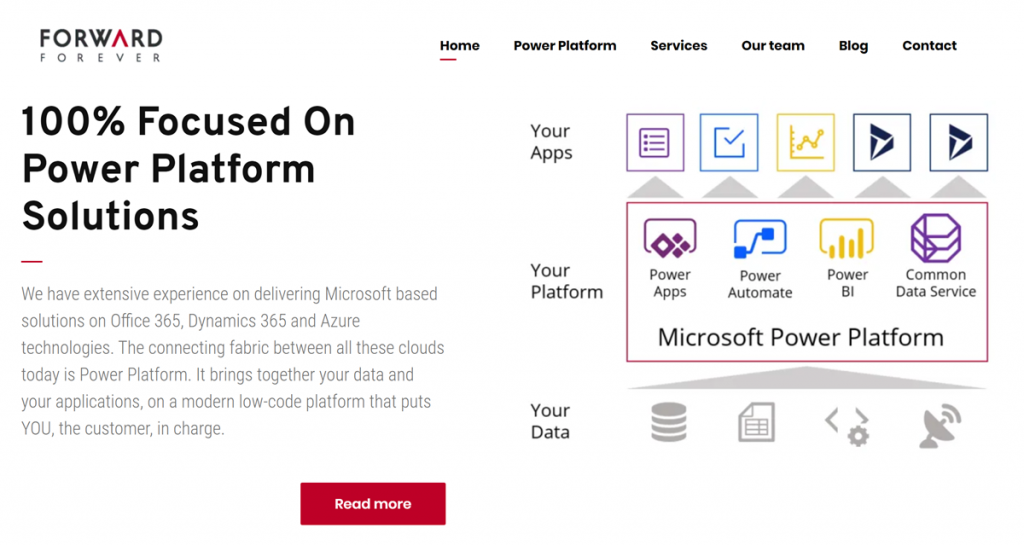
One week ago I left my job and took an important step away from being an employee – something I have been for the past 20 years. I am now working towards building a new company that will offer services in the Microsoft Power Platform field of technologies. We are not quite ready yet to share details about what’s coming, but this will change within a few weeks time.
Becoming an entrepreneur is not something that happens overnight, nor is it a journey that would have a very predictable route and schedule. Still, now that journey has begun. For me it is a time of both reflecting on the past as well as envisioning the future. Funnily enough, this balancing of thoughts between the two ends of the time spectrum actually results in a strong sense of “living in the now”.
To better understand the direction where I see myself heading, I wanted to write down the steps that have lead me up to this point in my professional career. Since for me writing is thinking, the primary purpose of the exercise was to gain perspective on my earlier experiences and see how the dots may actually have connected when observed from a distance – i.e. after enough time has passed to wash away the minor details from my head. So, for those who are interested, here’s my story from 2000 to 2020.
Exploring customer data management
At the beginning of the new millennium, in the Spring of 2000, I briefly joined the dot.com boom at its height and got to experience the first round of revolutions introduced by new mobile technology. There wasn’t much non-voice data moving between mobile devices of course (with only 2G available) but the explosion of digital service usage by consumers meant that a wealth of data on their behavior had started to accumulate. Even though I had no actual understanding of the source technology that spewed out this virtual trail of what someone had done with their handset or their PC browser, what I did find absolutely fascinating was how this data could be interpreted to tell us what those millions of customers liked and didn’t like.
In my first real jobs I was positioned within the marketing organizations of companies who were running digital consumer facing services. I took part in the operational campaign management with target group definition and queries, but also had the opportunity to report on the response rates as well as combine these with other customer value metrics to create new insights from this data. I did my bachelor’s thesis on “measuring email direct marketing effectiveness in customer relationship building”. Its founding idea of being able to track the individuals who opened the message or clicked on links and then cross reference that with customer profile data from the CRM system seemed like an incredibly efficient way to gain new knowledge about the relationship’s state and direction. Sure, the actual systems needed for working with that data and automating email & SMS campaign logic were still hugely expensive to implement at the time. But hey: at least a junior analyst like me could create some pretty neat Excel summaries on the cheap, thanks to all that sunk cost spent on IT consultants who had built the data platform.
Had I stayed in this mobile wonderland, I might well have gravitated deeper into what was then referred to as analytical CRM, which could easily be seen as the path towards the business of crunching big data at massive scale. However, I didn’t really ever possess the mathematical skills needed to become a proper data scientist. It seemed to me like there must be plenty of similar opportunities out there in other industries, too. I imagined almost any company that understood the value of actively managing customer relationships could optimize their operations by having smarter processes in place that gathered and made use of the CRM data. Wanting to explore the alternate realities of CRM that existed out there, I found myself moving towards B2B scenarios where the transactions were of lower quantity but of much higher value. Funnily enough, I soon discovered a negative correlation: the more valuable these transactions actually were, the less likely it was that a systematic process was followed and accurate data captured about the engagement with the potential customer. The holy trinity of People, Process, Technology and how they impact CRM success would quickly become apparent to me, thanks to being exposed to the human element of how the users of CRM systems actually behave.
This was an era where everything was very much focused on doing more with the PC. To be more precise, it was about getting the employees to enter more data via their PC keyboard strokes and mouse clicks into the centralized databases that would then turn this data into reports and possibly even partially automated completion of business processes via integrated systems. Alongside my marketing tasks I ended up becoming responsible for running the complete IT services for an organization with ~50 users. Sure, initially I didn’t know much at all about going beyond the personal computing devices running Windows XP, but with access to a few aging Lotus Domino servers that were reaching end of live, I soon ended up taking this organization to modern tools like Microsoft Exchange 2003, Microsoft SharePoint Services 2003, Microsoft SQL Server 2005 and, yes, Microsoft Dynamics CRM 3.0. I didn’t yet realize back then how crucial it was that I had to get my hands dirty with all these MS server products. We needed to save up on the consulting fees while at the same time ensuring these systems supported the day to day business processes that kept the money flowing in and services flowing out.
Learning the CRM consulting trade
Next I went to work on Dynamics CRM 3.0 implementation, integration and development projects within a software company that was deploying the system globally to all its area offices. Again, the willingness to get my hands dirty with the kinds of technologies that I didn’t have much formal qualifications to be setting up (remember, I had mostly been “just a marketing guy”) proved to be a survival mechanism that paid off in terms of the results achieved when faced with surprises and uncertainty along a brand new path. Sure, it also taught me how easily the aspirations for achieving business process change can fail if attempting to accomplish it mainly through IT projects. Feature bullets in software rarely turn into success stories in business, when moving past the demos and presales. Nevertheless, seeing the endless number of moving parts involved in building a working technical foundation to enable this business transformation made me respect the depth of detail that proper CRM systems consultants must master.
The single most important method for surviving in the sea of technological options and varying user requirements was building up my skills to acquire information from the global community that worked with the Dynamics CRM product. As a way to participate and give back, I launched my own Surviving CRM blog to share my experiences and document the many gotchas I had encountered. Observing all the progress made in new software versions from MS and the many partner products was whetting my appetite for taking this tech stack further. In the everyday life at the office, though, I was facing the agony of not being able to upgrade our systems into newer versions because of the nature of corporate IT and numerous dependencies between other systems and software versions. This was what finally pushed me to the next stage in my professional career. I had been participating in the CRM v5 Beta program (or “TAP”) and by the time CRM 2011 was nearing launch, I knew more about it than probably any consultant in the country. Which then quickly lead me to become one.
In late 2010 I joined the IT division of a telecom operator that had built a hosted CRM 4.0 environment and offered a cloud CRM service that customers could sign up by just paying the monthly fee. Having experienced the massive IT effort needed in delivering Dynamics CRM from your self-hosted servers, this SaaS model immediately struck to me as a revolutionary way to cut down the barriers that had kept business users stuck with Excel sheets instead of a proper information system designed to manage their processes and customer data. The SaaS concept itself was of course familiar to me from before already. I had become an advocate of Shadow IT solutions in my earlier company, in an effort to find better ways for employees to share information and organize their tasks. So, even though I was initially tasked with managing the hosted CRM solution from a technology perspective, the true beauty I saw in the cloud service business model was having to deal with less IT to deliver working business applications.
On the day I signed my contract for what was to become my first IT consulting role, I was sitting in the cab with my new manager and browsing through Twitter (on my HTC Touch Pro 2 running Windows Mobile). “Oh, it looks like Microsoft has announced this new cloud service called Office 365” I said to him at one point. Even though it wasn’t directly related to CRM, I’ve always framed that as the moment when the business of hosting MS software via SPLA licensing model in the local data centers died. A whole couple of months before I would even start my job, that is. In the beginning of 2011 the global availability of Dynamics CRM Online made it all too obvious that the players in the hosting business weren’t equipped to deal with what was ahead. Stuck again with no ability to upgrade our own hosted platform to the latest version (yeah, this was “cloud” back in the days) meant that I ended up aggressively selling against our in-house services and promoting the MS cloud option as a way for customers to ensure they’d be getting long term benefits from their CRM system deployment efforts.
With a long enough experience on working on the customer’s side in CRM projects, I wasn’t your typical consultant who’d sing whatever songs needed to close a deal in presales stage. My manager at the time often described me as “brutally honest”, which was & still is an accurate description of my style of engaging with the audience (I took it as a compliment and I believe deep down he also meant it to be one).
With the start of the global cloud era, combined with the rise of mobile apps and social networks, things seemed to have started moving forward pretty darn fast. At least that’s what it felt like when observing this new world light up around me, in the many digital channels I paid attention to. It was in this time period where I also started doing more concentrated work on trying to analyze what the signals from the MS ecosystem meant, through producing both internal memos on how I envisioned the business landscape around us to evolve, as well as writing down my thoughts on public blog articles. Being a geek with too much free time in my hands and too many networks, blogs and forums on my reading list, I kind of turned my CRM work into a CRM hobby. This became quite an addictive form of entertainment for me to consume – long before media formats like podcasts and vlogs became a thing in our industry. All I needed was a feed of text & images to keep me hooked for hours on end.
Since I didn’t really believe in the value proposition of hosting MS software in local data centers of a telco, I thought what I’d next want to see is how things are run when working in a pure IT consulting environment. My second CRM consulting position was within a software development company that did things on a broad technology stack, for varying types of customer projects. One of the offerings happened to be Dynamics CRM, which on a deep enough technical level did tie into the .NET based custom development work done more broadly within that company. Running the whole business through a pure “by the hour” project model was much more straightforward than the earlier business model I had seen, where the same account managers were supposed to sell the customers pretty much anything from printers to CRM projects.
We even had the technical competence for developing Dynamics CRM extensions as sort of “apps” – which were mainly integration templates in real life. The market shift towards CRM Online proved to be a bit of a struggle for those integration patterns, so a majority of the new customers projects that I mainly recall actually deploying into production at that time were in the public MS cloud already.
The biggest gap in this business model built around software developer competency was the lack of any surrounding offering in the Microsoft application space. The heritage of custom software development didn’t really lend itself well to consulting customers on how to leverage different evolving parts of the Office 365 portfolio, for example. It was this lack of alignment in the broader MS ecosystem that ultimately became a blocker for the company’s commercial success.
It was during this position that my Dynamics community contributions earner me my first Microsoft MVP Award. Having already set my eyes more on the outside world rather than the immediate project work at hand, this new expansion of my professional network lead me to gain an ever wider view into the true breadth of Microsoft’s product portfolio and R&D activities. It made me realize that instead of just doing what I know, I gotta go out and strive to do what is possible with this technology stack and the ecosystem around it. Do what others are still hesitating to do.
Betting on the Microsoft cloud
For my third consulting role I jumped into an even smaller company that didn’t yet have a CRM practice in place. They were, however, a cloud native company in the sense that their focus was on riding the wave of what Office 365 allowed modern, more agile MS partners to achieve. At this point all the traditional system integrators were still stuck in their past on-prem methods. Funnily enough, my first Dynamics CRM deployment project there was still for an on-premises environment, but in 2014 that didn’t yet feel like such a technical handicap as it would eventually turn out to be.
The team consisted of high performance individuals who were not only skilled with the MS tools out there but also willing to live on the edge when it came to validating new products and features. It didn’t really matter if on a day-to-day level the individual consultants were still in practice focused on their own core areas: either SharePoint or CRM. What we were doing & how we were doing it was aligned with the path of the Microsoft Cloud, resulting in strong synergies in all areas of the business. The cloud story also truly came to life when presented to customers this way, rather than as siloed IT projects of implementing a specific system to meet specific requirements.
This did require a leap of faith also from the customer organizations, since often the specifications could not be tightly defined before kicking off a project. You needed to have an agile enough mindset to appreciate the value of experimenting with how the out-of-the-box functionality could support the business, rather than immediately resorting to custom development. After all, why go and implement the process exactly the way how some process owner out there had dreamed it, before they had ever seen the tools that would be available in the modern MS Cloud? For me, as a code illiterate consultant that would explore all possible ways to solve a problem before resorting to requesting a plugin or Javascript to be developed, this was the original low-code/no-code approach for enabling digital transformation within organizations. Long before anyone had seen Power Apps or Automate, and only with a shaky understanding of what Power BI would later become.
Dramatically cutting down the time-to-value with this fresh new approach of designing the sales, service and marketing solutions primarily on top of existing cloud app capabilities did deliver some pretty darn nice results for customers. With the growing MS product portfolio that evolved from CRM Online to Dynamics 365, there was always just more & more on the plate. We kind of just had to keep serving these new dishes to the customers, since we had pulled of the previous rounds so well. Being a lean consulting machine became an implicit target in its own right, which pushed everyone to higher and higher revs. Well, at least it pushed me to chase some elusive goal of efficiency and growth that I began to find increasingly demotivating. At some point I started asking myself “if this is what success looks like then do I really want it?”
Being there at the start of the new CRM practice, I had originally made it fairly clear (to myself) that our biggest challenge would not be in the new projects for new customers and getting them through the initial system deployment. It would be in the life after go-live. Where every CRM partner typically fails to remain in close co-operation with the customer, right when they are facing the inevitable Trough of Disillusionment as expectations meet reality and the path forward becomes muddy. Someone needed to be there to ensure that measurable business results were built up, gradually over time, as both the usage and process coverage was expanded though systematic, well planned actions. Upon reflecting on my achievements in addressing these challenges, I simply wasn’t satisfied with the depth of impact made in the area that I had considered most important before starting the journey. This was one example of an area where I had pushed aside the silent goals derived from one’s value system, in order to stay on the path of success. In the corner of my mind I found other similar conflicts, too.
I realized that just doing more of what’s in front of you, faster and in a more productive manner, isn’t ever going to change the direction of where you’re heading. Another discovery was that I was primarily accountable to myself for tackling the aspects that I found troubling in what the everyday work consisted of, since it’s of no use in trying to project your perception of problems onto the work community and expect them to step up in solving them. Regardless of the business performance indicators, we all have our personal success metrics that also need to remain aligned with where the team is aiming at. The misalignment can end up eating your intrinsic motivation once the rush of sheer speed wears out, even when everything seems to be fine on the surface. It happened to me, which left me no choice but to seek for a new trajectory to attain personal growth.
In search of scalability
I’ve always felt that much of what is done in your typical CRM deployment project is a waste. Reinventing the same wheel for every engagement isn’t all that rewarding at the end of the day, because it ties up expert resources in a non-scalable way. Projects should ultimately be a vehicle for building something that needs to be unique for a reason, yet looking at the Microsoft based CRM systems I’ve come across during the past ~15 years, the end results of these projects from a technical standpoint are often frighteningly similar. Sure, CRM as a software category is an example of a fairly well established concept that can only be done in so many ways. Those minor differences that end up costing money for a valid reason (i.e. integrations, industry specific business logic, analytics) don’t necessarily justify building something radically different for each customer, yet they are laborious to come up with. Still, the single biggest need for spending time in the CRM implementation project is about managing the change inflicted upon and experienced by the system’s users, rather than the software always requiring such time investments to be ready for use.
Whenever there is a situation like this that involves systems, practices and organizations that operate mainly in the digital world, you know it’s a business model waiting to be disrupted. Instead of always selling consulting hours to deliver a CRM project at the start of it all, why couldn’t there be “starter kits” that had been designed to get you up & running with a basic setup that works for most companies/business units/teams in the target customer segment? Simple CRM apps like Pipedrive or HubSpot already give you a system that doesn’t come with a mandatory “insert credit card to purchase a project team for X days” step in the deployment process. Shouldn’t it be perfectly possible to craft such offerings on top of a flexible business application platform like the one Dynamics 365 contains beneath the apps? Wouldn’t these packaged solutions then also offer a great story for plugging in additional apps and modules once the foundation had been set up in a standardized way, to make use of the Microsoft Cloud’s many services and the products from the partner ecosystem?
My second job in the telco industry was all about experimenting with this hypothesis. In order to enter a market where the IT consulting companies seemed perfectly happy to hold on to the customer specific project delivery model, the new contender had to build a product that would challenge the status quo via a distinct value proposition and a new revenue model. Getting new Dynamics 365 customers quickly off the ground with minimum customization work and maximum self-service support materials was one part of this plan. The other aspect was connecting these Dynamics 365 customer environments with as many communication & data services as possible with readymade apps rather than via traditional integration projects. If there really was market potential in bringing CRM solutions to SMB customers who didn’t fit the normal target group criteria for consulting projects, then this was what you’d need to build for catering to that audience.
These concepts are pretty much straight out of the Microsoft playbook for how partners should seek a role for themselves in the era of cloud CRM that tends to commoditize the core application capabilities and lower the barriers for ISVs to integrate their own services with the global business application platform. The problem has always been that when operating in small markets like Finland, there’s fairly little room for partners to specialize in catering to specific verticals, or build any app functionality to test out in the home market. You’d need to aim global right from the start, and the risks in that seem to be too great when compared to the safe alternative of doing generic projects for local customer organizations you know, though the team of experts you also mostly know. Going beyond that requires investments in everything: planning, development, marketing, sales, support, the usual. Most of all it requires tolerance for failure as you experiment and fail, before you understand what it is that’s actually needed to succeed.
Not too many opportunities exist in the local market to do something like this, so when they arise, you need to give it a go. Even when it sounds likely that things might not work out, the only thing to really ask yourself is “what have I got to lose?” I chose to see where this path would lead and how long it would carry me, because I saw that there really wasn’t anything important for me to lose in making that choice. The possibility to learn from a whole new business activity of developing products outweighed the harm that would come from stepping outside an organization that had been optimized around delivering customer solutions on MS Cloud and into an enterprise where such a service would be merely a single drop in the ocean. Sure, from my past experience I could envision a million reasons why this thing would not work in the CRM market that I knew so well, yet I found myself being able to give “what if” a chance regardless.
As I had expected, a lot of barriers were in place to stop us from getting up to speed with building the products that were needed to bring the vision to life. Following my pattern of brutal honesty, I wasn’t too shy on telling everyone fairly early on where I saw the next obstacles that we were bound to hit. Reflecting back on this, even though I might have been right in my analysis of the many details that stood between the product’s capabilities and getting to real customer value, perhaps it would have been more beneficial for me to try and play along a bit more. Banishing the inner critic is not something that comes easy to me, but that would certainly be a welcome skill when attempting to foster creativity and paint a picture of what we should be aiming for on a high level.
I won’t go further into details here, as we’re about to reach the point in our chronological journey where not enough time has yet passed between then and now. What I can share is that the opportunity to work for a large information worker organization offered some very valuable perspective into the role of technology as both the enabler and the blocker for business success. This is something you can’t ever quite grasp when coming in as a consultant from a small company with zero legacy and hardly any organizational barriers – even if your actual project delivery work happens within these enterprise walls of the customer organizations. There are both huge possibilities and great inertia found in such environments that invariably affect how business applications need to be designed, deployed and fostered. Just like already earlier in my career, being able to experience the process from both sides of the table has been essential for me in gaining the perspective and empathy needed for achieving long lasting results in this field.
In my roles as a Tech Lead and later Product Lead I had the perfect opportunity to observe the Power Platform emerge from the white space left between the established product areas of Microsoft. Had I been buried deep in project work for those usual CRM customer environments that most Dynamics 365 professionals spend their days in, it would have surely been much harder to see what’s happening out there. Of course I also had on my side all the connections that have been made possible via the MVP Award, both from the Microsoft product team and the unique network of experts that is Business Applications MVPs around the world. This combination provided me the confidence needed in making the decision that has lead me to now write this retrospective of my past 20 years.
What lies ahead
If you’ve read the story this far, then I think you deserve a break! I know I certainly do, which is why there won’t be an immediate part 2 for this blog post. But it’s coming, in one form or another.
Looking back on all these steps in my professional career, I feel a strong sense of gratitude for being given the opportunities that each role has brought along. I have never regretted accepting any single position, because at the end of the day, it has always been me who has shaped that role into what it eventually became. Staying within the existing boundaries defined by someone else and then just improving my performance inside that box just isn’t who I am. For both good and bad, my mind is often working on solving the next problems that have yet to be identified as problems by others.
The reason I’ve stayed on the move instead of settling down for a longer period of time within a single organization or position has been the inescapable urge for pushing these boundaries. That feeling of “there’s gotta be even more out there” – and there has always been.