Tag: ALM

  • Working with solutions in Dataverse for Teams

    Working with solutions in Dataverse for Teams

    For over a year now, we’ve been living in a world where Microsoft has two separate offerings of Dataverse. When it comes to the tools especially around solution management, there are certain differences app makers should be aware of.

    In this article I’ll go through the peculiarities I’ve ran into when building solutions in Dataverse for Teams (DV4T). But first, a few words on why you should care about the Teams based environments when building Power Apps.

    Positioning of Dataverse for Teams

    Understandably, not everyone is a fan of the Teams version of Dataverse. After all, it’s a cut-down version of the full Microsoft Dataverse that many have been using for Dynamics 365 and XRM scenarios for ages. However, there’s that one unbeatable feature in Dataverse for Teams that’s hard to ignore: it’s FREE!!! (*With capacity limits, though.)

    If you are building a complex business application for a specific audience, it’s almost always sensible to pay a little more and get the Power Apps Per App or Per User license to unlock the full Dataverses platform capabilities. But when you need an app with a casual usage pattern that applies to a huge number of individual users, sometimes it just ain’t feasible to go premium all at once. So, to avoid falling back to SharePoint lists, Dataverse for Teams a.k.a. DV4T can be a well justified choice from an architecture perspective.

    Just because you’re using Teams as a platform for your low-code apps doesn’t mean you don’t need to plan for ALM (application lifecycle management). A single production environment ain’t going to be sustainable in the long run for the more important business processes. There are good news and bad news when it comes to Dataverse for Teams in this regard.

    Let’s get this one bad news out of the way first: all of the APIs to programmatically interact with Dataverse are not available when working in a Teams environment. So, any pro-dev ALM processes that involves automation via DevOps pipelines and such is out of the question.

    That leaves us manual ALM, meaning export and import of solutions by a human being. Nothing wrong with that, since surely the vast majority of business apps running on the platform globally are developed and maintained this way. After all, there really isn’t a low-code specific ALM process available in Microsoft’s world today that wouldn’t require at least some pro-code developer skills in the delivery team.

    The secret life of solutions in DV4T

    When you build apps from within the Teams UI, you will never encounter the word “solution” in the app maker experience. The Power Apps app inside Microsoft Teams will instead show you tabs called “built by this team” and “installed apps”:
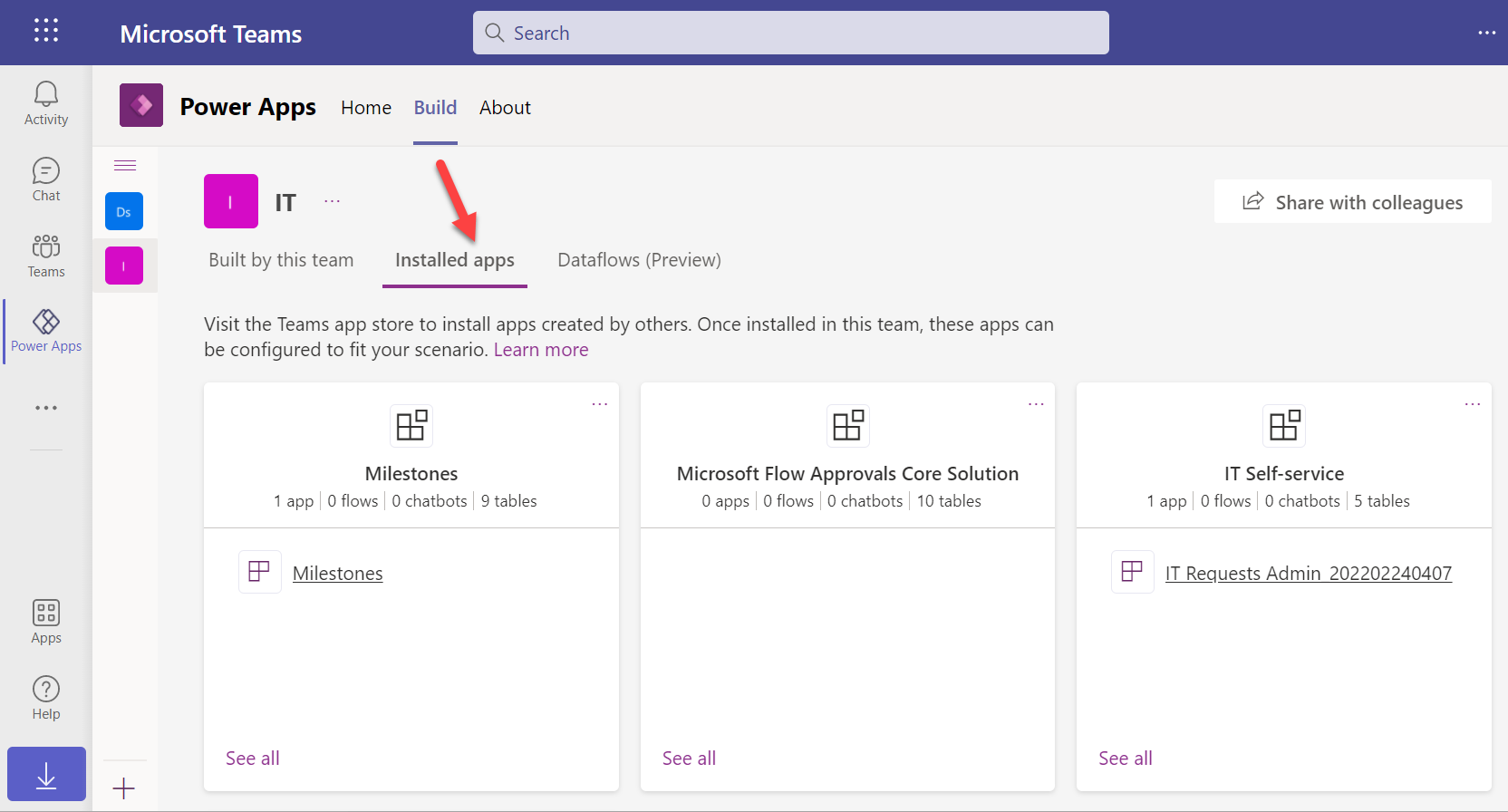
    How does one create new apps here alongside the already installed ones? By importing managed solutions into the DV4T environment. Of the three apps in the above example, IT Self-service has been imported as a managed solution package from another environment. Milestones is a sample app from MS with its own proprietary install experience, whereas Flow Approvals is just the raw infrastructure bits that get auto-provisioned when you create your first approval request in an environment.

    All the unmanaged components in this environment will be found under the “built by this team” tab. Looking at the source DV4T environment from where the above IT Self-service app has been exported from, here’s how its bits and pieces show up in that environment:
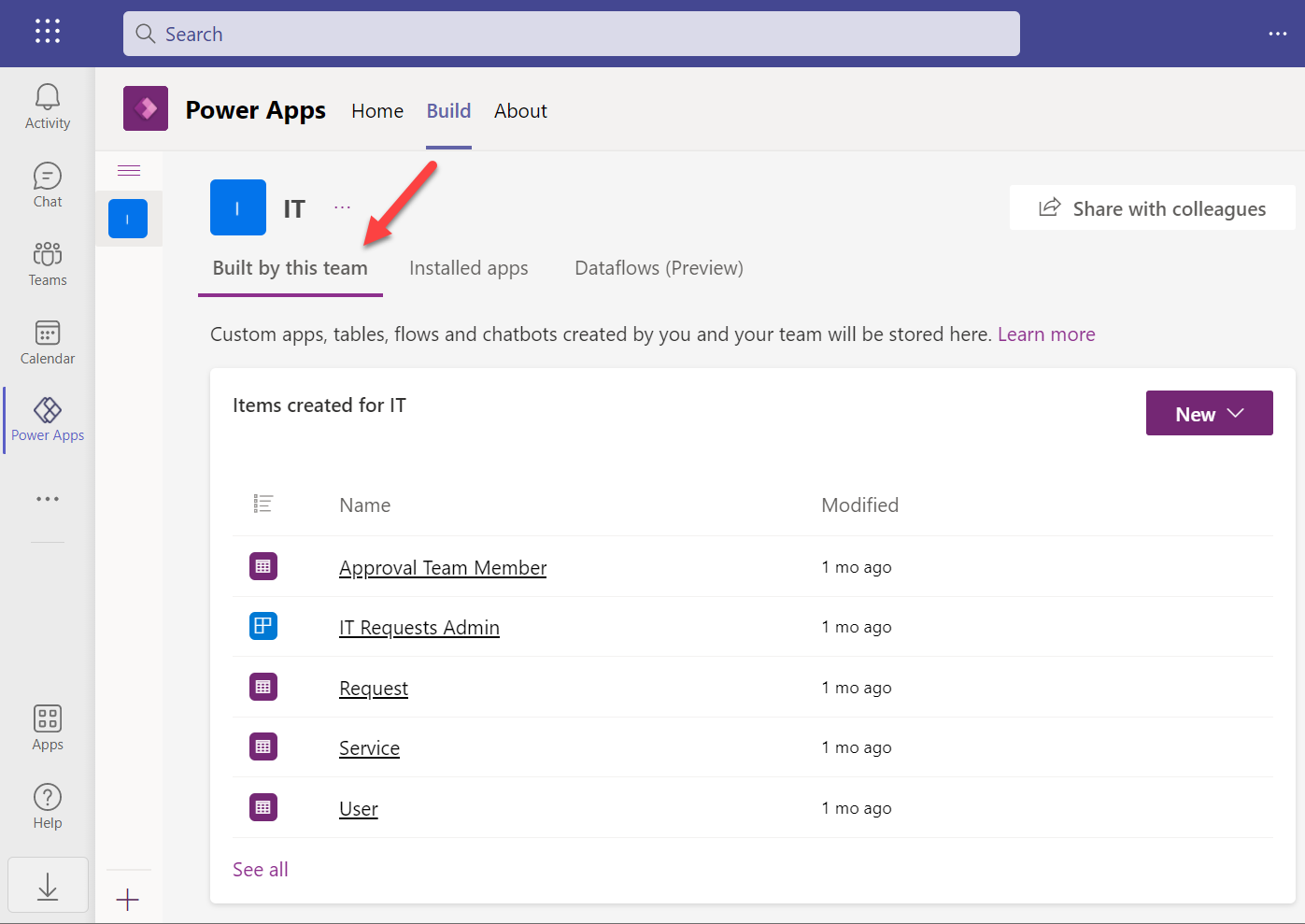
    When you click “see all” you’re taken to what looks a bit like the modern solution explorer in Dataverse, except it’s missing most of the features you’d expect to find there. When you consider for a moment that this experience is aimed at new citizen developers who aren’t really even aware of what “Dataverse” means, it does make a lot of sense.

    We’re not like them, though. We are advanced low-code app makers who know what we want to achieve with these tools. Our escape hatch from this simplified world is the “Open in Power Apps” button that can be found when selecting “Apps” from the tree view.
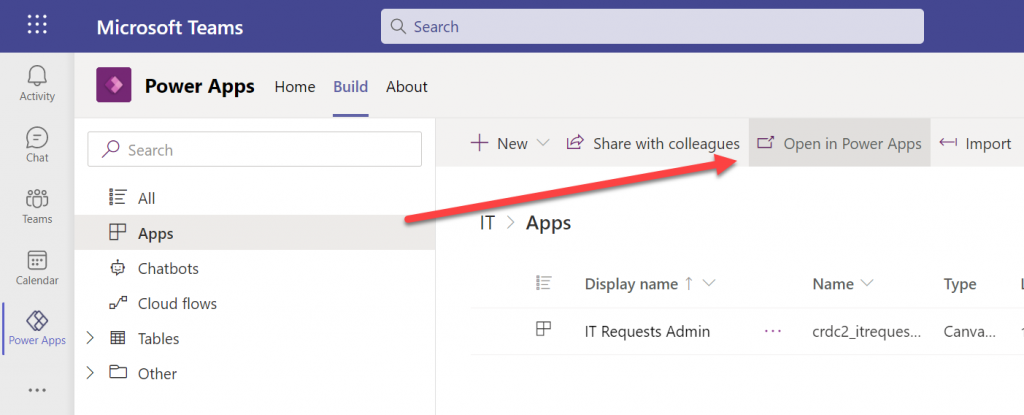
    We’re then taken into a special version of the Power Apps Maker portal that cannot be accessed directly from make.powerapps.com. This is because the DV4T environments do not show up in the environment picker of the usual Maker portal (they do on the Power Automate side, though). Time to add a browser bookmark for this URL, to keep you from having to always remember the curious navigation acrobatics required to land here.

    Anyway, at least we’re now in a place where the good ol’ solutions can be created:
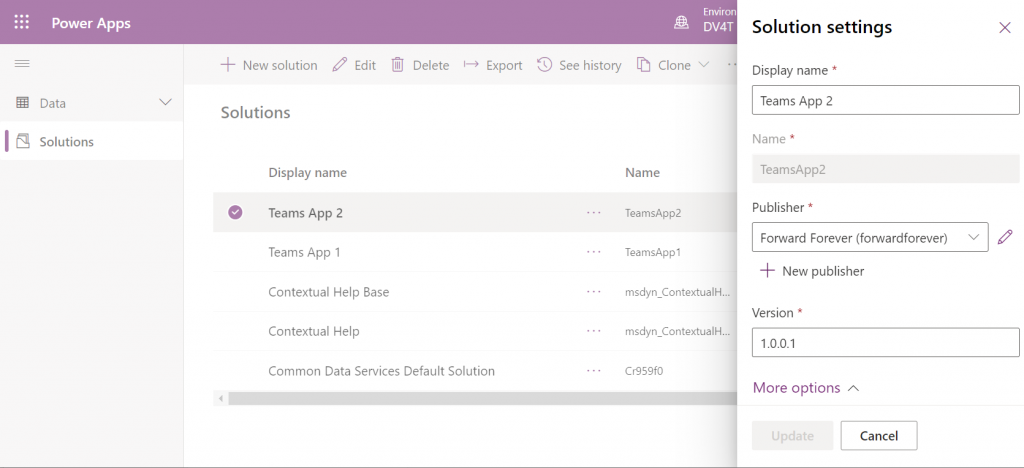
    You’ll quickly notice that only a subset of the full solution explorer features are available here. I’ll next demonstrate how this can lead to some challenges in your app development tasks.

    Choices in a DV4T world with less… choices

    The IT Self-service app that was mentioned above is a fairly straightforward app with a few tables, a canvas app and a cloud flow. After getting the initial version ready in the development environment and preparing to configure it for another Dataverse for Teams environment, I ran into an interesting issue. This example reflects some of the “gotchas” you should be aware of when working without access to the full Dataverse tools.

    We can import solution files from the Power Apps experience within Microsoft Teams, too – even if the word “solution” is avoided. When importing my test app from here I encountered the error “import failed due to missing dependencies”. Clicking on the “show dependencies” button didn’t do anything at all.
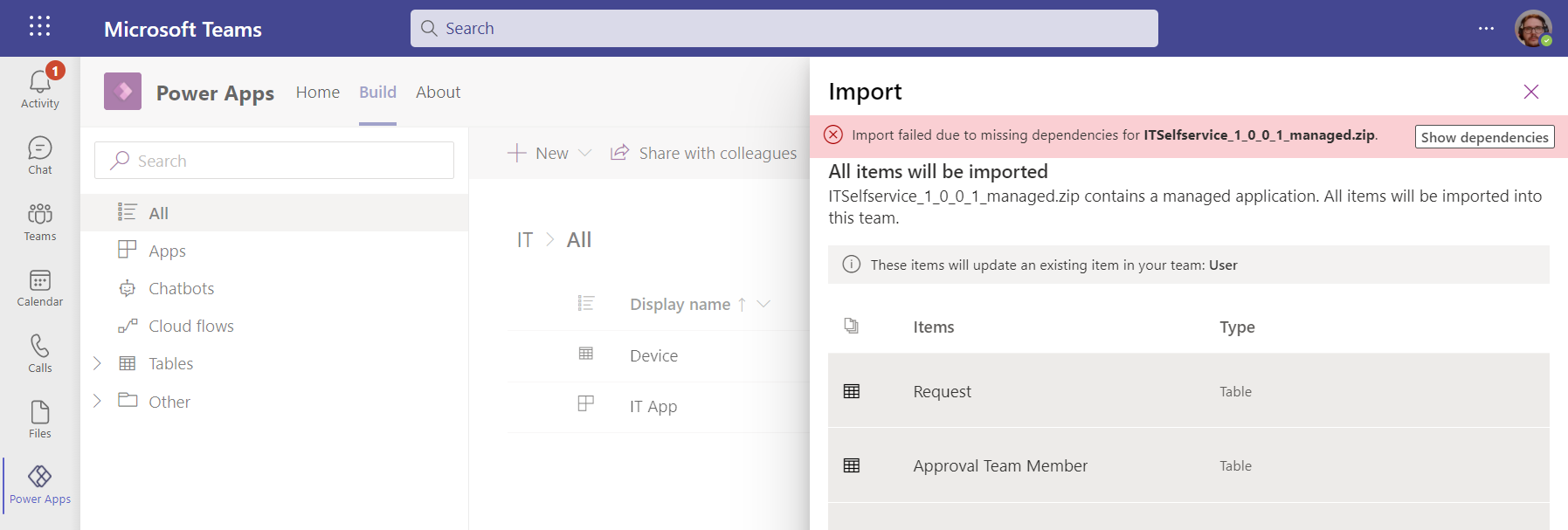
    Switching over to the Maker portal UI for this DV4T environment, then initiating the traditional solution import process, I was able to see the that my solution package was apparently missing a Choice:
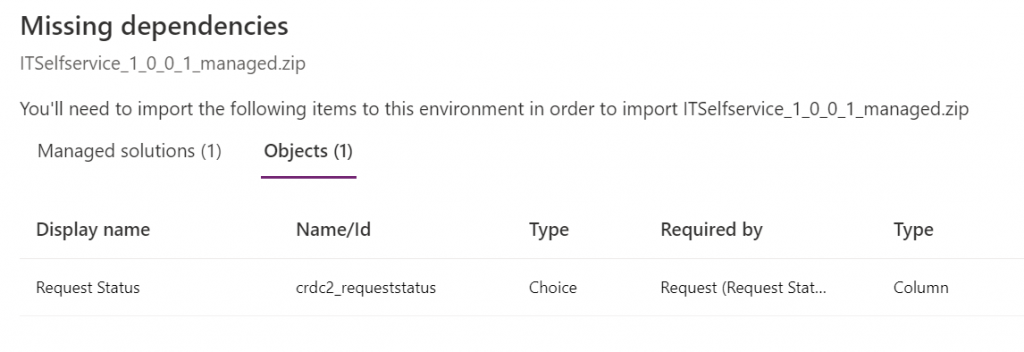
    Ah, the awkward naming choices that Microsoft has recently made with our beloved platform… Ok, I’m now switching back to the old terminology that makes more sense.

    So: I had added an option set field for my entity. However, it was a global option set, and now the solution package was missing the actual list of values that are stored within this separate solution component.

    How did I end up in this situation? I’m not actually sure. I did a test with a different app, to see whether it makes any difference if I create the table columns from the Teams experience (which is very citizen friendly in its Microsoft Lists type UI) or the Maker portal. It is different in the sense that Teams creates a local choice vs. the global choice that the Maker portal defaults to (as recommended by Microsoft’s own Docs). Still, the solution export/import worked without any dependency errors on both versions.

    No big deal, I’ll just add the missing component into the solution… Not so fast, Mr. Advanced Maker! Just because you’re working in a UI that resembles the full Dataverse solution explorer, doesn’t mean you have the same features at your disposal. Although Choices is one of the nodes that does show up in the tree view, you can’t actually find it in the “Add existing” menu:
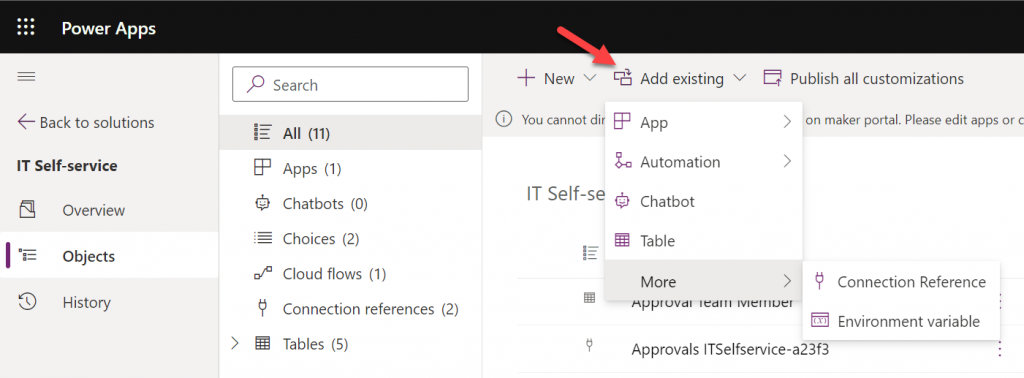
    Those of you who work with full Dataverse know that the “Add existing” menu contains well over a hundred items. The official Docs on solution component types only list 90 values at the time of writing but MS is adding internal components there all the time. We sure don’t need most of them in DV4T, but this omission sounds a bit unfortunate.

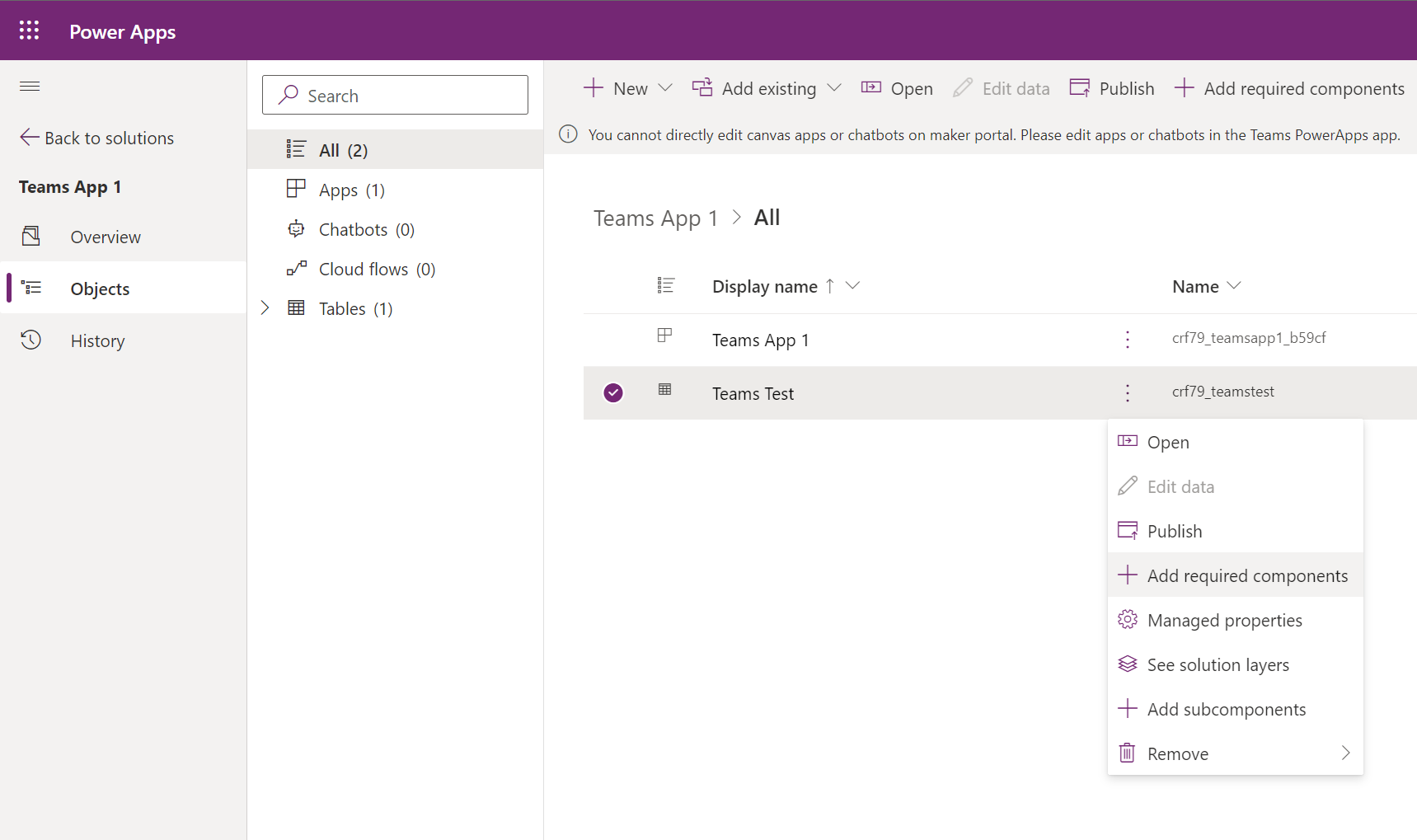
    I had already done all sorts of debugging and hacking to find a way around this annoying limitation until I discovered a UI based way out. I saw that the existing Choices in the solution had the “Add required components” option behind the three dots. Unfortunately the Tables view didn’t include the same option. In the full Dataverse solution explorer we’ve got it in the main toolbar, but DV4T is different in this regard, too.

    Finally I found the place where the option does apply to tables, too: the all objects view. Success!
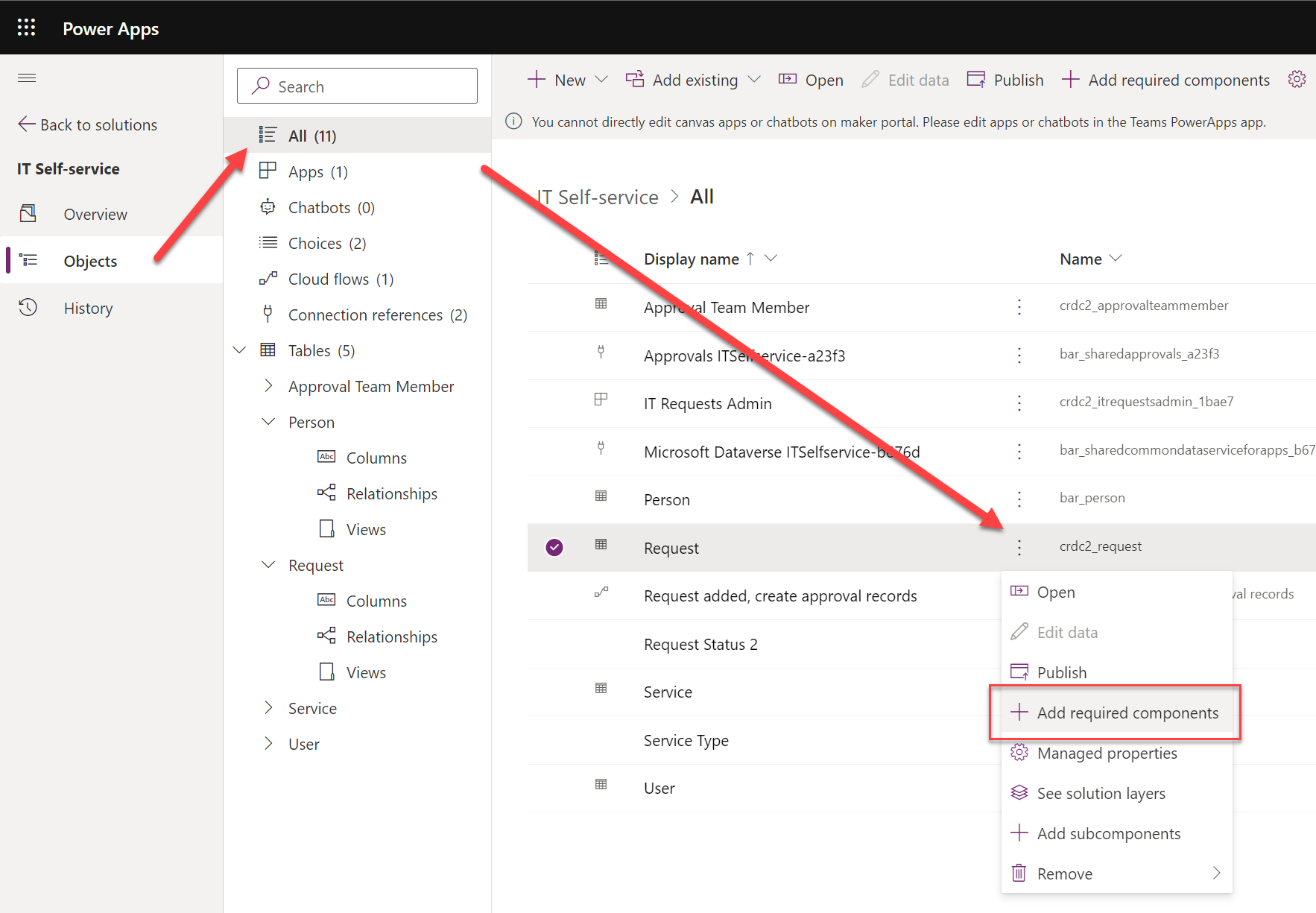
    It took a few hours for an experienced low-code developer to discover how to do what he wants to do in this simplified environment. It was still faster than replacing everything with a new column at this point, though. I had almost accepted the fact that I had simply clicked on the wrong navigation path somewhere in building the app and managed to break the boundaries of the DV4T sandbox. Luckily that wasn’t the case today.

    Solution publishers

    When you start adding items into a Dataverse for Teams environment via the Teams UI, they will get created under the CDS Default Publisher. The prefix for new solution components will be something like “crdc2”, meaning a random value that’s different in each environment. At least it isn’t the dreaded “new_” prefix…

    You can create a your own custom publisher when creating a new solution via the DV4T edition of the Maker portal, similar to how the full solution explorer works. As long as you create the items from under this solution in the Maker UI rather than the Teams UI, the correct prefixes get assigned to them. However, since you cannot create a new canvas app (or chatbot) via the Maker UI, this means your app schema names will always get the CDS Default Publisher prefixes.

    There are nice new features like the table editor in the Teams UI, which you might be tempted to use for quick editing of demo data while building your app. If you’ve created your tables from the Maker portal side, though, you won’t find them in the Teams UI:
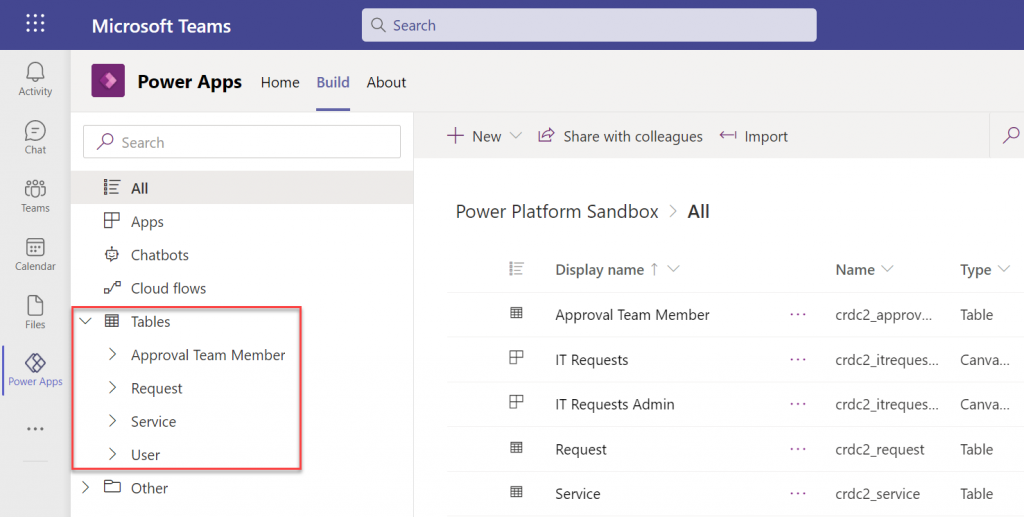
    The reason for this is that the Power Apps app inside Teams will only display the unmanaged solution components for the environment’s default publisher. So, if you tried to follow solution management best practices and created your own solution publisher, the doors will be closed over on the DV4T native app building experience.

    Unmanaged, invisible solutions

    This leads us to another gotcha on how DV4T treats solutions that come from outside the current environment. We already saw the differences in how the managed solutions imported into the environment are listed under “installed apps” and unmanaged stuff is under “built by this team”. That’s how the Teams experience shows things, and as we’ve come to now understand, it isn’t always sufficient for advanced makers.

    When we do the equivalent of “switch to classic” in the Teams world and hop over to the Maker portal view of the environment, are things in their right places again? Well, not if you imported an unmanaged solution into the environment. Here, try and find the unmanaged IT Self-service solution from this list below:
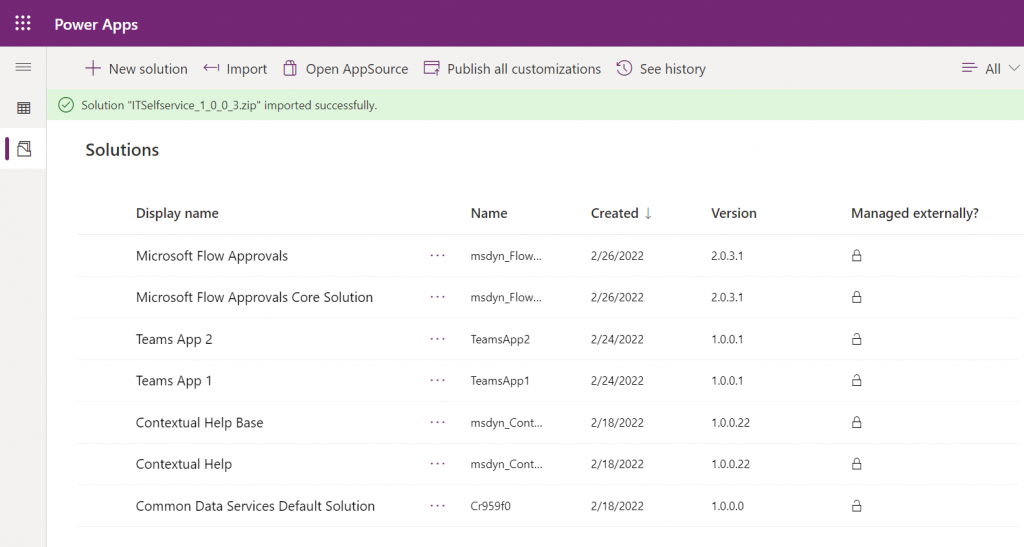
    No matter how many times you hit refresh on that page, your imported solution won’t show up. All the imported components do exist in the environment, though. You can access them via the Common Data Services Default Solution:
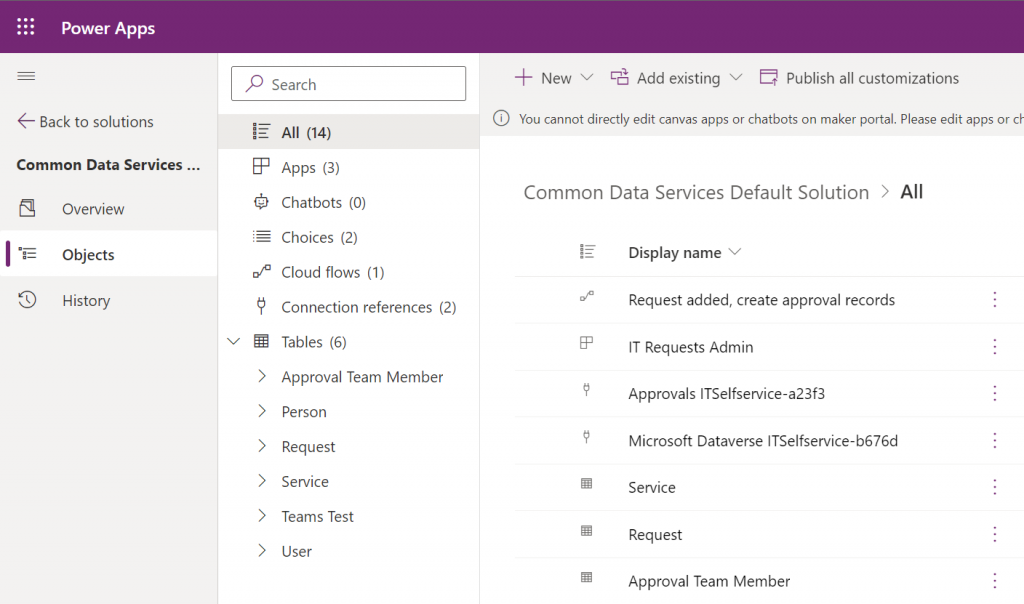
    Why isn’t the solution visible then? Because Microsoft decided that you don’t need to see it, apparently. Deep down in the database all the solution metadata is stored. You can tell this from the fact that if you try to re-import the same solution, you’ll see a message “this version of the solution package is already installed”.

    The limitation isn’t technical then, just a UI level filter. Yet from a practical point of view it is very real in a DV4T environment. This is because all the standard Dataverse APIs are blocked, so using tools like XrmToolBox to work around UI limitations and improve app maker/developer productivity are out of the question.

    Closing thoughts

    Dataverse for Teams has capabilities for running quite extensive business applications (just look at the CoE Starter Kit for reference). Many internal low-code apps could benefit from having a proper relational database behind them, yet they may not be feasible to be implemented with features requiring Power Apps premium licenses due to their usage patterns. The current app packaging story of DV4T raises some concerns on how solid this foundation will be for applications that will need ongoing maintenance and development.

    Ultimately it would be best if we had a clear path for using the full Dataverse as our development environment, then publish the final app into DV4T for testing and production. As it stands today, the Canvas app editor experiences between the two environments are technically different. Also, it can be all too easy to “infect” your solution with some dependencies to features of full Dataverse that are going to block importing it into a DV4T environment, based on my experiences.

    Update 2022-10-20: Today I learned about one more gotcha with Dataverse for Teams that involves Power BI reporting. If you build your tables from within the Teams Power Apps UI, you won’t see a “publish all customizations” button. However, unless you publish your customizations, the TDS endpoint won’t pick up the choice column labels. You’ll only have the ID values but the “name” fields will be blank. So, as a best practice, always keep the full Power Apps Maker portal open while building Teams apps/tables and remember to publish your customizations from there – just like you always have in the XRM days.

  • ALM for low-code: are we there yet?

    ALM for low-code: are we there yet?

    Application Lifecycle Management, ALM, is a topic rarely covered in the mainstream pitch for how low-code/no-code solutions are transforming app development practices. This is understandable, since the initial time-to-value, from an identified business need to a working application (or at least a functioning prototype of one) is where the major difference to the traditional software development initiatives are easiest to demonstrate. It’s the “five minutes to WOW” effect that gets most of the attention.

    Relying on configuration and formulas over custom code does promise also a lower maintenance overhead for the post go-live phase where the apps are used and evolved gradually to remain in line with the business requirements. There is less to worry about the potential impact of changes in each of the underlying components that keep the app running when you’re subscribing to a service like Power Platform that aims to abstract away many of the moving pieces in Azure and other related cloud services.

    You shouldn’t assume life to be completely worry free, though. If you don’t plan ahead on what type of work is needed after the creation of your low-code app, then a nasty surprise may lie ahead for someone, somewhere, at the most inconvenient time. In the worst case your organization has become reliant on an app that no one owns & no one knows how it works, only to realize that your processes have already stopped due to errors caused by a change either inside or outside the system. Updates to the cloud components or changes in APIs used via Connectors, for example. A slower yet equally frustrating problem can arise from identifying a future change you’d really need to implement for the app in question, yet you don’t have the means to make that happen in practice.

    The rise of low-code application development and the forecasted arrival of 500 million new apps in the next 5 years is making IT organizations very aware of the need for setting up governance models to address this new reality. Having baseline knowledge of what apps are created, by whom, for which audience, for what purpose, through what technologies, on what data sources etc. is often the discussion that needs to be done first to analyze the current situation. A great tool for facilitating this is the Power Platform Center of Excellence (CoE) Starter Kit, which gives you an overview of the big picture for Power Apps and Flows in your tenant. To go deeper and actually manage the lifecycle of an individual (potentially business critical) application, we need to start discussing ALM.

    What is this ALM thing anyway?

    Microsoft has published fresh new documentation on ALM with Power Platform that could be viewed as a similar Starter Kit for this topic as the aforementioned CoE. It briefly covers the high level summary of what ALM means:

    ALM is the lifecycle management of applications, which includes governance, development, and maintenance. Moreover, it includes these disciplines: requirements management, software architecture, development, testing, maintenance, change management, continuous integration, project management, deployment, and release management.

    A very broad concept then. What I like most about this intro chapter is the definition of the goal of ALM: “driving efficiency through predictable and repeatable software delivery”. That’s the essence right there. Anything that reduces the differences between how individual app makers / developers perform common tasks within the whole lifecycle of a specific business application will improve the state of your ALM practices. Those with a software development background may immediately venture into thinking about various DevOps methods and tools at this point, whereas I’m always most concerned about how the business can get a grip of what exactly is happening to their applications over time. Who built what, based on which specification, when was it deployed & where to, how were the changes documented, what impact did it have on others systems, how were users educated on the new features, and so on.

    Microsoft’s ALM guidance is mostly revolving around the technical level specific to Power Platform, meaning how solutions and environments should be used. If you haven’t heard it before, then the solution framework that was born in 2010 for the XRM era has been actively expanded to cover more & more areas that are not a part of the Dynamics 365 Customer Engagement on-premises server. Canvas apps, Flows, AI Builder models, Power Virtual Agent chatbos, Export to Data Lake configs, pretty much everything in the Power Platform is now manifested as solution component. More is on the way, based on how Matt Barbour has stated things like Power BI and integration services being “on the radar” for the Power Platform solution system.

    The expanding technical capabilities and scope of components shipped via solutions is of course great news. However, as we are now talking about the platform for every developer, not just pro devs, my number one question about Power Platform ALM is not “will it scale up to new products and features” but rather “will it scale down to new types of apps that don’t follow the lifecycle of a CRM system?” So, there’s two dimensions I feel will be critical for the ALM story to succeed: 1) unifying the mechanisms to manage configuration & code across the different app teams within MS Business Applications Group, and 2) democratizing healthy ALM practices by making them accessible to citizen developers. The first one is well underway with the solutionization of everything, but how about the second one?

    Managing your “source low-code”

    The fundamental challenge with why ALM tools aren’t already a part of every Power Apps maker’s or Dynamics 365 customizer’s core workflow is that they don’t exist within the context where these people do their work. This audience doesn’t need Visual Studio for anything, nor would there be anything familiar with the terminology used by version control systems like Git. This is alien technology from Planet Developer, which the no-code app makers would have to learn specifically for the purpose of managing how their configuration deliverables are moved from one environment to another. Compare that to the “export solution as .zip” / “import solution .zip” actions availble in the Power Apps Maker GUI that gets the job done for them. Many of these app makers surely understand the value that a formal deployment process and solution versioning could offer, but the barrier has been much too high for them to make that leap.

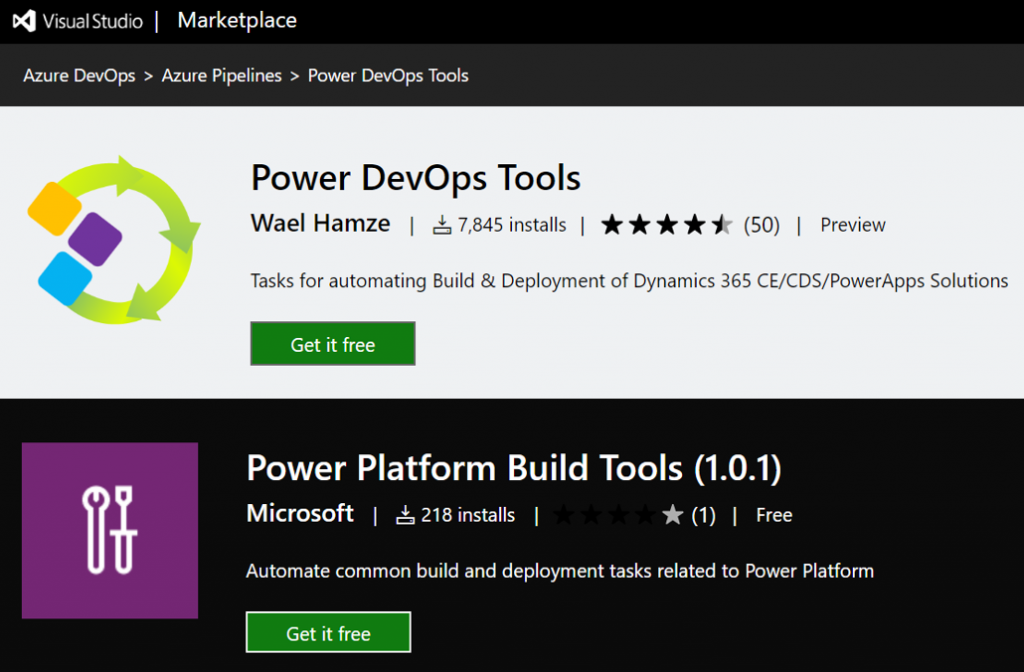
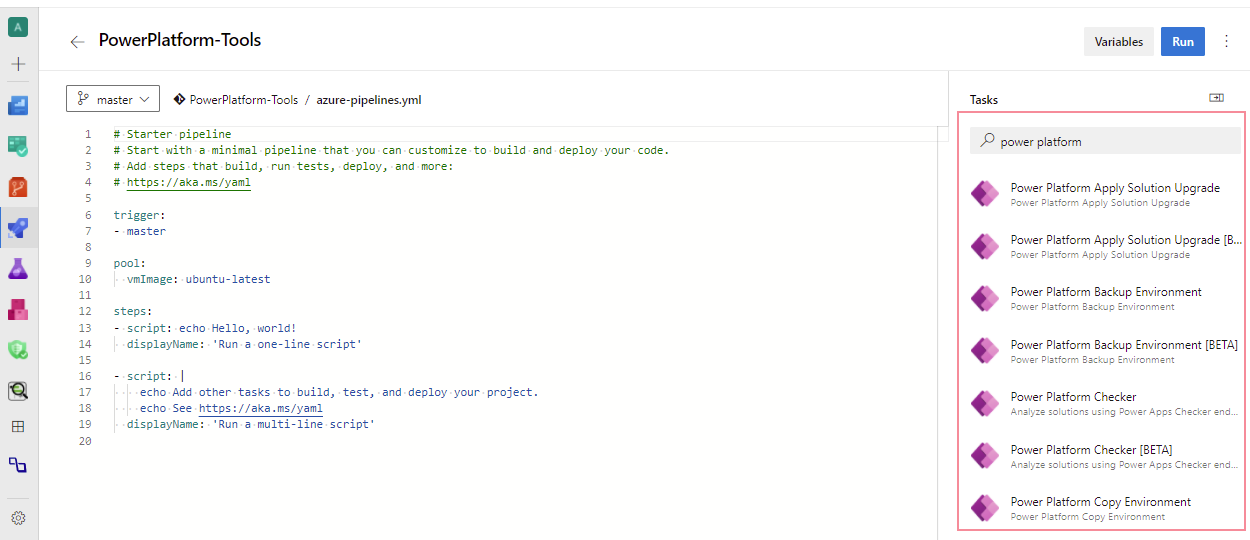
    There have been tools for pro-code developers working with XRM solutions for many years already, some provided by MS and many built by the community. Today there are official Microsoft Power Platform Build Tools available for Azure DevOps, which offer readymade tasks like solution export, import, unpack, pack, publish, with more features to come. Rather than tweaking PowerShell scripts, it would seem like there’s a way to visually configure the cloud to do some ALM magic for our low-code apps. Sure, this is not within Power Apps directly, but could this be considered just another admin portal that the citizen developers might learn to navigate?

    Get the Microsoft Power Platform Build Tools

    Setting up an Azure DevOps pipeline that pulls solutions from your dev environment, commits them into a repository for version control and then deploys that same solution to test or prod still isn’t exactly a next-next-next process. However, following a Power Platform specific tutorial, even a non-developer like me can get this up & running in a few hours. MVP Nick Doelman has written exactly what I needed, so if you’re interested in building your very first ALM pipeline, I recommend you to try this out:

    Simple ALM for Power Apps/Dynamics 365 Projects Revisited – Power Apps Build Tools edition

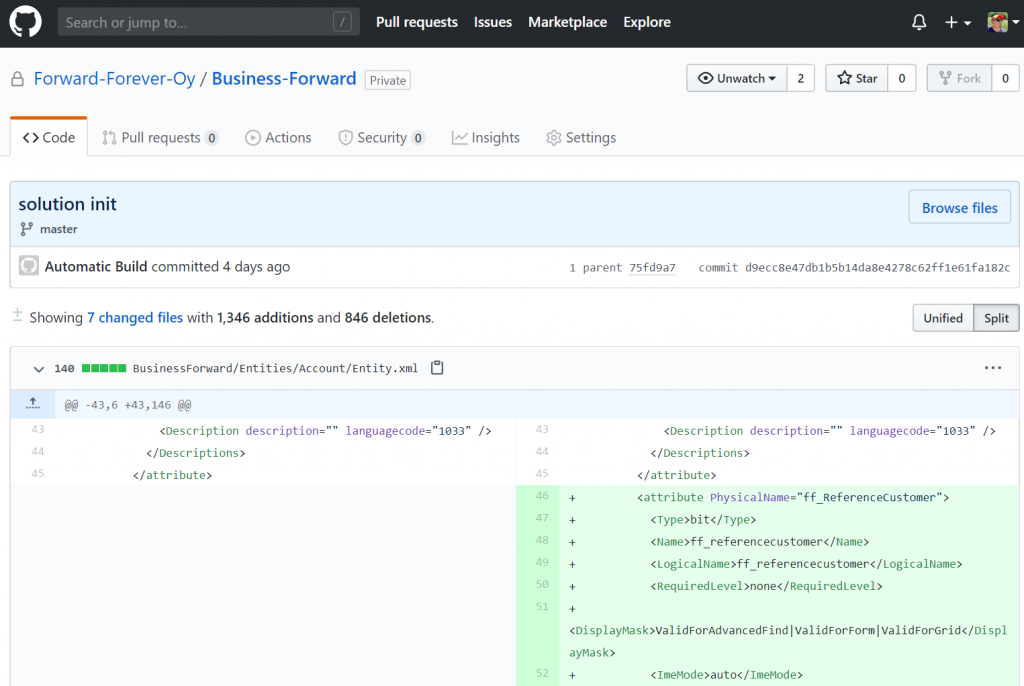
    Combining this with a recent update to the Power Apps Build Tools that also introduced support for MFA protected environments (meaning you can log in with an Application User identity), I was able to get our company’s “CRM” solution’s customization changes from from Dev to GitHub and Dev to Prod. Here’s what it looks like now when adding a new field on the accout entity:

    “Woo-hoo, we now have proper ALM in place!” Well, not quite. All that we really achieved with this was the possiblity of doing it “right”, meaning there are DevOps pipelines that could be used for handling configuration changes automatically instead of manually by individual low-code developers. Until I actually go and remove all Power Platform service admin roles from my colleagues, anyone of them could still go and mess up the production customizations directly. So, proper ALM is only partially about the tooling and automation – you still need to the exact same thing as without DevOps, meaning defining the processes and agreeing on the practices for how the business applications are managed.

    Regardless of this, it does makes perfect sense for low-code app development projects to evaluate if they would get benefits from leveraging automation tools like Azure DevOps. You’ll need to have the solution configuration stored somewhere anyway, so why not put it in a version control system that’s designed for “real code” and gain access to things like viewing the changes of individual solution components – rather than just dumping the files on OneDrive/SharePoint. Who knows, taking that step might even unlock further opportunities to automate and harmonize your application management processes.

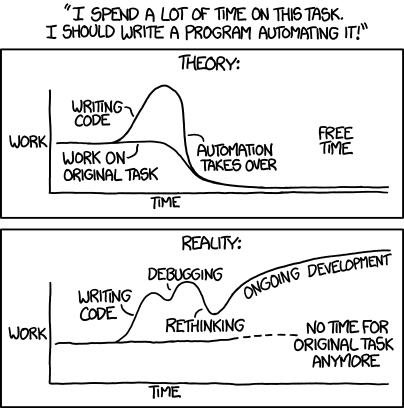
    We should keep in mind that automation is a double-edged sword. In theory it can save you a lot of time, yet in practice it may often turn into an additional time sink of its own. The legendary webcomic XKCD beautifully illustrated this dilemma of Automation, which I think is especially true here in the ALM discussion. The tasks that you’re trying to automate need to happen on a frequent enough basis for a long enough time before you could achieve a positive ROI from investing in setting up your pipelines. A single citizen developer building a one-off app may not yet meet that threshold, so preferably in your automation scenario there should be a team of developers who will do several planned releases for the app in question.

    ALM for a team of low-code developers

    Microsoft likes to promote the stories of Power Apps Champions who have managed to make digital transformation a reality for their organizations by building low-code apps that would have earlier required a team of software developers. This marketing approach higlights the role of an individual hero, but from an ALM perspective the dependency to any individual person’s heroic actions and secret knowledge is rather a problem that should be solved. Once that initial app idea and first PoC starts turning into something business critical, you should have a team in place that can ensure its continuity.

    This team may not resemble your typical software development team. Yes, it’s quite likely that there will also be people with programming skills either working in the team or closely with it, but the primary competence on the technology side for this team is in assembling the features and components of the chose application platform into solutions that solve a wide variety of business problems. They are less likely to be all working with the single code base of a large application, doing pull requests, commits and all that Git jazz, simply because a fair share of Power Apps aren’t going to be built that way at all.

    If you look at Power Apps Canvas apps today, they are essentially a document made of JSON that cannot be simultaneously worked on by multiple developers. This is very different from a traditional app project on the Model-driven side (let’s say in a CRM context) where one person could be building the customer data management features while another team member is working on products and order management. All with their own dedicated entities, having so little overlap that simultaneous work within the same dev environment is often doable. Even though Components promise to offer a more modular way to build capabilities for the Canvas world (and Model, too), I suspect that the client side experience of a single app will typically remain a “one maker show” in the near future.

    Sharing elements and patterns across different apps built and managed by the team is, on the other hand, in a much greater role in the low-code approach. Here components, template apps and other reusable pieces of configuration can be of high value. Power Apps began its journey as a citizen-first app creation experience yet is gradually accumulating more of these features that mean every app doesn’t have to be a unique project. We’re getting more & more possibilities to see beyond the Maker GUI, like “peek code” in a Flow or use Monitor to debug Canvas app formulas. However, based on what Microsoft representatives have publicly said, it doesn’t sound likely that these low-code tools would evolve into allowing app makers to directly manipulate the configuration files in VS Code, for example. There are community tools like CanvasAppPackager from MVP Daryl LaBar that will help app developers understand complex Canvas apps, but these are NOT meant for building or modifying apps.

    Even in Model-driven apps the list of supported modifications for customizations.xml is fairly limited. So, keep this in mind when thinking if the pro-dev tools and ALM practices that are based on direct source code manupulation are going to be a fit for the low-code app developer team or not. Your Power Platform experts need to be primarily fluent with the admin tools from MS and the community (always start from XrmToolBox), plus they’ll need excellent skills for using collaborative tools like Teams within your org to share their lessons learned. Once you’ve got this side is covered, then you can move onto Azure DevOps and the likes.

    Environment management is another big topic for low-code apps on Power Platform. Having a separate CDS environment for every developer working on their corner of an application is Microsoft’s recommended approach to keep changes isolated. As your number of “ALM enabled” apps in the tenant will grow, the total number of environments will grow even faster. Assuming a theoretical 5 GB size for the CDS database of an environment, the $200/month storage cost itself wouldn’t actually be that significant if it saves a few hours of work from those developers. What you don’t want to happen, though, is having dormant dev environments consuming CDS capacity for many months with no actual deliverables from them – especially when your CDS quota is defined on a tenant level with no control available for reserving it to specific apps/environments.

    There are remedies to this problem. The “governance way” is managing the environment creation/deletion though a process that provides transparency to environment usage and enables allocating costs accordingly, for example via custom apps built on top of the CoE Starter Kit. The “ALM way” is provisioning on-demand environments from the source code in your repo via DevOps automation, then scrapping them after the active development work stops. While I sort of fancy this idea of “everything as code” where all of the infrastructure and configuration is managed via the same pipeline, I can’t help thinking that the most difficult thing about environments for business app development isn’t necessarily the configuration or the code. It’s the valid test data needed for making the app come alive. Yes, of course you could also script the perfect test data set to be generated alongside the environments, but again, we’re taking the level of effort needed in achieving deployment automation onto a very non-citizen developer level and approaching the XKCD scenario.

    Managed Solutions: what do you REALLY want to manage?

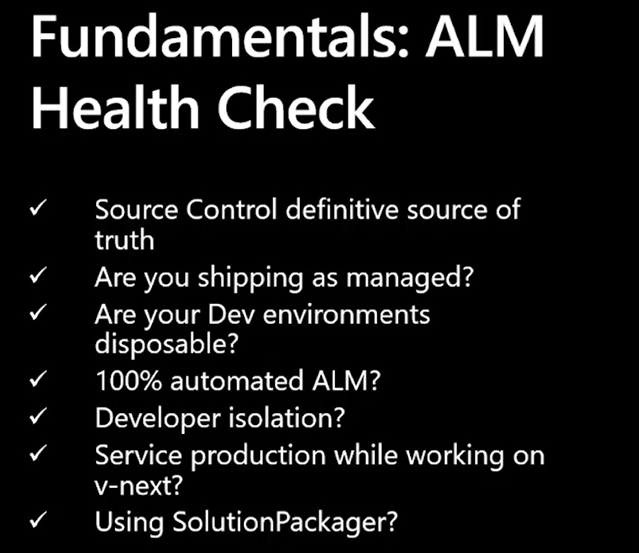
    Whenever Microsoft talks about ALM, usually you’re going to hear their statement on “use only managed solutions in production” sooner later than later. It’s not surprising that also the latest guidance, such as the MBAS 2o20 sesssion on Advanced Application Lifecycle Management capabilities lists this high up on the ALM Health Check list:

    In the user community around XRM there’s been an endless debate around whether unmanaged or managed solutions are really the way to go, and we’re not going to find the ultimate answer to it here in my blog. Personally, I’ve always had a hard time understanding the exact benefit that a customer organization would get from self-imposing the limitations of managed solutions onto themselves. It just sounds to me like installing a different lock with a dedicated key onto the window blinds in every room of your house. Expensive, overly complex, and very likely to leave you in the dark when someone forgets which key was used for which lock. It can also give you a false sense of security, as the main door to your house is still left completely unlocked, because Microsoft doesn’t yet offer a way to protect your production environments from the deployment of unmanaged customizations by anyone with sysadmin rights.

    In the context of low-code specifically, if you don’t have a seriously mature ALM process in place, I’d say you’re fairly likely to hurt yourself when playing with the sharp objects that are managed solutions. This is why during my 10 years of working with Dynamics CRM, XRM and now Power Apps, I haven’t yet deployed a single managed solution inside a customer specific project. On the other hand, I have worked with removing managed solutions created by the customers’ previous partners, after the ALM process has broken down for one reason or another (“not existing” being one of them), then replacing them with an unmanaged layer of customizations that has been a better fit for their overall CRM landscape. Yes, those other partners probably defaulted to following MS instructions on using managed solutions in every production environment – this guidance remained the same since CRM 2011 days, after all.

    Please do note that I’m not saying managed solutions wouldn’t serve a purpose. When you are building an actual app product that is meant to be deployed across multiple environments for different customers, managed solutions are of course the way to go. They offer the container for keeping your stuff separate from the stuff delivered by other app vendors, when deployed into the single CRM system that’s used widely across the enterprise by different user groups for different processes. Any proper commercial product development initiative should also be able to absorb the ALM overhead from environments, automation etc. and turn that into increased revenue from being able to ship software releases faster and more reliably as time goes by, thanks to the upfront investment made. It all makes sense here, but this is a very different landscape than how I perceive the typical use cases for low-code apps within organizations to evolve as Power Platform becomes more widely adopted.

    Remember: you’re no longer building “one place for all customer data”, rather you’re often creating several targeted apps for very specific purposes and audiences. Most of these app experiences will likely be fully developed by either savvy citizen developers, an in-house team of Power Apps champions, or an external consultant brought in to get that job done. The app lifecycle can be very short, even targeted to be used in one-off events (or under temporary disruptions such as COVID-19 social distancing), whereby some apps may actually be “disposable by design”. These are pretty much the opposite of monolithic CRM systems where a wealth of different ISV solutions need to peacefully co-exist throughout the years. So, whichever solution strategy you choose for your Power Platform environments, make sure it solves a real problem that your low-code app developers and admins are facing, rather than directly adapting practices that have been designed for the ALM needs of pro-developer teams working full-time on shipping a sizeable amount of custom code alongside the low-code application platform configuration information.

    A different approach to ALM: Power BI deployment pipelines

    The broad umbrella of Microsoft Power Platform covers also technology that isn’t (currently) built on the solution framework: Power BI. Since it is in practical terms more part of MS Data Platform, the mechanisms used on the BI side are understandably quite different than those originating from the citizen-dev PowerApps (back when it was still spelled together) or CRM systems. What makes this an interesting area to observe is that from what I’ve understood, the traditional development of reporting solutions hasn’t exactly followed the typical software development path either. Checking in reports to source control systems may not be the natural workflow of a Power BI content author or data analyst, so the barrier for adopting advanced ALM practices is likely to be pretty high for this audience, too.

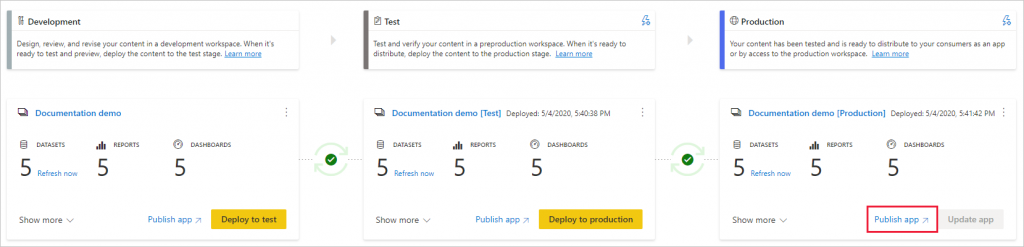
    Power BI deployment pipelines is a feature that has recently been launched in preview. Labelled as an ALM solution, as also Power BI now packages report content into “apps”, this functionality is actually baked right in to the native user interface of the PBI service:

    deployment pipelines landing page

    Reading the introductory text gives us an idea of how this feature is positioned:

    Deployment pipelines help enterprise BI teams build an efficient and reusable process by maintaining development, test, and production environments. BI creators can incrementally transition new or updated content between environments, reconfiguring them with the appropriate data connections and permissions. Pipelines are very easy to use and take only few minutes to setup. No previous expertise or coding skills required.

    Wouldn’t it be nice if we could take the term “BI” from that paragraph, replace it with “App” and have a similar story to tell for low-code business app developers? A targeted experience that would be readily available for each & every customer environment right out of the box would certainly be the most effective way to democratize healthy ALM practices.

    You’ll need Power BI Premium capacity for using deployment pipelines, so the reporting ALM story is aimed towards the enterprise audience. If there ever was a native deployment pipeline functionality for Power Apps, I’m sure the usage would require consuming some type of paid for capacity from the Power Platform product subscriptions. I believe this would still be a lot easier approach for selling the idea of why customers need to invest in having proper ALM infrastructure and capabilities in place, since it wouldn’t be just an extra layer of billable hours added on top of app development project budgets but rather something much more tangible.