Tag: add-on

  • Gentlemen Prefer Solutions: The Expanding Dynamics CRM Footprint

    Gentlemen Prefer Solutions: The Expanding Dynamics CRM Footprint

    If you haven’t worked with CRM Online using Office 365 Global Admin rights recently, you might have missed the new delivery mechanism that Microsoft has created for additional CRM functionality not included in a new Online org by default: preferred solutions. Unlike the traditional solution import mechanism under the CRM application’s Settings area, these preferred solutions are both installed as well as updated (upgraded) via a miniature “CRM app store” controlled by and reserved for Microsoft exclusively. To access these preferred solutions you need to go to the O365 Admin Portal, open the CRM Online Administration Center, choose an instance and click the edit icon next to “Solutions”. You’ll be presented with a list like this one:

    Preferred_solutions_manage

    OK, maybe not exactly like this one, unless you work in the United States. You see, these preferred solutions are also targeted to preferred customers, meaning in practice CRM Online customers who use a tenant located in North America. Let me point this preferred region out to you from the Office 365 and CRM Online datacenter map:

    O365_datacenter_map

    The current availability of the preferred solutions is as follows:

    • Insights for Microsoft Dynamics CRM Online: powered by InsideView, this service is free for CRM Online US customers only. Presumably due to the fact that their database wouldn’t have very good coverage of companies in other parts of the world. You could of course buy the service from InsideView directly if you really must have it.
    • FantasySalesTeam: acquired by MS in August 2015, this gamification solution is built on the concept of fantasy sports that’s apparently a huge industry in the US but less familiar in most other regions. Sales people all around the world surely are a competitive species but no one turns the competition into entertainment quite like the Americans do. Expanded availability of the preview is coming any day now.
    • Voice of the Customer: built in the UK and acquired by MS in March, the solution formerly known as Mojo Surveys has been launched in preview mode for US customers only. Ouch. Well, don’t worry, this feedback management solution will surely come to other geos quite quickly (or MS will need to deal with some customer feedback of their own…)
    • Office 365 Groups: not acquired from anywhere but rather an original Redmond design, this solution became available already back in CRM 2015 Update 1 (v7.1) time frame as a preview globally (yay!)and is now available in full production support mode to all CRM Online customers.
    • FieldOne Sky: only the sky’s the limit for this solution that’s available to CRM Online users with Professional licenses, no matter where your field service personnel may roam. Acquired in July 2015, FieldOne is running mostly on Microsoft’s XRM platform, but the mobile client still relies on Resco and allows only access to a subset of CRM default entities, so for broader mobile use you’ll still need to buy a separate Resco license.

    Although not a CRM solution in technical terms, it’s also worth mentioning that the CRM App for Outlook which was released as US only preview last summer is now available to all CRM Online users who are on CRM 2016 version. I haven’t seen any upgrade time slots being scheduled for existing CRM Online customers yet, so currently mostly newly provisioned orgs can access the Settings – CRM App for Outlook menu to enable users for this lightweight successor to the “heavyweight” Outlook client of the past. (more…)

  • XRM Strikes Back

    XRM Strikes Back

    Adxstudio_logoIn case you missed the announcement last week, Microsoft has acquired Adxstudio. This is simply wonderful news for anyone working with Microsoft Dynamics CRM, for a number of reasons. First of all, the Adxstudio Portals product brings in a critical piece of functionality that has so far been missing from Microsoft’s own portfolio, which is surfacing the information and processes of CRM to external parties via integrated web portals. Second, the amount of knowledge and real-life experience that will be brought into the Dynamics CRM product team on topics like solution management, ALM practices and in general the life of an ISV partner in the Dynamics ecosystem is bound to make Microsoft’s product offering even better in the future.

    The third point, and the main topic of this blog post, is that in my eyes this acquistion validates one very important aspect when it comes to Dynamics CRM as a business application platform: XRM is alive and kicking. In order to understand why I think that way & why it makes a big difference to the Dynamics CRM ecosystem, we need to look back a bit and understand what’s been happening on the acquisitions front during the past few years.

    Let’s Go Shopping

    It is not that uncommon for enterprise software vendors to grow their solution portfolio by acquiring companies rather than organically developing new products and features. This timeline from a few years ago demonstrated how Oracle and Salesforce were buying companies related to Social CRM technology. (Funnily enough, the company who posted the timeline was first acquired by ExactTarget, which then got sold to Salesforce within 1 year from that post.) Microsoft hasn’t been quite as active in this shopping spree as some of its competitors, but they do seem to have picked up the pace during the past few years.

    ThreeCommaClub_sAre acquisitions a smart way to spend cash then? Back in the days when Microsoft bought Yammer, the price of $1.2 billion was questioned by many. Three years later the valuation of Slack, which you could call “the Yammer of 2015”, is set at $2.8 billion. Once you get to the “three commas” level, the traditional laws of physics no longer apply, meaning it’s not about technology underneath the product or anything else tangible that sets the price tag for a company. So, instead of handing out investment tips to the big boys in the “,,,” club, let’s discuss a more down to earth aspect of software company acquisitions: integrating the new technology with the old.

    In these days of cloud based services with open API’s, it’s really not that difficult to develop a bit of code that will allow you add a bullet into your marketing materials, claiming “X now integrates with Z”! Heck, with services like Zapier or IFTTT, even a code illiterate geek like me could take two applications from the consumer or business space and make them talk with one another, just by setting up the business logic via point & click configuration in a browser window. If I’d want to push tweets with a negative sentiment into Dynamics CRM as support tickets, all I really need is to watch a video from Azuqua, sign up for their subscription service and click my way through the process shown below.

    In the marketing speak, any software integration will always described as “seamless”. The reality of what you can actually achieve via the integration (if anything) may not become apparent until it is validated in a real-life use case that takes into consideration the variations in configuration & data contents found in live systems, executing an end-to-end business process rather than a simple data exchange between two IT systems. In practice, a cloud application vendor that promises to integrate with 20 different CRM platforms is unlikely to understand very much at all about the built-in logic of each target system, nor the specific use cases in which organizations wish to leverage such integrated features.

    Integrating pieces of software together isn’t a very unique task. After all, that’s the origin behind the term “systems integrator” that’s sometimes used when referring to consulting companies that deploy enterprise IT systems like CRM software and stitch it together with other systems. Integrating actual products, on the other hand, is a much more challenging task than just integrating software. Not only do you need to deliver a solution that adapts to the needs of many customers instead of one, but you also must be able to align the capabilities of all the related products in your portfolio in such a way that makes sense to the customers and end users. Avoiding redundancy and overlap while still smoothly transitioning the old & new users towards the new, truly seamless experience that delivers on the promises made regarding the integration – yeah, I can imagine that being a bit of a product management challenge for sure.

    Microsoft’s Acquisition & Integration Track Record

    The list of acquisitions Microsoft has made in the recent years that involved product functionality related to Dynamics CRM includes the following notable examples:

    • Skype (2011) – At $8.5B, this was the biggest MSFT acquisition to date and the Skype brand has since then replaced Lync as the telephony/messaging brand for consumers and businesses alike.
    • Yammer (2012) – Another big one. The whole social revolution in information work meant MSFT needed to make both their products as well as product development processes more like that startup & viral model of Yammer and less like that traditional enterprise software world of Office & co.
    • MarketingPilot (2012) – Although not primarily a marketing automation solution for digital channels originally, the MP acquisition was transformed into Microsoft Dynamics Marketing (MDM) to attract the CMO’s with an technology budget that would soon pass that of the CIO.
    • Netbreeze (2013) – While Yammer targeted the internal social collaboration scenarios in organizations, monitoring the public social media channels needed a separate channel. Enter Netbreeze with it’s initial Microsoft Social Listening brand and the later reincarnation as Social Engagement (MSE).
    • Parature (2014) – Along with marketing resources targeted to social channels at a growing pace, the customer service work also moved away from call centers into online support portals and customer reps communicating via services like Facebook. Parature was the answer to meeting the market demand on this front.

    For each of these products it was easy to come up with numerous scenarios in which the organizations using Dynamics CRM could benefit from embedding this new technology into being a part of the sales, marketing and service processes managed via CRM, linked directly into the account & contact records, thus promising to deliver that a true 360 view of the customer relationship. Of course the mere change of ownership for the IPR behind these acquired technologies didn’t yet change anything in the physical world that would make such scenarios become reality. How would these new pieces of the puzzle in practice be fitted together with the existing big picture was the important question to ask. Would 1 and 1 be 2+, or closer to “one point something”?

    Yammer_endAt the time of acquisition, there were some existing integrations to Dynamics CRM available for Yammer and Parature. If we take the former as an example, then there was obvious overlap between Yammer and CRM’s own Activity Feeds feature that was introduced to the platform on the year before. While Yammer of course has far more end user functionality available in its own application, on the Dynamics CRM side there’s actually quite a lot less that we can do with these type of social posts in the business process context than with the native Activity Feeds feature of CRM. Since the posts are now split into two different feeds (Yammer and “System Posts”) inside two different databases with two different security models and several different client application UI’s, it’s not so obvious that this new integrated world is a better fit for all Dynamics CRM customer organizations. (For a discussion on the future of Yammer & CRM, check out this blog post from Gustaf Westerlund.)

    Looking at a larger integration effort, Microsoft took the foundation of MarketingPilot and rebuilt much of it to create Dynamics Marketing, but they still decided to keep it as a separate application that can be used with or without Dynamics CRM. So, what does this mean for CRM customers then? Looking at the surface, the main application navigation is identical between MDM and CRM, but the form and view controls presented to the end user have different logic in each application. The system administrator cannot perform similar UI and data model customization on MDM than what the CRM platform provides. Microsoft offers a connector service hosted on Azure that synchronizes data between CRM and MDM databases, but the scope is limited to a set of predefined record types. As an end result, while you get a wealth of marketing resource management functionality via MDM, there will be limitations on how you can integrate the solution to act as part of you specific business processes and data model configured into Dynamics CRM.

    Doing It The XRM Way

    If as an independent application architect it was clear to you from day one that the product you’ve set out to build should work in the most seamless way for Dynamics CRM customers, you probably wouldn’t first develop a separate application and then start thinking about how to connect it with the CRM database. In such a scenario your architecture design would most likely start from the core of the customer data and business processes that CRM is typically used for managing, as you would want to ensure that your solution is well aligned with the installed base of Dynamics CRM organizations out there. Next you would take a look at what functionality the XRM platform offers that could be leveraged as the building blocks of your own solution, to avoid time spent on developing the “plumbing” already available in each CRM deployment where your application would operate. Only after this would you go and build the external services needed in delivering your application’s functionality, by connecting to other systems, presenting data in non-CRM user interfaces where needed, enforcing licensing policies for your product etc.

    The XRM way of developing products has clear benefits not only to the solution provider but most importantly to the organization using the product. The user identities and access rights have a single administration point, the user experience is likely more familiar to your CRM users, you have no application interfaces to configure or manage and the data will (mostly) sit inside the same database as your existing customer account and contact information. Most importantly, from a functional perspective, you can keep on building your business specific processes and reporting for the XRM applications in the same way as you would customize your Dynamics CRM application. If you’re seriously investing in CRM as your business process hub, doesn’t that all sound quite tempting?

    Also Microsoft appears to have understood the temptation behind such a model, since the Dynamics related acquisitions it has made during this year for the most part have XRM written all over them:

    • Mojo Surveys: Design surveys inside CRM, by modeling the questionnaires as CRM entities and tracking the detailed response data back to the customer records. Will be include in CRM 2016 release as a Survey Designer / “Voice of The Customer” feature. Pure XRM ISV solution from Fusion Software, who still continue to work on similar non-MS products like CRM SalesFlow.
    • FieldOne: Field service solution that started out in 2001 with a bit more classic approach for their “Terra” product, then bet the farm on XRM and rewrote it as “Sky”. Built on top of Dynamics CRM and also leverages other leading ISV solutions like Resco for mobility and Scribe for integration. Oh, and coincidentally, Adxstudio for their service portals.
    • FantasySalesTeam: The only non-XRM product on this acquisition list. Well, I guess it doesn’t hurt MS to have some apps in their portfolio that integrate with Oracle Sales Cloud and the likes…
    • Adxstudio: If there ever was a prime example of an XRM application, it would have to be Adxstudio Portals. Their solution was already included as a part of CRM 2011 SDK to replace the earlier Portal Accelerator, and now the circle is complete. With up to 128 custom entities, Adx hasn’t been afraid to use Dynamics as a true XRM platform, all the while offering the critical missing piece that would connect the internal facing business applications with the customer facing websites.

    Depending on what’s the position of your application in relation to CRM, it’s of course not mandatory for it to be fully baked into the XRM platform for it to deliver great value to end users. Also, if Microsoft were to just keep on buying more and more ISV solutions into their product portfolio and assimilating them all into one big CRM suite, there’s a potential risk of ending up with a SAP-esque enterprise monolith that’s no longer serving the needs of the customers (by the way, for anyone interested on some insights on the current state of the “SAP nation”, I recommend reading the book by the same name).

    Still, I for one am much more optimistic about the recent XRM based acquisitions when it comes to the expected time to value for customers and partners, as there shouldn’t be a pressing need for MS to rearchitect these solutions to try and integrate them with the existing Dynamics CRM product offering. From our perspective, they’ve been done right from the start. In a couple of years time I think we should reflect back on these different acquisitions made, to see if XRM truly got its revenge or not.

  • The State of Dynamics in 2015

    The State of Dynamics in 2015

    There’s been a lot going on in the world of Microsoft Dynamics during the past few months. As the summer vacation period is now here for many of us (hopefully), this feels like a good moment to reflect back a bit, discuss how the world has turned and share some thoughts on what I think it potentially means for people working with Dynamics CRM. The topics I’ll explore in this post are:

    • Practical impact of the cloud for Dynamics CRM customers
    • Dynamics as a business for Microsoft
    • The intersection of CRM and Azure
    • The platform aspects in the Dynamics CRM product

    CRM at The Speed of Cloud

    For a long time Microsoft had to work hard in convincing customers that their CRM Online cloud offering was functionally on par with the on-premises version, instead of it being a “Lite Edition”. After all, how could a public cloud service ever offer the same level of customer specific customization as the application bits sitting on your very own server’s hard drive? “The power of choice” as a unique selling point for the Dynamics CRM platform has certainly played a central role in reducing the perceived risk of choosing Microsoft over some other cloud-only vendors or traditional enterprise software rooted heavily in the isolated server environments. While this still remains an advantage, it’s less strategic these days when the cloud is the clear default in the minds of most customers.

    During the past couple of years MS has been applying a policy where many of the new CRM features become available first in the cloud. Not only does this make logistic sense for MS as they can control the application delivery more tightly and reduce the time it takes to get a feature from design to deployment stage. It also caters for the kind of audience that is likely to be more receptive to application updates in general, meaning the organizations who have already made their leap to the cloud – or who have never known any other way. This crowd won’t get so easily paralyzed with changes that affect how their tools work and they’re also more likely to adopt new services and features. This in turn helps Microsoft gather user feedback much faster, collect telemetry data from application usage, author case studies highlighting the business benefits from latest product releases, and so on.

    Now, since the cloud has become the default deployment option, it does still mean that not everyone who’s “up there” will want to immediately deploy the latest version once it becomes available. Luckily Microsoft has made some great improvements on how CRM Online customers can manage their environments, effectively building the capabilities for the next generation “power of choice”. For starters, the latest update policy now states that “in Spring of 2015, customers will have the choice to take the two updates as they become available, or take only one update per year.” Thanks to the features available for non-production (sandbox) instance management it’s also easy for customers to create copies of the CRM Online production org and test the upgrades as many times as needed before go-live. What used to be a scary leap of faith into a cloud platform where MS decides what happens to your precious CRM is changing more and more into the “on demand” type of service that you’d expect from the cloud, also in the deployment administration side of things.

    CRM2015U1_Groups

    The latest CRM Online 2015 Update 1 (a.k.a. Spring ’15 Release, codename “Carina”, version 7.1) has made it very clear how the cloud accelerates also interoperability between different applications. Being an Online only release, v7.1 has allowed MS to introduce a great number of new features that don’t live purely within Dynamics CRM but rather Office 365. OneNote integration leverages the SharePoint Online server-side sync, similarly as Folder-based Email Tracking relies on Exchange Online sync. The new CRM App for Outlook is also delivered via Exchange Online into OWA and Outlook 2013. The ability to open views in Excel Online for editing right inside the browser window and submit back the changes is naturally all thanks to Office Online. The brand new Office 365 Groups collaboration feature is, you guessed it, all orchestrated by the O365 platform. So, even though there are many important enhancements in CRM v7.1 application itself, this release really does highlight the fact that if you’re using CRM Online but not taking advantage of other Office 365 applications yet, then… Well, perhaps you should consider if your strategy with productivity tools is giving the best return on your investment.

    Another thing that has also become more apparent is that it’s not just a single batch of CRM application bits that gets delivered in a release. The dependencies to related systems have meant that some of the new features announced for Spring ’15 have rolled out only after the CRM v7.1 application and DB updates became available. Certain features like the CRM App for Outlook or the new CRM for Phones still aren’t available, even though we’re in CY15 (calendar year) H2 already. As the cloud service starts to consist of a growing number of separate components and each product has rapid release cadence instead of a 3 year plan, we’re bound to see more of a continuous stream of updated functionality instead of big bang launches.

    MS Business Applications Reorganized

    This leads us conveniently to the hot topics related to the organization around Microsoft Dynamics. As many of you must have noticed, Satya Nadella announced a major reorganization of MSFT leadership team in mid-June. For the Dynamics folks, here’s a quote of the most relevant part of the press release:

    “Executive Vice President Scott Guthrie will continue to lead the Cloud and Enterprise (C+E) team focused on building the intelligent cloud platform that powers any application on any device. The C+E team will also focus on building high-value infrastructure and business services that are key to managing business processes, especially in the areas of data and analytics, security and management, and development tools. As a part of this announcement, the company will move the Dynamics development teams to the C+E team, enabling the company to accelerate ERP and CRM work and bring it into the mainstream C+E engineering and innovation efforts.”

    In short, MBS is no more and its leader Kirill Tatarinov will “explore what’s next for him”. Microsoft Business Solutions unit was always a bit of an island at MS when observed from the outside, and I’m sure people inside will have run into plenty of invisible walls that haven’t exactly helped in delivering the very finest business applications that seamlessly connect with everything else Microsoft builds. Now the engineering, sales and marketing functions for Dynamics CRM and ERP products will be consolidated into the broader MS organization, with Scott Guthrie (C+E leader), Kevin Turner (COO) and Chris Capossela (CMO) taking care of the Dynamics business. There’s an excellent piece written on the reorg from Dynamics perspective by Frank Scavo, which I encourage you to read for further details: Microsoft Unbundles Its Dynamics Business Unit.

    Guthrie_Azure

    Throughout the history of Microsoft’s ERP and CRM product lines, there’s pretty much always been speculation about whether MS would spin off the MBS business if the right amount of money was offered for it. Being an island of its own certainly helped in envisioning how such a transaction could take place, since the bidder would have gotten not just a piece of source code but the whole organization and partner network around the products. When you put your Dynamics CRM glasses on (hey, even I don’t wear them all the time!) such idea never seemed like a very happy path for neither MS nor the potential buyer. There’s hardly any other product in the MS portfolio that pulls in such a broad range of the Microsoft technology stack when deployed for a customer organization, so trying to untangle it from these roots would be potentially disastrous for the product, in addition to causing MS to lose far more revenue than direct CRM license sales. I can’t speculate much about the Dynamics ERP products due to lack of hands-on experience in deploying them, but spinning off Dynamics CRM after the most recent move seems even less likely than it was to begin with.

    Nadella_BenioffThen again, we should keep in mind that just a while ago Nadella was seriously considering to acquire its nr. 1 competitor, Salesforce, if we are to believe the reports about the $55 billion offer made. If the results of these talks would have been different, we might have been now talking about Microsoft with not just 1 CRM and 4 ERP products but with two huge CRM platforms in its pocket. Not to mention all the underlying infrastructure and technology with which Salesforce competes with Azure, the world’s largest developer conference Dreamforce etc. This would have surely been a very different “State of Dynamics” post in that alternate reality. So, it’s good for us to keep in mind that at the end of the day it’s really just business, not software, and strange things can happen when the big boys are competing with one another.

    The Dynamics of Azure

    Back to the present day, what we now know for sure to be the near term agenda for Microsoft is to move the Dynamics CRM and ERP engineering teams to the Cloud + Enterprise group. So, what do they actually build there in C+E? Well, obviously anything to do with Azure, for starters. Then there’s the server & tools side of things, like SQL Server and Visual Studio. Power BI and BizTalk must also be familiar names for anyone who’s worked in Dynamics CRM projects. What doesn’t fall under C+E is all things Office, meaning products like SharePoint, Exchange, Skype, OneDrive and other productivity tools commonly found from Office 365 subscriptions – and naturally used alongside Dynamics CRM. So why is Dynamics being grouped together with the platform tech and not the productivity apps?

    Nadella_IntelligentCloudC+E is actually the group that Nadella used to run before being appointed as MSFT CEO. In case you’ve forgotten, Nadella was also leading MBS up until spring 2007 (at which point Kirill Tatarinov was appointed as his successor). For old times sake, here’s a snippet from his farewell post on the “Frontiers of Business Applications” blog:

    “We made tremendous progress with Dynamics ERP, CRM and Office Small Business product lines. Six years ago we were not a player in biz apps… the acquisitions in ERP got us to leadership position in mid market and now we are contender in Enterprise. CRM has helped us grow the fastest server product line in Microsoft’s history and now poised to offer “choice” of LIVE service.”

    I think it’s safe to say that Nadella understand a fair bit about not just the Dynamics of Microsoft’s CRM & ERP but also the general market dynamics behind how organizations today are deploying, extending and integrating their business applications. If we look at all the shiny new things that C+E has been launching into their cloud back-end portfolio, like Azure App Services or the Azure IoT (Internet of Things) Suite, then it’s not so difficult to envision that technology like this will also need front-end services for organizations to adopt them as part of their core business processes. If these processes happen to be managed with Dynamics applications today, then hey, perhaps Microsoft could do something on this front to speed up the adoption, right? Reading this blog post from C+E Chief Strategist James Staten sure seems to indicate that Redmond is well aware of the business opportunity.

    How soon will we see concrete evidence from Scott Guthrie and his team that being part of the C+E organization means Dynamics “C&E” (as in CRM & ERP) customers will gain new some next generation capabilities into their own business applications? Knowing the current release cadence with MS products, I hope this reorg would have already started to show up as new priorities being reflected in the backlogs of various product teams in C+E. The thing is, we don’t even need any brand new product features for Dynamics specifically, but we sure could use some higher visibility for Dynamics as the go-to solution for demonstrating how the MS cloud stack can be put into use in practical terms.

    For example, the Power BI story has been unraveling far too slowly for any Dynamics CRM Online customer that would have been interested in leveraging MS products for some cloud based data analytics. Commercial offerings like the Sales Productivity license promotion have been bundling these products for a long time, yet there’s been very little you’ve actually been able to do with the two together, due to lack of support for CRM Online as an automatically refreshable data source. Another example could be Azure Logic Apps, which were announced back in March, but as of today Dynamics CRM or ERP connectors are still unavailable for anyone wanting to configure these workflows to connect with their cloud business applications. Fine, you can support Salesforce and other partner solutions at launch time by all means, but punishing customers for choosing Microsoft is something I hope the new C+E family will put an end to.

    Azure_Logic_Apps_Dynamics

    Platforms and Products

    Back in the early days of XRM a.k.a. “Any Relationship Management” the concept of having Dynamics CRM serve as the foundation on top of which organizations could build their own relational business applications and potentially replace legacy LoB systems sounded perfectly valid. The XRM idea was conceived in the on-premises days, though, where the business owners couldn’t just go and subscribe to a cloud app of their choice to solve their problem with a bit of shadow IT. Sure, they could have also requested an XRM org to be customized for this purpose, but 99% of them probably weren’t familiar with the concept. Oh well. The capability is nevertheless there in the platform that all Dynamics CRM applications run on today, and MS even hinted at more emphasis being put onto the XRM toolkit during Convergence 2015 presentations.

    These days when we think of business application platforms, the image in our minds isn’t probably limited to just a relational database with a few entities and forms for data entry. Thanks to the aforementioned explosion of cloud apps and our many mobile devices, the modern platform concept is, in my humble opinion, a network of connected services that allow you to get your job done, no matter where you are or in which particular app you are. So, rather than looking at how the business application itself is implemented on a technical level (as an XRM solution package deployed to your company’s CRM Online org, for example), in practice more important questions are how does it relate to the other apps the business is using, how it communicates with the outside world and how it fits with the workflow of the end-to-end business process? When observed from this perspective, some might argue that Office 365 with its growing collection of integrated apps is actually more of a business application platform than CRM is.

    Office_365_app_launcher

    Do I see CRM turning into just another icon in the O365 app launcher then – becoming a packaged, ready-to-use product like OneNote or Sway? No, and I think the new organization structure at Microsoft also highlights the fundamental difference between such products. Sure, MS is investing more and more resources in making Dynamics CRM more easily approachable as a “mainstream” product, by creating sites like the new Microsoft Dynamics CRM Online Onboarding Success Center​​ (for comparison, check out the Office 365 Onboarding Center).  We’ll surely see increasing effort put into lowering the entry barrier for especially SMB customers as MS tries to become less reliant on their Dynamics partner network to acquire and retain customers for CRM. The way I see it, turning Dynamics CRM into a packaged application that you can just sign up for and start using for common tasks that businesses tend to perform with their customer and sales data sounds both like a low hanging fruit and mission impossible at the same time. Sure, in terms of application features Dynamics CRM is ready to cater for a whole variety of different types of guests, but just like people do not prefer dining with a Swiss knife, I think there will remain the need for experts to plan the correct eating utensils for the meals, present them on the table and if needed, instruct how to operate them in the most elegant manner. Anyway, making the whole process of attending this grand CRM dinner more straightforward and educating the guests on what they can expect to find on the menu will surely benefit all the parties, so hopefully this type of mainstreaming will be done for Dynamics CRM.

    If we accept the fact that Dynamics CRM is still very much a platform in itself (although delivered under the broader O365 platform), then we must also acknowledge that the platform part doesn’t means just building customer specific XRM deployments. Strategically an even more important factor for Microsoft is the number of partners that develop solutions for connecting Dynamics CRM with their services and apps. Although there are a number of established ISV’s operating in the Dynamics ecosystem that offer the kind of add-ons and integrations that are essential ingredients in today’s CRM implementations, I think it’s safe to say that when it comes to the amount of apps available for Dynamics CRM customers to buy, we’re nowhere near the level that could have been expected back in 2011 when the current solution framework and the Dynamics Marketplace were introduced. It’s also far too common to see vendors develop a v.1 app and then not invest sufficiently in maintaining it as the CRM platform evolves (at an ever growing speed, thanks to the cloud era).

    crmwatchlist_eliteBroadening Microsoft’s own offering to marketing automation, social channels, customer service and other recent additions in the Dynamics product family has surely helped in improving the credibility of Dynamics CRM as an enterprise level player (that has a distinct Enterprise licensing tier now, compared to many years of “all you can eat” pricing model). We’ve also seen announcements from the Dynamics team about partnerships formed with established players like Adobe and Lithium, with the promise of more announcements to follow in the near future. I’m sure these are all beneficial moves for Microsoft in their broader strategy for CRM, validated by evidence like the CRM Watchlist 2015 Elite award from Paul Greenberg (a.k.a. Mr. CRM himself) where he’s confident in stating that “Microsoft gets ecosystems”. This just isn’t quite enough, in my humble opinion, if MS isn’t able to attract and grow the kinds of ISVs that will help the Dynamics CRM customers to connect with the latest services that the “cool kids” out there are using, or affordably bridge the smaller functional gaps that aren’t strategic for MS in terms of the Dynamics CRM product roadmap. As Greenberg also states in his Watchlist results analysis:

    “Microsoft has to be much more cognizant, consistent and proactive about seeing their Dynamics product portfolio as an end to end platform – which will make them competitive in the 21st century.”

    This is the area where I place my biggest expectations from the new MS organization structure to make some visible changes. If we observe what Scott Guthrie and the numerous product teams under Cloud + Enterprise have managed to do to Microsoft’s image in the eyes of the broader developer community in the past couple of years, by open-sourcing their work as well as embracing existing standards rather than inventing their own, then that’s certainly the kind of whole new appeal and earned good will the Dynamics ecosystem could use, too. Making Dynamics CRM more accessible for new vendors to connect with and build their IP on, while at the same time increasing its financial attractiveness by better driving customers to explore the add-on market offering is the kind of virtuous cycle that a thriving business application platform truly needs. If the new “mainstream” position of Dynamics in MS’s portfolio means that the CRM & ERP products would be considered as the de facto tools for solving the business agility challenges that MS talks about when pitching its Azure technologies, this would also help a lot in solidifying Dynamics as the premier platform to build your business processes on.

  • Auto-Numbering with CRM Workflows: Real-Time vs. Asynchronous

    One of the missing features that is often requested for Dynamics CRM is the ability to automatically assign numeric identifiers to records (see the feature suggestion on MS Connect). Sure, we’ve had the Auto-Numering feature for a limited set of default entities (contracts, cases, articles, quotes, orders, invoices, campaigns) since the early days of CRM 3.0, but generating numbers on a standard entity like account or any custom entity has not been possible out of the box.

    As if often the case, workflows offer a way for the creative user to overcome such limitations and enhance the CRM functionality with some custom business logic. The usage of workflows to generate automatic numbers for records has been described in several blog posts, of which I’d like to point out the ones written by Karel Iuel and Leon Tribe. The high level concept of this process is as follows:

    • Create a custom entity to hold the current counter value of the number
    • Link your business entity to this custom counter entity through a N:1 relationship (meaning the single counter record will be the parent for all the intended child business records)
    • Trigger a workflow rule from the business entity record creation that performs the following actions:
      • Links the new business entity record to the existing counter entity record
      • Increments the counter value
      • Assigns this value as the number for the child business entity record

    With the recent enhancements to workflows in the CRM 2013 release I thought I’d take this scenario and use it to compare the different outcomes with the new real-time workflows and a traditional asynchronous workflow process.

    Number assignment with a Real-Time Workflow

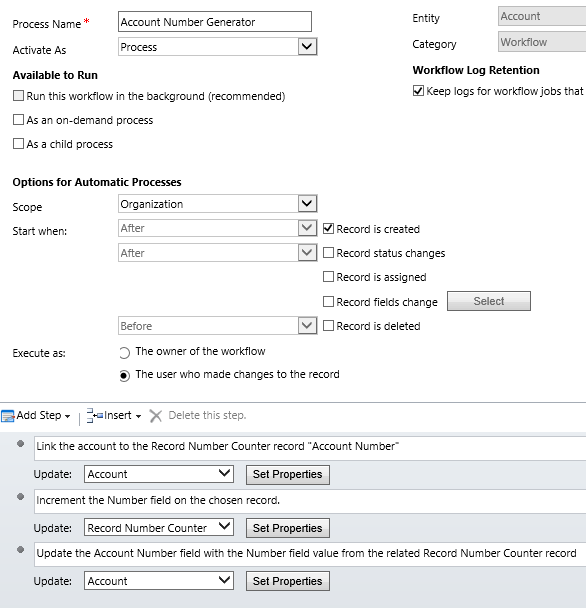
    Let’s first see how the aforementioned methods work in a CRM 2013 environment. I’ve created a new custom entity called Record Number Counter and added a 1:N relationship to the account entity, with the intention of assigning an automatic number to any new account record that gets added into the CRM database. To actually make this happen, we need to have a workflow process in place that performs the three steps outlined above. Note that the box for “run this workflow in the background (recommended)” is unchecked, meaning this will be a synchronous, real-time workflow process that starts immediately after the specified event, which in this case is “record is created”.

    CRM_2013_auto_numbering_real-time_workflow

    Let’s do some account data importing next to test the results of this workflow. I’ve created an Account Number record of the Record Number Counter entity with its Number value set to 100 500, which means the next account record to get created should be numbered 100 501. With a set of 500 test records to import in my csv file, I’m expecting the counter to hit 101 000 by the time the job is done.

    So, off we go with the import job and then we start to anxiously click on the Refresh icon on the account entity view to see which values get assigned in the Account Number column.

    CRM_2013_auto_numbering_test_1

    Looks like everything is as we wanted it to be! All the 500 account records have been assigned a unique number and the counter value is incremented by one after each assignment. Sure, we’re getting the local number formatting setting from our integer field applied into the target text field on the account (in my case it’s the empty space as the thousands separator), but that’s not a huge issue for our home grown auto-numbering solution. The concept itself appears to be working, which is the main outcome we were after.

    Why this won’t work in CRM 2011

    If you’ve been reading any discussions on the workflow driven method of auto-numbering, you may have come across issues with the numbers not always being unique. If you create a single record, then wait for the workflow process to complete and check the results before the next record, everything will most likely look ok. But when there’s a bigger volume of database inserts taking place in a bulk operation, the results may not be as expected. (more…)

  • No-code Customizations with North52 Formula Manager, Part 3: Case Resolutions

    In the previous articles (part 1 and part 2) we’ve explored how the North52 Formula Manager can be utilized in automating steps related to the sales process. This time we’ll be looking at a scenario related to service management, in an effort to make it easier to share knowledge and report on the resolutions of cases recorded in the Microsoft Dynamics CRM database.

    Cases vs. Case Resolutions

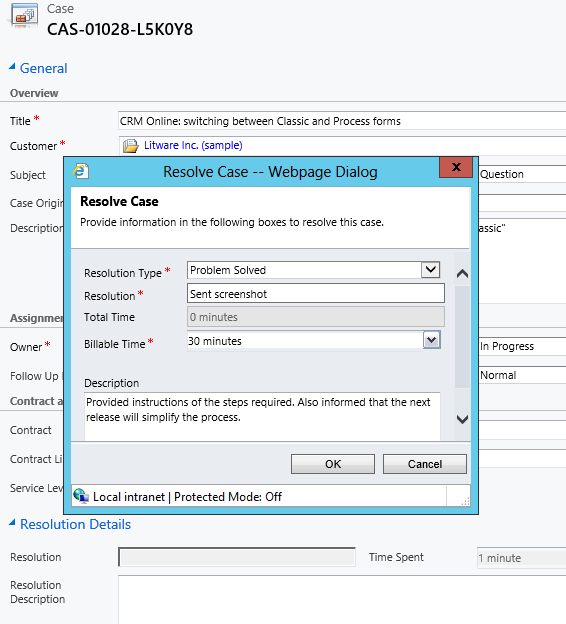
    Case_resolve_cancelIn theory it should be pretty straightforward how you work with a case record: they are support tickets that are initially open (active) when you create them and eventually they end up getting closed as either resolved (service was provided) or cancelled (duplicate ticket, customer never replied etc.).
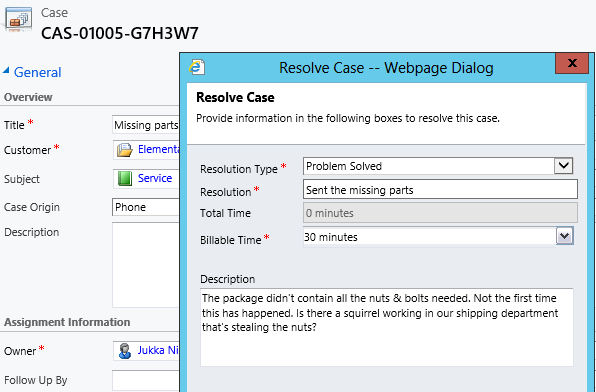
    The point where complexity raises its ugly head is how the resolution process works: instead of entering the case resolution details onto the case record itself, the user is presented with a window that creates a Case Resolution activity underneath the parent case. While this is a perfectly valid design in terms of the nature of the interactions, as there could be situations where the case gets re-opened and resolved again (thus being a 1:N relationship with the case), it does make it more complicated to work with the resolution data later on.

    Resolve_case_dialog

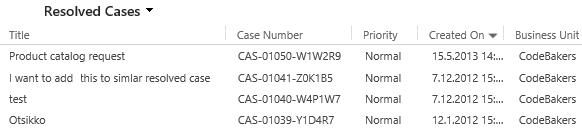
    For example, say you’d want to study the resolved cases by using a view of the case records. In that view you can see the case subject, owner, status and other standard fields, but there’s no information visible on what the actual resolution to the case was. “Ok, so I’ll need to customize the view and show columns from a related record. That’s not too difficult, now is it?” Unfortunately that’s not going to work, because the information we’re interested in resides on the N side of the relationship. Since there can be several case resolutions for a single case, no columns from this entity can be displayed in a case view. So, we can’t construct a nice Q&A list that the service reps could leverage in scanning for similar cases on a new question from a customer. We can only see the problem, not the resolution.

    Resolved_cases_view

    You could build a view of case resolutions, the child entity in this relationship, but that’s not very convenient either. Although case resolution is an entity of its own, it’s not actually available in Advanced Find to directly build queries on. It is possible to access a list of case resolutions by crafting a view of activities with that specific type, but you’ll still be limited to only the generic activity fields. As an example, the field Billable Time (Time Spent) cannot be accessed in a view, which makes it rather difficult to report on this data entered as a part of the service process.

    Activities_Advanced_Find_case_resolution

    Using a Formula to Replicate the Case Resolution Fields on the Case Form

    Luckily Dynamics CRM is a flexible platform that allows you to develop new business logic to fulfill the requirements for your service process. In this situation, if we could simply have the Resolve Case dialog fields copied over to the parent case, this would solve the aforementioned problems. So, how to proceed then?

    If we want to alter the default behavior or the service entities, we should first have a look at the workflow process capabilities of Dynamics CRM to see if can  configure a workflow rule that is triggered when the case resolution is created. This time we won’t get very far with that idea, though, as neither the case resolution nor the activity entity can be used as a workflow trigger. Fair enough, we’ll then need to come up with a lower level solution to meet this requirement. Assuming we have access to a .NET developer who knows the Dynamics CRM SDK, creating a custom plug-in to copy the fields to the case record would be a worthy option to consider. Since the title of this post promised “no-code customizations”, let’s instead look at how we could achieve the same functionality with the Formula Manager.

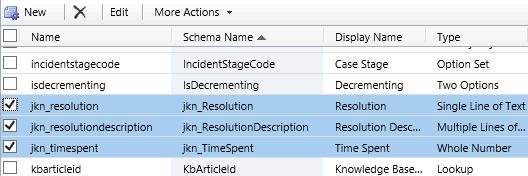
    First we need a place to host the case resolution data of course, so let’s add three custom fields on the case entity: Resolution (text field), Resolution Description (multiple lines) and Time Spent (whole number with duration format). On the case form they can be put into a section of their own and set as disabled, since the user shouldn’t directly update them.  Then we’ll create the three formulas that will populate these fields with corresponding values from the case resolution entity.

    Case_custom_fields

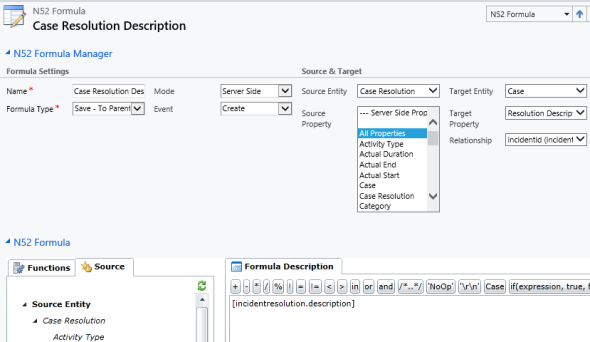
    We’ll be using a formula of the type “Save – To Parent” and attach it to the create event of the case resolution entity. As our target (parent) entity we can select case, but notice that you’ll actually need to specify the relationship field value first before you’re able switch the value in the target entity field. Let’s take the Resolution Description field we just created as the target property. The formula itself in this case will be very simple, since all we need is a value directly from the source entity. We can use the source entity tree visible in the bottom left corner of the screen to browse through the available fields or just type in directly the value [incidentresolution.description].

    Formula_case_description

    The other two fields will get an identical treatment, which means we can click on the Clone Formula button on the ribbon and create two copies of the original formula. Just update the target property field and select a new source field value into the formula description window accordingly. After we’re done, we can publish the formulas and try them out by resolving an existing case.

    Resolve_case_formula_1

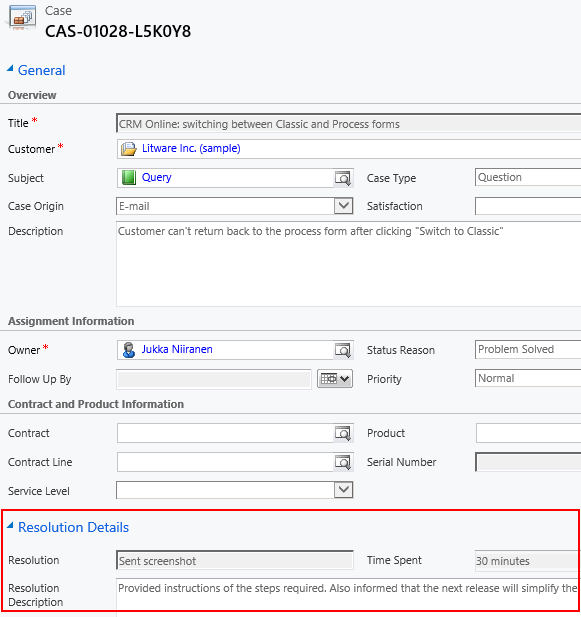
    After we’ve entered the details into the Resolve Case dialog fields and clicked OK, our formula will update the underlying case form in real time to reflect the same values presented directly on the resolved case record. Unlike asynchronous workflow processes, the formulas can perform their tasks right in front of the user, which makes the user experience more consistent.

    Resolve_case_formula_2

    Making Use of the Resolution Data

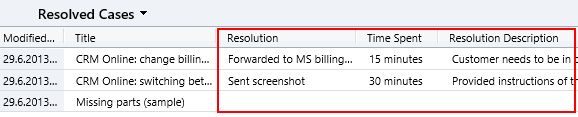
    Now that the fields are available on the case entity, we still need to ensure that the user actually has access to them through all the necessary routes. First we should of course include them into the Resolved Cases view we talked about earlier.

    Resolved_cases_view_updated

    Seeing the resolution field contents directly in the view is a great improvement, but an even more important feature is to enable the users to search for this information. You see, one of the peculiar default settings of Dynamics CRM is that the Quick Find view for case entities only covers active (open) cases. (more…)

  • No-code Customizations with North52 Formula Manager, Part 2: Line Items

    In a previous post I wrote about how the North52 Formula Manager solution can help you build some common customizations that would otherwise require writing Javascript for Dynamics CRM entity forms. The scenarios included:

    • Setting default values for lookup fields
    • Dynamically changing the field requirement level
    • Displaying popup warnings
    • Launching dialog process windows

    This time I will show a few examples of the Formula Manager capabilities that would typically fall into the domain of writing C# plugin code to enhance the business logic of Dynamics CRM. Being a functional CRM consultant that doesn’t normally deliver a single line of code (at least for production environments), these scenarios would traditionally require me to hand over the task to a CRM developer. What we’re about to see is an alternative method of creating just formulas with the graphical tools available in the solution package to get the same job done.

    Updating Opportunity, Quote, Order or Invoice Products

    In Microsoft Dynamics CRM 2011 you can trigger workflow processes on the line items of Opportunities, Quotes, Orders or Invoices. This allows you to execute custom logic when, for example, new Quote Product rows are added for a Quote record. Unfortunately what you cannot do with standard workflows is to actually update the line item record itself.

    Workflow_update_quote_product

    Well, this surely looks like a dead-end for most of the use cases you could think of for triggering the workflow process in the first place. If I wanted to, for example, pull information from the selected Product record and save it on the Quote Product’s fields, such as product description, vendor details or a line item number to sort the quote rows, this apparently cannot be achieved with CRM’s workflow functionality.

    Let’s look at how we can solve the problem with Formula Manager instead. In our scenario we would like the description field of the Quote Product record to be updated with the description field contents of the selected Product record. What we therefore need is a “Save – To Current Record” type of formula that is triggered on the Create & Update events of the Quote Product entity. We can limit the update events only to the Existing Product field by setting the Source Property value. The Target Property of our formula should be the Description field.

    Finally, we need the actual formula that will feed the values from the related Product record into the Quote Product’s description field. To retrieve the description field contents we’ll use the FindValue function and tell it to search for a Product record that has the same productid as the existing product selected on the Quote Product record. While we’re at it, let’s also ensure that the Quote Product actually has an existing product instead of a write-in product by verifying the productid field contents with the ContainsData function. The end result will look like this:

    if(ContainsData([quotedetail.productid]), FindValue(‘product’, ‘productid’, [quotedetail.productid], ‘description’),’NoOp’)

    FormulaManager_update_quote_product_description

    Now when we navigate onto a Quote and add a new Quote Product record underneath it, the description field will inherit the value from the related Product and display it directly on the Quote Product form (assuming you’ve made this default field visible on the form in the first place).

    Quote_product_description

    Not that much more complicated than building a workflow rule, just as long as you familiarize yourself with how the formulas work and how to format the parameters required by the functions.

    Creating Line Items

    Let’s proceed with exploring the world of line item records in the sales process. Updating existing records automatically is a nice capability to have for sure, but what about automating the complete process of creating the line items for an Opportunity, Quote, Order or Invoice? For example, if we wanted to ensure that there is always a standard Delivery Fee or other persistent item included whenever we’re creating an Order of a specific type (or for a specific customer group), then this is another area where the out-of-the-box functionality of Dynamics CRM workflows can’t be used, since new Order Product records cannot be created through a workflow rule.

    With Formula Manager we have no such limitations in place, rather we are free to create any type of records we want with the CreateRecord function. The example formula below was actually provided to me by North52’s John Grace to demonstrate the solution’s functionality. The Save – Perform Action formula is attached to the Create event of an Order record, which in turn triggers the creation of a new Order Product record. The contents of this auto-created line item can be defined either directly in the formula or alternatively queried with the FindValue function familiar to us from the previous example.

    CreateRecord(‘salesorderdetail’,
    1,
    ‘salesorderid.salesorder.’ + [salesorder.salesorderid],
    ‘productid.product.’ + FindValue(‘product’, ‘name’, ‘Bike’, ‘productid’),
    ‘uomid.uom.’ + FindValue(‘uom’, ‘name’, ‘Primary Unit’, ‘uomid’),
    ‘quantity.10’
    )

    FormulaManager_create_order_product

    Now, as a limited time special offer, any new Order that we create (or a Quote that we convert) will get 10 Bike products added onto it with their unit price dynamically retrieved from the Price List selected on the Order. What a sweet deal!

    Order_Products

    Cloning Records

    For a Dynamics CRM administrator these type of automated steps can be really handy in enforcing business rules and ensuring correct entry of data onto sales records. If we’d show them to your typical salesman, though, he might not be so impressed with this type of detailed process automation functionality.

    “Sure, it looks like we could save a few clicks with these formulas. But here’s the deal: many of the quotations I make are practically identical. They contain the same line items every time, with only some variations in quantity and discounts given. What I’d really want to do is simply select a quote I’ve created for another customer and create a copy of it. You know, the “Save As” button that’s found in all the other Office applications. Why couldn’t CRM also have that? It would be a huge time saver for me.”

    Ever had this kind of a discussion with your CRM users? If you have, then you’ll surely appreciate the fact that Formula Manager provides a Clone function that allows you to create a new copy of any existing record. Not only that, but the function also clones all the related 1:N & N:N records, which means you can create a copy of both the Quote and Quote Product line items with a single function!

    To get an understanding of how the function could be leveraged in delivering the “Save As” functionality your sales users have been asking for so long, watch this video that demonstrates not only the formula in action but also how you can use the Ribbon Workbench to build a custom Clone button for the required entities.

    Clone_Quote

    Think these type of features would be useful to have in your Dynamics CRM organization? Then go ahead and grab the fully functional Standard Edition of Formula Manager that allows you to have 10 active formulas at a time, for test or production use.

  • No-code Customizations with North52 Formula Manager

    North52North52 Formula Manager is a very interesting solution that promises to simplify the process of customizing and extending Dynamics CRM by offering a graphical toolkit to implement custom business logic that would otherwise require developing plug-ins in C# or adding Javascripts on the forms. Instead of writing custom code, the business logic can be configured through the N52 entities inside CRM, with the help of a Silverlight based editor to write formulas that check conditions, perform validations, update fields etc.

    In this article I’ll show you a few simple examples of how a person with no coding skills can perform some customizations that go beyond the GUI tools that Dynamics CRM offers. I’ll use the opportunity entity to add some client side actions to make the sales process a more guided experience for the end user. You can grab the free Standard edition of Formula Manager and use it’s 10 available formulas to try out these examples in your own CRM environment, or watch some of the training videos from North52 that cover several other scenarios.

    Default values

    The sales records in Dynamics CRM contain a few fields that sometimes don’t deliver any added value to the user, but they still need to be filled for each record. One common example is the usage of the price list. If your organization only has a single valid price list at any given time, the CRM users would surely appreciate it if the system could automatically populate the lookup field with the default price list when creating a new opportunity.

    Opportunity_default_price_list

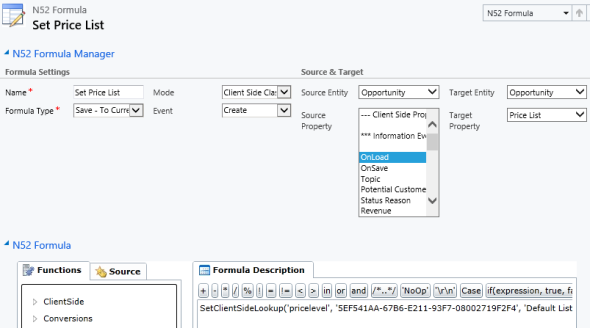
    This is a very simple formula where all we basically need to do is populate a lookup field with a static value. To get the GUID of the price list, open it’s form in a new IE window by pressing Ctrl+N and find the string like “3F2504E0-4F89-11D3-9A0C-0305E82C3301” from it. Then create a new N52 Formula record and define the formula type as Save – To Current Record. We’ll set the mode as Client Side Classic and set it to run on the Create event, as we want the price list field to be populated with the default value only once – when the user creates a new opportunity record. The source and target entities should both be set to opportunity, as we’re updating the current record. The source property in this case is the event that triggers the formula, so let’s select OnLoad to fill the field immediately when the form is opened. Finally, the target property should be the field that will be updated with the results of the formula, in this case Price List.

    Different field types on the CRM form require different kinds of update procedures. Since we’re dealing with a lookup field and populating it as a client side event, let’s pick the SetClientSideLookup function from the N52 Formula menu and give it the required parameters of the entity name, record GUID and record display name:

    SetClientSideLookup(‘pricelevel’, ‘5EF541AA-67B6-E211-93F7-08002719F2F4’, ‘Default List’)

    FormulaManager_opportunity_default_pricelist

    Now we’ll just need to publish the formula and go test it out by creating a new opportunity record and verifying that the price list gets set to the record we wanted. In case you get an error prompt from N52 Formula Manager while opening the form, please revisit the formula record and verify that you’ve selected the correct options.

    Required fields

    Changing the requirement level of a field based on another field on the form is another common requirement. Let’s assume we have a simple sales process with three stages (picked up from the default CRM sample opportunity data): 1) Prospect, 2) Qualify, 3) Closing. We’ll use the Status Reason field’s (customized) values to drive the process and we want to enforce the following business rules:

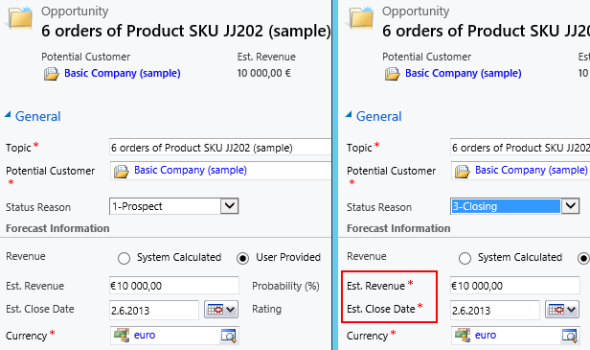
    • If stage = 2) Qualify then make Estimated Close Date field required
    • If stage = 3) Closing then make Estimated Close Date and Estimated Revenue fields required

    In the UI the user would see the requirement level change dynamically when he or she changes the Status Reason field value and clicks elsewhere or tabs out of it.

    Opportunity_required_fields

    To achieve this feature with Formula Manager, we would build a formula that references the statuscode ID values and the schema names of the fields we want to set as required. Something like the following if-statements:

    if(([opportunity.statuscode]=’2′), SetRequiredFields(‘estimatedvalue’), if(([opportunity.statuscode]=’3′), SetRequiredFields(‘estimatedvalue’, ‘estimatedclosedate’), SetNotRequiredFields(‘estimatedvalue’, ‘estimatedclosedate’)))

    Basically what we do in the formula is first check for the stage 2, then stage 3 and finally use a default action for stage 1 to return the fields into not required status (so we also support moving backward in the stages). We’ll set the formula to run on the opportunity entity as a Client Side – Perform Action formula, tied to the source property of the Status Reason field, which effectively means it’s triggered with the OnChange event of that field as the user manipulates the form values. (more…)

  • Dynamics Marketplace vs. Microsoft Pinpoint: where are all the CRM apps?

    When Microsoft released the 2011 version of Dynamics CRM and introduced the solution management functionality they also introduced the Dynamics Marketplace: an app store for CRM solutions, integrated right into the CRM user interface. Here’s an excerpt from the blog post Driving Success with the New Microsoft Dynamics Marketplace:

    The Microsoft Dynamics Marketplace is a new online service – based on Microsoft Pinpoint — that helps our customers maximize the relevancy and value of their Microsoft Dynamics investments by connecting them with valuable, high-quality applications and professional services from our worldwide Microsoft Partner Network (MPN).   At launch, the Marketplace has more than 1,400 solution listings, including over 700 application listings and over 700 professional services listing forboth CRM and ERP

    So, if you want to find the best listing of CRM solutions and other related applications, Dynamics Marketplace must be the place to go, right? Umm, actually not. You’re better of going to Microsoft Pinpoint to perform your search. Let me demonstrate this to you through a real life example.

    Today I saw an announcement from Sonoma Partners, one of the most high profile companies in Dynamics CRM consulting business, about a new, free solution called Universal Search. As I followed the link on the press release onto “Microsoft Dynamics Marketplace”, I actually found myself at Pinpoint instead. It’s not a huge difference in the user experience, as Dynamics Marketplace is a subset of the Pinpoint platform. However, on this occasion I paid attention to the fact that the solution had actually already been published there on August 30th. Hmm, how come I didn’t notice it when scanning the Marketplace listings just last week?

    I decided to do a little side-by-side test and opened up the US versions of both Dynamics Marketplace and Microsoft Pinpoint, narrowed down my search to applications only, selected Microsoft Dynamics CRM 2011 and sorted the list by release date. Here are the results:

    • Dynamics Marketplace: 197 applications
    • Microsoft Pinpoint: 584 applications

    Wow! A search on the generic Pinpoint site gives you three times more CRM 2011 apps than the dedicated Marketplace. Click the image below to see an example of search results that you’d be missing out on if you only use Dynamics Marketplace. 4 out of the 6 latest CRM applications listed on Pinpoint are not available on the Marketplace search.

    Why is this happening? Ignoring the chance of technical errors in the search indexing, the difference is caused by the more strict requirements imposed on submissions to the Dynamics Marketplace. If you read the blog post I mentioned earlier, you’ll find the following summary information:

    A Microsoft partner needs to have either the CRM or ERP competency in order to get listed on the marketplace.  For solution listings, partners must be an authorized reseller of Microsoft Dynamics solution or have a solution that is verified as Microsoft Platform-Ready. Additionally, there is an optional Certified for Microsoft Dynamics (CfMD) designation available for an additional fee.

    That’s a perfectly valid explanation to the difference and the intentions behind the verification processes are surely good. Some customers may well decide to minimize the risk of causing harm to the operation of their business critical CRM systems by only choosing add-ons that are CfMD. Of course, if even solution vendors like Sonoma Partners are releasing products outside of the Marketplace criteria, one might ask if that is a sensible guideline for customer organizations to follow or not.

    For anyone who wants to keep track of the useful ISV add-ons released for Microsoft Dynamics CRM, they’ll get a much better experience browsing Microsoft Pinpoint rather than Dynamics Marketplace. I myself fall into this category and also try to do my share in promoting the ISV offerings by maintaining a list of Dynamics CRM Links to interesting apps I come across. Another result of the Marketplace limitations is that the majority of the valuable, free tools for CRM developers and customizers are published on CodePlex. So, in effect, we have three separate “app stores” from Microsoft. Or perhaps the term store is inaccurate in this case, as none of these three have cashiers in place, so maybe they should rather be called “app galleries”.

    We haven’t seen much development on the Marketplace front since its release, which is quite a shame as we could really use some help from Microsoft in building a more vibrant ISV ecosystem around the Dynamics CRM product. There’s just so much more potential in the app store model, as illustrated by this awesome vision of a better Dynamics Marketplace that Neil Benson & Matt Wittemann. With the nearing commercial launch of Windows 8 and the accompanying Windows Store, the expectation levels of customers and developers alike have surely grown beyond the basic application listing that Dynamics Marketplace currently offers.

  • Top Dynamics CRM links in Q1 2012

    In addition to Surviving CRM, I also maintain a blog called Microsoft Dynamics CRM Links. However, it’s not an actual blog but rather my public bookmarking service for collecting interesting tools, solutions, add-ons, services and other sites that are related to Dynamics CRM. If I discover a useful new tool on, say, CodePlex, I simply create a new blog post using the tool’s name as the title, the URL as the body text and add a few tags for link categorization. I keep the list on WordPress.com because it provides a great cloud based app for managing any content, not just blog posts.

    Even though the primary purpose of the site is for me to personally keep track of interesting links that I may need to come back to later on, there are also other people who have discovered the site, most likely through a search engine. One day I was looking at the statistics that WordPress.com collects and thought that this actually provides an interesting view to what the Dynamics CRM online community is currently searching for. In the spirit of open data, I decided to publish a snapshot of the website visit stats to show what’s hot in CRM right now and also promote some of the most useful tools and apps out there, to help more people discover them. So, without further ado, here’s the list of…

    Most popular Microsoft Dynamics CRM links, Q1 2012

    1. Auto Number for Microsoft Dynamics CRM 2011
    2. Hierarchical Treeview for Dynamics CRM 2011
    3. CRM 2011 User Settings Utility
    4. Ribbon Workbench for Dynamics CRM 2011
    5. MS CRM 2011 Twitter Integration by Pragmasys
    6. MS CRM 2011 Pragma Toolkit: Ribbon, Sitemap Editor
    7. CRM 2011 TreeView for Dependent Picklist
    8. Silverlight CRM Attachment Image
    9. KingswaySoft SSIS Integration Toolkit for Microsoft Dynamics CRM
    10. CRM 2011 Visio add-in: Business Unit Org Chart
    11. Ribbon Editor for Microsoft Dynamics CRM 2011
    12. Dynamics CRM Dashboard for Microsoft Lync by Orbit One
    13. Powertrak In-line Editable Grids for Microsoft Dynamics CRM 2011
    14. Metadata Document Generator for Microsoft Dynamics CRM 2011
    15. CRM 2011 Attribute Mapping
    16. CozyRoc SSIS+ with Dynamics CRM Connection Manager
    17. CRM 2011 Attachment Image Browser HTML Web Resource
    18. Skype Connector Tool for Microsoft Dynamics CRM 2011
    19. Bing Maps Browser for Microsoft Dynamics CRM 2011
    20. Dynamics CRM 2011 Script# Xrm.Page library
    21. Web Resources Manager for Microsoft Dynamics CRM 2011

    There we have it, the most in-demand apps or tools for Dynamics CRM! Just don’t take the list ranking too seriously, as this isn’t a very scientific way to analyze the true popularity of the links. Some of them have been published earlier, some during Q1. Some have better keywords for search engine optimization. The page view volumes are quite limited, as the top page received 145 hits during three months. Nevertheless, I think the data still gives a fairly realistic view of the functionality people working with Microsoft Dynamics CRM are typically searching for, such as:

    • Auto-numbering
    • Hierarchical data visualization
    • Ribbon & sitemap editing tools
    • Displaying images on forms
    • VoIP integration (Lync & Skype)
    • Customization documentation generator

    One way to look at it would be that these are all features/areas where Microsoft could improve the out-of-the-box functionality that Dynamics CRM 2011 delivers. Luckily there’s an active ecosystem around the platform that is creating either commercial or free solutions to address these areas. Especially the open source tools on CodePlex or free code samples published on various CRM expert blogs are highly valuable resources that I’m thankful for, which is why I attempt to do my own little part by sharing the best links with others. I encourage you all to do the same.

  • Dynamics CRM summer news round-up

    The number of blogs, forums and news sites revolving around Microsoft Dynamics CRM can feel somewhat overwhelming, especially when you’ve spent some time being “unplugged” from the constant feed of information that surrounds our everyday lives. During my four week summer vacation I did managed to keep my hands off CRM most of the time, but the news and posts accumulating on my Google Reader still kept me quite firmly in the loop. Here’s a summary of a few Dynamics CRM related topics that caught my attention this summer.

    Refreshed Virtual PC image with Portal Accelerators

    Microsoft released an updated version of the VPC image that comes with Dynamics CRM 4.0 preconfigured, available for download on CustomerSource or PartnerSource. There’s more on it than just CRM, check out the following list for all the goodies:

    • CRM 4.0 with Update Rollup 11
    • Windows Server 2003 R2 SP2
    • SQL Server 2008 SP1 – SSRS, SSAS
    • SQL Server 2005 Express Edition
    • Office SharePoint Server 2007
    • Office Communications Server 2007
    • Office PerformancePoint Server 2007
    • POP3 Server
    • Visual Studio 2008
    • IE8
    • Office 2010 SP1
    • Windows Mobile 6 SDK and Activesync

    The image has been tweaked to include two virtual hard drives (VHD), allowing the swap file to be physically located on a USB drive, which is promised to improve performance by ~30%. How that figure has been determined is beyond me, but the environment works quite well on my Core i3 2.26GHz, 4GB, Win7 x64 setup. It would of course have been super nice to get your hands on a SharePoint 2010 environment, but the hassle of x64 environment virtualization with Hyper-V instead of Virtual PC would have not been worth all the trouble (although I’ve heard VirtualBox should be able to run also 64-bit images without Windows 2008 hosts). Let’s just settle for MOSS 2007 with Office 2010 client components.

    What made this VPC image especially interesting to me was the latest versions of the Portal Accelerators. Now, I never really had hands-on experience with the first wave of Portal Accelerators released for CRM 4.0, but from what I’ve heard the results delivered didn’t quite live up to people’s expectations. This new breed of accelerators, on the other hand, is based on the technology found in the commercial products of Adxstudio, who have built a full blown content management system on top of Dynamics CRM. I simply had to test drive the Customer Portal and Partner Relationship Management Portal, after seeing them promoted in Convergence 2010 Atlanta. (more…)